Wednesday, September 5, 2007

Ashley C. Post 2

Ashley Cannaday

http://www.deathreference.com/images/medd_01_img0030.jpg
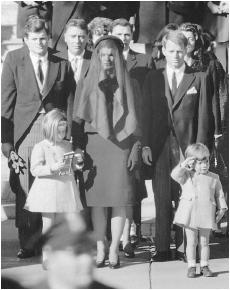
The first image I chose for this assignment is of The Kennedy family at the funeral of John F. Kennedy, with John Jr. giving a salute. To me, this picture creates unity and strength among Americans. The assassination of President John F. Kennedy shook our nation. It was a major tragedy that, in the end, brought us closer together. For days straight, every television was on, and everyone was glued to footage of the incident. It was as if the rest of the world had just stopped. America became more connected, and came together as a nation in order to get through the tragedy. Plato would have approved of this image, because it benefits the state. It makes the nation stronger and more empowered. To Plato, the death of JFK may be justified because it resulted in the greater good for the state.


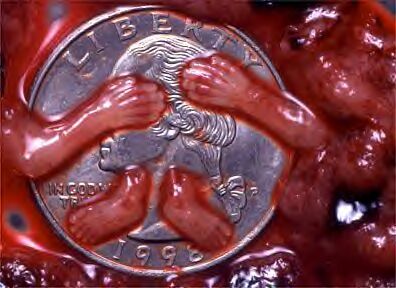
The second image I chose shows an aborted human fetus next to a U.S. quarter. It is a very graphic image and may be offensive, so I will only post the link to the image: http://www.jesus-is-savior.com/Evils%20in%20America/Abortion%20is%20Murder/slaughtered_child-abortion.jpg

. In this photo, the first object that you see is the quarter, and what draws the most attention is the word “Liberty.” However, upon closer examination, it becomes clear that the quarter is on top of the remains of an aborted fetus, and that the hands and feet are clearly definable. This image is an example of one that would lead the nation towards disharmony and conflict. The issue of abortion is heavily debated in America today. Some believe in a woman’s right to choose, while others argue that life begins at conception and that abortion is murder. This image evokes sadness and even disgust in the viewer. By showing the hands and feet of the fetus, it is humanized. It makes you think of the fetus as a person, and not just a clump of developing cells. This image is obviously used to support the view that abortion is murder. The topic of abortion has divided America, causing conflict rather than camaraderie. Plato would not approve of this image because it causes dissent among the nation. It splits the state into two opposing views, and as Abraham Lincoln once said, “A house divided cannot stand.” This image threatens the prosperity of the nation.


Christopher Post 2

Christopher McCauley

The World Metro Map, by Mark Ovenden, which hangs in the Tate Modern Museum in London, is a very different piece of art. It is a “parody,” for lack of better words on the design of the map for the London Underground System. The “map,” is made up of a crude representation of the entire globe, and the stations represent different major cities all over the world. I think this piece of art suggests to lead the nation forward because it depicts how tied together we are with the entire globe. There is not one city that can not be reached by some means except for a few in the area represented by Africa; however this area is shown as “under construction,” which means that attempts are being made at linking this part of the globe as well. Ovenden shows our nation as a part of the whole (world, that is). I think if Plato were to look at this piece of art he would be slightly confused. I am sure he would not know what Vancouver or Jakarta is, and I do believe he would not enjoy the fact that Sparta is not shown on a representation of today’s world. Context aside however, Plato would argue that this piece of art is only the “essence,” of what today’s world is. We would like to believe that we are all connected on a lovely little subway map, but the truth is we are caught up in war, and violence, and hatred, and terribly apocalyptic ideas. The idea of unification exists, but it is not a plausible, palpable thing, except perhaps, on this piece of art.

This image of a burning flag is negative for the advancement of our country because it shows the disorder and disharmony that exists within it. It shows that people are unhappy with our government or with the direction in which our country is going. Whether it is a certain man from Texas, or a certain wife of a certain man from Arkansas, or even that certain man from Arkansas himself, people are unhappy with the government. It perhaps shows that democracy is ineffective, at least, for those who venture to burn flags, and they might prefer anarchy. It does not seem to me that having no government would help move our country along. I think Plato would look at this image and say that “the maker of the image knows nothing of true existence…” (A quotation directly from Book X of The Republic). He would look at those who burn flags and say that they do not truly understand what the government is exactly because it is just a representation of truth, and that with no government at all, the essence of government also disappears and therefore, would be completely chaotic.


Joe K Post 2

Joe Kelly

"To keep a fledgling state safe, Plato reasoned, this ower of the arts should be marshaled and used for the good of the state—to empower the state and lead it on a prosperous path, toward unity and glorification rather than toward disharmony and conflict."

The above quote from the prompt is included in this post because I find it useful in highlighting a key difference between Plato's Republic and ours. As Dr. Levis mentioned in class this morning, they are two quite disparate conceptions of government, and with this in mind, I'd like to go in a different direction.

Plato outlines in The Republic a society ruled absolutely by philsopher-kings, men who possess the ideal attributes required to rule independently of the factions and mobs of democratic politics. In such a society, "disharmony and conflict" would serve only to interfere with the plans of these wise sovereigns, plans that would otherwise "lead [the state] on a prosperous path, toward unity and glorification." Thus, the value of controversial art in Plato's Republic is decidedly negative, with only the potential to stir up trouble.

However, the republic of the United States of America places a very different value on this type of art. Whereas Plato created his Republic as an alternative to democracy, ours grew to welcome democratic ideals such as the free exchange of ideas. We do not have absolute faith in our leaders as Plato did in his philosopher kings, so we place checks and balances on them, not the least of which is the capacity for political opposition. The United States, then, values art much more highly than did Plato, primarily for its role in our political discourse and cultural advancement. For instance, I'd like to share an image from Jacob Riis' How the Other Half Lives: Studies Among the Tenements of New York (no worries, Professors, I know this hasn't exactly been current for over 100 years, so I still have two images to go after this one. Just allow a history major this one indulgence.)


How the Other Half Lives was published in 1890 as an expose on the terrible living conditions of New York slums at that time. Until its release, many upper and middle class Americans were unaware of the plight of the urban poor. However, afterwards, the issue of tenant reform was given special focus in New York politics.

However, the issue clearly does nothing to promote the "glorification of the state." The title almost chastises the more affluent members of society for their obliviousness of those less fortunate. This is clearly controversial work, but we can see that it had a positive impact on society.

My point in all of this is that what serves to "empower the state and lead it on a prosperous path" in Plato's Republic is very different from what manages to do so in our modern republic. Plato pre-supposed the wisdom of his philosopher-kings, and thus believed that opposition would only confound their efficient process. The United States, however, has traditionally mistrusted central power, and thus valued controversy in politics. The prompt asked for us to "[i]dentify some current artwork that you (or others) suggest leads the state or nation forward," and I went on this tirade to point out that what I suggest (and what history suggests) moves this nation forward is very different from the "unity and glorification" that Plato valued. With such a vastly different context, Plato's feelings toward the political implications of modern art are irrelevant. Even though he might consider a piece of art to be too contentious to be valuable at all, we would value it in part because of its controversial implications.

Now I shall do what was actually asked of me.


Plato most certainly would not approve of the above image, taken by Colin Gregory Palmer. It depicts a homeless man sitting on a bench outside of what appears to be a government building, with all of his belongings in a little cart. The stars and stripes hang over his head, as if the artist is blaming the government for allowing such squalid poverty to exist among its citizens. Implicating that the government is responsible for such a blight on society would surely draw Plato's ire toward this image as it fosters dissent from the status quo, not unity. I, however, would argue that this image serves to reduce the populace's ignorance of poverty. To me, a step to reduce poverty would be a prime example of taking a "prosperous path."


Yes, this is the image I claim takes America in a negative direction, or, at the very least, keeps it in a negative place. While it certainly is an attempt to unite America in the wake of a tragedy, it ignores the fact that not all Americans are trusting in the Christian god, or even any god at all. While it is true that this image certainly unites all Christian Americans, it ignores the fact that Americans of other persuasions experienced the same tragedy and were affected in the same manner. As for Plato's opinion, I can't say for sure what he would say; it's possible that he would consider this art valuable because of the unity it implies. It's also possible that he would see that it does in fact possess divisive properties, though I'm not sure how sympathetic Plato would be to minority faiths.

theresa post 2

Theresa Chu

Image 1

The cover of TIME magazine’s annual Person of the Year issue is a work of art that Plato would have deemed acceptable, for it serves to “empower” the state. In 2003, American troops had been deployed to Iraq, and the United States was beginning to experience a severe division in views regarding the Iraq War; however, this magazine cover depicting three American soldiers served to bring many Americans together in support of the troops.
As Plato states in Book X, art has the ability to bring out emotions in the people experiencing the art. In this way, this magazine cover allows readers to feel pride in their country and troops as well as a sense of freedom and security. Because of this, the country is able to progress and to become more unified.
Image 2
This work of art (Picnic) by an Iraqi surrealist painter named Muayad Muhsin depicts an arrogant Donald Rumsfeld with his army boot-clad feet propped up on a destroyed artifact of Iraq’s past. In the background stands a giant statue of a lion with his head smashed open; furthermore, white papers are flying into the air symbolizing the loss of libraries and museums due to the bombing of Iraq by the United States. Plato would have disapproved of this painting not only because it is art, but also because it has the potential to divide a country and provoke conflict; moreover, this painting evokes emotions of hatred and sadness that Plato believed to be the weaknesses in humans.

Jenn Post 2

Jenn Shea

Image 1

In this post- September 11 poster, the New York City World Trade Center buildings are represented and shown billowing with smoke prior to collapsing. In the background is the American flag waving and the phrases “Never Forget” and “United We Stand” are a very bold aspect of this poster. This image, although it portrays a very disturbing and upsetting image, is seen by many to promote unity and forward movement in the United States. It calls for a more unified nation in the war against terror. In this sense, this poster could also be seen as propaganda in support of the war the United States is currently fighting. Nonetheless, whether one supports Bush’s war policies and actions after September 11, it is clear that this image strives to bring the country together in an era of mayhem, uncertainty, and threat. According to Plato, even though this is imitation and clearly not the actual World Trade Center, this image would be acceptable in the advancement of the state because it is trying to move America toward order after the tragedy of September 11, 2001. This can be seen in Book X of The Republic when Plato writes, “…let us assure our sweet friend and the sister arts of imitation that if she will only prove her title to exist in a well-ordered State we shall be delighted to receive her—we are very conscious of her charms; but we may not on that account betray the truth.”

http://www.ybf.org.uk/neverforget1024x768.jpg


Image 2

In this apparent anti-Bush piece of art, George Bush is shown on a U.S. stamp with “Patriot Act” written under him and a gun pointed at his head. Personally, I am not a huge fan of many of Bush’s policies, but I still find this to be backwards progress in the Unite

d States, as apparently many others also would because this image was banned in Wisconsin. This image shows animosity toward the president in reaction to the USA Patriot Act, but takes disagreement to a new level by displaying the gun pointed at President Bush’s head. Not only would Plato see this as a false representation of a stamp, he would also comment on the manipulation of the photo, as he comments in Book X of The Republic that, “Thus every sort of confusion is revealed within us; and this is that weakness of the human mind on which the art of conjuring and of deceiving by light and shadow and other ingenious devices imposes, having an effect upon us like magic.” Another idea that Plato touches upon is the ignorance of an artist in regards to reaching the truth of something when he says, “The poet is like a painter who, as we have already observed, will make a likeness of a cobbler though he understands nothing of cobbling; and his picture is good enough for those who know no more than he does, and judge only by colours and figures.” This piece of artwork then, according to Plato, would only be worthwhile to those who agree with the creator of this art and who do not fully understand the intentions of the Bush administration. To Plato, this would create disorder within the state in the obvious sense that it furthers the political divide in the United States and in a deeper

sense because it furthers the ignorance of the American people as they only look for what displeases them about Bush.

http://www.bigredandshiny.com/issues/issue28/pix/news/ANTI-BUSH_ART_CENSORED_24191115_thumb.jpg


Ruth Post 2

Ruth Ellen Day

This first image I chose is an ink drawing by Mary Hilger. It is a depiction of Mother Theresa in many of her works of love. This image would lead a nation forward because it is an example of how all humans should act toward others. People should act with compassion, not hatred, and should strive to make the lives of all people comfortable and livable. Viewing this artwork would call to mind all of the acts of love and charity that Mother Theresa performed. It would inspire citizens of a nation and of the world to live their lives as close to this example as possible. I believe that Plato and I would have been in agreement on this particular piece. In the Republic, Plato implies that art is useful only as examples of ideal beauty. This image may not display beauty in the physical sense but it does display beauty of the spiritual sense and Plato was a strong believer in the immortality of the soul, “… considering that the soul is immortal and able to endure every sort of good and every sort of evil.” (Book X). Also, though this image does not depict literal truth, it does represent the true nature of Mother Theresa’s life and the acts of love that she performed. This would not cause the viewer to “neglect justice and virtue” but to embrace them.

The artwork I chose that I believe does the opposite of my first image is called “Bearded Orientals: Making the Empire Cross” by Priscilla Bracks. This image, which was showcased in a prestigious religious art completion in Australia, depicts Osama Bin Laden in a Christ-like pose. I believe that this glorifies a mass murderer and promotes violence. Christians and most Americans should be offended by such artwork because it degrades Jesus Christ and glorifies a man who was responsible for an unforgettable tragedy in the United States. It is impossible for anyone who dislikes violence to see this image as beneficial. Jesus Christ is a symbol of love and peace while Osama Bin Laden is a symbol of hatred and violence. Depicting the two as one entity not only makes a mockery of Jesus but also of the virtues that he represents. This image, does not in anyway promote truth, so I am convinced that Plato would agree that this image would prove detrimental to any society. What Plato desired for his Republic was war from without and peace and cooperation within. Such an image would only cause misunderstanding and controversy within a state or nation. Its only purpose is to spread lies.

Ted Henderson post 2 second half

There is in fact a style of artwork that, for the most part, I find unhelpful in promoting the general good of the public. This is not to say that every piece of art created in this style is destructive and unworthy of being deemed expressive and useful, but in general, I believe that graffiti, most notably that seen spray-painted on countless concrete surfaces in urban areas, does not promote any general state of being for us as a nation. Graffiti, as much as many people believe it to be a substantial form of artistic expression, is without a doubt a common form of vandalism, and is a direct violation of not only United States law, but blatantly goes against the moral code upheld in the minds of many citizens of any country that it is wrong to deface or misuse property that is not one's own. A fact that causes me to be even less sympathetic with those who take part in graffiti is that, in most cases, graffiti in no way glorifies or makes note of any sort of worthwhile moral thought, or deep thought of any kind for that matter. Certainly those who practice graffiti as an art would have a bit more of a defense against the argument that the spray-painting they involve themselves in is not morally worthwhile to a nation if it weren't for the fact that nearly all of these building-side paintings of theirs are simplifying a fancy looking version of the self-given nickname of the artist. If one is going to take part in defacing property not belonging to them self and deem it art, I at least ask that this art display something slightly more meaningful than their own name, be it fancy looking as it may.
I believe it to be quite clear from his writings in The Republic that Plato would in no way find graffiti to be a morally substantial art form. Plato made the point in these writings that art was not fit for a "well-ordered State" (The Republic, Book X) unless it was created with the purpose of either honoring a famous and noble man for his deeds in life, or glorifying the creator of humanity and the ideal realm which he, along with other philosophers of his time, believed all people should continually strive for in the lives they lead. Obviously, graffiti seldom servers either of these purposes, and in the only instance in which it seems to be utilized in some sort of a moral sense are those few instances in which it is used by a mistreated people as political protest. It is because of the fact that graffiti does not fulfill these ideals that Plato believed all art must consist of that I find it safe to assume he would have blatantly scoffed at those who believed the spray-painting of buildings, sidewalks, and monuments to be an art form which was worthy of existing in a "well-ordered State".