Showing posts with label post 4. Show all posts

Thursday, September 20, 2007

laura post 4

1) Individuality of thought is far more capable than any nuclear warhead or biological weapon can ever be of enacting change or resolutions within a society. The National Socialists Party saw the threatening nature of such difference in mind and realized the only means for Germany being a world power would be to extinguish any existing flames of intellect. All forms of art are sound examples of how all brands of people construct their personalized ideas and sentiments into the tangible. Thus, the German autocracy utilized their power by ridding their society of any art that provoked thought or sensuality. In regards to the artistic movement of Expressionism in the early German 20th century, Goebbels, in probable agreement with all other National Socialist elites, saw the “spirit and chaos” of this particular movement “as analogous to the spirit of Nazi youth.” (Barron, 12) The art considered to be avant-garde work was not pure German and therefore should cease to exist in the eyes of those who adhered strictly to Nazism ideals. For any art associated with intellect, individuality, or sexual appeal was far too detrimental to any cultural “advancement” sought by the National Socialists. What was rather desired in this state was art “that could easily be understood and whose depictions of men and women exemplified the Germanic race”, which included the Neoromantic and Neoclassical art. (Mosse, 25) Thus, art that excited was eradicated, leaving repeated styles of art that did nothing but prohibit the advancement Hitler said he desired for Germany.
2) Lyonel Feininger was an American Expressionist and Cubist painter who taught at the Bauhaus during the reign of Hitler in Germany. His early works included comic strips that appeared in early German newspapers and Expressionist style art, but his later works involved the analytical forms of Cubism. “Lady in Mauve” depicts a woman, obviously in mauve, parading the streets of what can be interpreted as a city. She is painted with very few curves and rather contains long sharp lines and angles. This allows the object of criticism to possess an heir about her that signifies her own personal empowerment. “I am woman hear me roar” comes to mind while engaged in her cubic beauty. I imagine her strutting down the now darkening city sidewalks displaying her lack of a man’s shoulder to rest upon proudly. Her beauty can be found in her individuality. The Lady in Mauve is not like the rest of the European women of her day. Deviation from reality is most readily in place as her squared chest and blocked hands do nothing to depict what an actual woman may look like. Yet, I admire her tall and broad physique and her ability to stand as tall as the buildings that she rather surrounds.
“Uprising” displays a group of citizens in a town racing down the streets in various colors and figure forms. Feininger attempts to create a different bodily shape for almost every character in this painting. There is obviously an uprising in amidst, yet we cannot be certain as to its origins. The most prominent figure in the painting stands boldly in red and yellow coloring, marching with what can be interpreted as a pitchfork that has a red cloth clinging to its sharp ends. This particular figure’s face appears to have more monster or skeleton like qualities than an actual human. His flesh appears to be white with dark circles and lines for his mouth and eyes. Many of the other characters in the painting have very undistinguishable facial features, but all appear to be in a state of chaos and haste.
a) “And what do you create?” Hitler questions, “Misshapen cripples and cretins, women who can arouse only revulsion…as the expression of all that molds and sets its stamp on the present age.” (Mosse, 25) Degeneracy was all that involved the “immoral” behavior and “abnormal” sexuality and thus, those “who refused to conform to the moral dictates of society were labeled degenerate.” (Mosse, 25) The views that were uncomfortable to society were most likely those under this particular label. We can conclude that the universal questioning of “Is this really art?” that applies both now and in the time of the Nazi reign, is important in regarding the actions of the Nazi party with the artwork of that day. The art that was placed in Entartete Kunst exhibit was that of the sort that caused people to tilt their heads and ponder on what was being portrayed in the canvas or various mediums. Hitler used this succecptable nature of the masses to his advantage by solidifying the silent notions of the German public of whether the modern art was actual art and positive for the state.
b) The “body politic” is transformed in both of Feininger’s artworks shown above. In the “Lady in Mauve” a woman is depicted in a very “manly” like manner, according to the early 20th century standards. She consists of radical lines, angles, and shapes that aren’t of the norm in demonstrating a woman figure. This gives way to an unwanted deeper interpretation of the painting in the eyes of Hitler and his regime. Both the man and human form in the “Lady in Mauve” is threatened. “Uprising” demonstrates just that very well as the characters in the painting act very chaotic and exhibit lunacy. These would be the very reasons Hitler would label this work degenerate. He sees it as providing ideas of rebellion through both its title and even more so in its visual nature. Also, the characters in the painting do not really resemble actual human figures, but rather monsters or disfigured beings. Hitler wanted art to show what society should desire to have and in many cases, the approved art demonstrated bodies with perfect physiques that left nothing in question. By ridding of these types of modern art, there were no “crazy” ideas for the long-standing “good” German public to refute. Yet, by not adding anything innovative to Germany’s culture, Hitler would provide regression.
c) Hitler associated the entire state of Germany as being a single body and therefore each inhabitant of Germany a contributor to the health of that body. He sought to rid of all of the “degenerates” in order to attain the utmost health. Hitler was very persuasive in using this technique, because the body is a very relatable subject in which anyone can imagine an illness of the body and its effect on the production in the “giant human” named Germany.
d) Adolf Hitler claimed, “What good fortune for those in power that the people do not think”. He indeed decided to rid Germany of all “degenerate” art, a large part including art that provoked or displayed sensuality. The absence of emotion is what Hitler longed for in his “perfect” society and he decided to eliminate the threat of this from the constituency by not allowing art that motivated feelings.
3) The modern artwork, “Art and Sex”, by Karl Zipser, exemplifies authoritarian worries to the very extreme. The man and woman are engaging in mutual masturbation, where the woman is arousing the man and his genitals. Sex is most definitely not left to question in this painting and also the emotions that ride alongside. I see that this piece of art demonstrates the evolving nature of our society, as sex is becoming less taboo, as it should. Ignorance is not present, due to the fact that you are fully aware of what is going on in the painting. “Art and Sex” is both informative and creative in the way that the sexual act is being displayed.

Wednesday, September 19, 2007

Jessica D., Post 4

1. Authoritarian regimes maintain absolute power and control by oppressing all forms of free expression. These types of governments exploit art to propagate their own ideologies and therefore are acutely aware of the unwavering power it has in influencing the public’s opinions, ideas, emotions, and perceptions. They know that if individuals are given the freedom and right to freely express their own ideas and opinions they will ultimately use this power to question and criticize their government. Authoritarian regimes do not want people to become free and independent thinkers, and therefore try to repress all forms of individualist expression. In The Republic, Plato actively voices his concerns about the threat and danger giving people freedom and power to voice their opinions has on an “ideal” state. In his opinion, the masses were not capable of making sound decisions that empowered, glorified, and ultimately united the state and therefore needed their government to “direct” the nation towards prosperity. Similarly, in his inaugurating speech for the “Great Exhibition of German Art”, Hitler talks about the importance of eradicating all art that promotes of the ideas and “false illusions” of degenerate madmen. The purpose of art was to solely glorify the German nation and people and propagate the Nazi ideology.


In his painting Guernica, Pablo Picasso depicts the bombing this Spanish town in 1939 by the Nazis. It is estimated that up to 1600 people were killed. Portrayed in black and white this very large mural is located in the Museo Nacional Centro de Arte in Madrid. Chaos, violence, and death are shown without a clear reference to what the etiology may have been. Human figures are depicted in pain, and dismembered with several of them looking upwards towards where the German bombers would have been. The work is interesting from many perspectives. Like many of Picasso’s works there are numerous hidden images and symbolism.

Particularly interesting is how he chose to depict human forms. All the individuals express their horror with open mouths and hands. Not only are the bodies distorted, most are also dismembered or incomplete. Each is clearly shown as an individual who is no longer whole because of this event. It has not only altered them psychologically, but also physically. The positioning of each body also appears to have hidden meaning. The soldier with the broken sword in a crucified position appears to have been the first to fall as all other forms are on top of his. The two grieving women moving towards the center, one with no body seem to be wailing and arriving from elsewhere.

Though none of the bodies in this work are “beautiful”, I believe this work clearly expresses the beauty of each human being. Each form, be it grotesque, missing a limb, or in a different stage in life is made very relevant and important by the uniqueness Picasso gives. No body is similar in position, shape, or situation even as they are all faced with the same horror. This is intentional. He could have placed huge numbers of bodies to depict the death of more than 1500. Physical beauty is not conveyed. The exquisiteness and uniqueness of each human is very important to the artist and a main theme. Deviation from other usual ways to convey the terrible event on a human helps make this very interesting. A conventional method of expressing this would have been showing German bombers dropping armaments on a city with large numbers of causalities. The departure from the usual portrayal of the human form helps underscore the affect on the victim.


2.

(a) The Nazis used the concept of degeneracy to describe anything or anyone that did not conform to their own “traditional” values and beliefs. Anyone who did not conform to the Nazi’s ideology was branded as being a “degenerate”. This term was applied to describe: Jews, Bolsheviks, homosexuals, and many artists; groups that all blatantly deviated from German “respectability” (Mosse 25). In his speech inaugurating the “Great Exhibition of German Art”, Hitler expresses his intolerance for artists that suffer from an “eye disease” and impose their “distorted” perceptions of reality on the German public and nation. In order to restore Germany to its full omnipotence, he believed it was crucial to “purify” the nation of the degenerates who corrupted and marred its eternal beauty and respectability.

(b) Hitler would be appalled by this particular work of art for several different reasons. Firstly, it does not represent or promote the beauty, perfection, and immortality of the Aryan race (Mosse 25). Secondly, it does not propagate Germanic moral values to its audience, but instead overtly criticizes war, promotes freedom, and does not represent reality (Mosse 26). Finally, this artwork is highly abstract and leaves room for interpretation by the individual and therefore would be considered to be a direct threat and danger to respectability and therefore German society itself.

(c) The human body is often used as a metaphor for the state, nation, or country because like any organism, it too is a living, breathing entity that can become easily “infected” and “diseased”. The Nazis used the image of the “ideal” God like body, to act as a direct representation of the “perfect” Aryan nation that yearned so badly to create. Hitler was disgusted by how the body was distorted and often grotesquely portrayed in modern art. He believed that the body was meant to be exalted and glorified, not as a sexual object, but as an immortal symbol of “Aryan beauty” (Mosse 28). The body just like the nation was to remain “pure” from any imperfection of any kind or sort. In his inaugural speech for the “Great Exhibition of German Art”, Hitler passionately asserts that he will take the “diseased body” and purify the German nation of the “putrefaction” that threatens its very health and survival.

(d) Mosse states that the concept of beauty was a direct reflection of society’s traditional morals and values, and therefore “helped to maintain control over the passions” ( 25). The act of suppressing sensuality in art is a tactic that asserts complete control over freedom of expression. Sensuality tests the boundaries of accepted “norms”, and allows individuals the opportunity to express their inner most thoughts and passions. The Nazis viewed beauty with sensuality as a danger because this was something that they could not have complete control over and therefore possessed the power to threaten the social order and very well being of the great German nation.


3.


Economic, social, religious, and political issues make war one of the most consequential events a society will encounter. Manipulation of public opinion has always been a crucial tool utilized by governments as well as those wishing to express dissent. Wars are fought on two grounds: the field of battle and that of public opinion. The utilization of visual imagery for political purposes is certainly not new. The Egyptians and Romans frequently depicted there exploits on arches and columns. Modern governments continue to use these techniques not only to communicate these ideas to their populous and military, but also their adversaries. Exaggeration, distortion, fabrication, and over simplification can all be utilized in an attempt to obtain legitimacy and support. Terms such as “weapons of mass destruction, axis of evil, and war of liberation” would be examples of contemporary verbal imagery.

This concept is considered so important that developed nations routinely have “propaganda” or “psychological operations” divisions as parts of their military. As these entities are felt to be effective, they are well funded and are integrated into the logistics of war. The imagery created can be in the form of radio broadcasts, posters, or leaflets. Examples of these would be the British dropping leaflets on German troops in 1914, Tokyo Rose’s radio show, and the famous World War II posters. The motivation of workers back home, and the military, as well as the demonization and demoralization of the opponent are the clear objectives.

A contemporary example of the use of propaganda in this manner would be the literature dropped by the US military in Iraq. However, the complexity of the situation makes it somewhat different than the examples mention previously. The target audience is not the homeland or the armed forces of a country. Language and cultural barriers combined with difficult and unsafe travel make this appealing. Hundreds of different leaflets have been utilized. These are dropped by planes, modified missiles, or handed out.

Below is an example of how this propaganda has been utilized in the conflict. It has been translated from Arabic and was produced by the US military. It depicts many of the characteristics of war propaganda. Right or wrong, Iraqis are clearly told they have two options: Ours or their’s. They can choose a sunny future where children smile in western clothes. This Iraq is depicted as one with happy workers who rebuild in the backdrop of oil facilities. On the other hand, they can choose the Iraq in flames, strife, and destruction. Here sinister individuals including Mr. Alsadir lurk in the background. No attempt is made to explain the etiology of the situation. Any viewer not agreeing with the agenda of those in the new government must then desire the later outcome! Seeing one’s country stricken with “violence and fear” is not an alternative for the viewer. The management of perception and emotion is particularly powerful. The complex situation is boiled down to what the picture depicts.


Shea post 4

“To be German is to be clear.” (Adolf Hitler) To be an authoritarian, to be a fascist, to be Hitler is to be clear. Of course it does not follow that to be clear is to be Hitler, but I digress. It is absolutely incontrovertible that Hitler and, consequently, The Third Reich, held firmly to unambiguous beliefs. You are either with us or against us; German or Jew, Aryan or degenerate, respectable or insane. Such harsh and unforgiving divisions leave no room for overlap or compromise. Rules like these make clear the obvious styles of art that must be censored, but when in proximity to such art, it may almost be said that it is the art that does the censoring and not the regime. Let me explain. “What was at issue was art as the expression of supposedly unchanging values in a society in search of those values.” (Mosse, 25) It can be said that most authoritarian states are in a condition of want at the time preceding their conversion. Entartete Kunst was a necessary step in the Nazi party’s ascension to power because it set up a series of guidelines by which not only the German public, but also the government itself, could define clean values. “Modern Art” was chaotic and confusing. With a revolution of industry and thought, came a rebellion against traditional artistic styles as radical liberties were taken with color and shape. The bourgeois and government officials alike were intimidated by the complexity of these intellectual abstractions. To have your people lost in the stationary pondering of interpretation is no good for a dictator. It leads only to the “confusion of natural concepts…destroying the general wholesome feeling.” (Adolf Hitler) So after gathering for itself all that art which inspired no such pondering, the National-Socialists presented it to a disoriented public as corruptive rubbish and reaped the benefits.

Now to generalize. Art threatens the power of regimes because it inspires individual thought. It may challenge conventional authority by suggesting an alternate source of power or by renouncing power as a worthwhile consideration. It may completely flummox the viewer by presenting something incomprehensible, thereby inspiring him/her to delve into new intellectual territory. Whether spurred to renewed action or stunned to speculative contemplation, one’s unpredictable response to unchecked art is rarely beneficial to society’s “output”. It is most important that the viewer has options, nebulous options, and so the threat escapes quantification.

Max Pechstein, a 20th century German Expressionist, creates humans as complements to their environment.

The figures in the first painting, Sommer, exist within a tumult of brushstrokes as a gathering of brushstrokes. I don’t say this absentmindedly. It is true that any painting is technically a compilation of brushstrokes, but within this painting the strokes exist both as themselves and as people, grass, sky. They are meant to be seen both apart from one another and in cooperation with one another as a statement on the connection between humans and nature. The message is this: Take some bits of life (brushstrokes) and mold them into something that lives (humans). They are shapely but without exact definition. Their facial features are not distinguishable and it is not clearly demonstrated whether or not they all have the expected body parts. They resemble each other. Shadowing on the bodies is exaggerated while light seems favored by the surrounding grass. It is pleasant to look at, I think. But the beauty lies within the concept of oneness among humans and their earth.

Circus presents humans in a different atmosphere and therefore as different types of beings. The angles are harsher and the strokes throughout are less evident. The work even seems less impressionistic because the moment being portrayed is observably fleeting, the subjects are in motion so the artist need not depict reality as deceptive. In a sense, with motion, or with change, comes truth. This truth allows for a slight increase in physical detail. The faces are nearly recognizable. Clothes separate genders and identities. The bodies are given distinct form and function. These figures are more aesthetically beautiful than those of Sommer. The crowd, stationary and therefore disconnected from truth are granted only the simplest of forms. They are almost transparent. They are deprived of the beauty bestowed upon the performers because they are not connected to the truth of life’s evanescent, motile nature.

a) Degeneracy is the uncontrollable, the ever changing. Hitler condemned Modern art as worthless because it was “isolated from its ethnic origins”. His theory was that art from a time period rather than a people was irrelevant on the grounds that it would be “un-modern tomorrow, since it will be outdated.” The importance placed on a connection to ethnicity also labels that which is universal or trans-racial as degenerate. The term is used to describe anything that differs from what is common or expected. All that is ‘abnormal’ or ‘unnatural’ is degenerate and consequently acts as a corruptive force.

b) Hitler saw degenerate qualities in the disorderly and indefinite nature of Pechstein’s work. The colors would have been too bright and not realistic enough to be considered truly German. These alternate perceptions of reality would have been thought of as lies or “misrepresentations” that served to deceive and mislead the body politic.

c) “National Socialism is the political expression of our biological knowledge.” Hitler presents Germany as an “already diseased body”. He uses this model to get the point across that even the slightest malformations or abnormalities within individual German people can cause total “inner decomposition” of their race. He seeks to “purge” Germany of “those influences that are fatal and ruinous to its existence.” This means finding those whose brains or eyes are faulty and removing them for the good of the people.

d) George Mosse exposes the effort by the Nazi party to separate the nude form from its sensual connotation as to avoid the flaring of passion among viewers. Tedious attention to detail removes an element of mystery that adds to the eroticism of nudity and replaces it with admiration or respectability. Nude men manifested the maintenance of order while women were often clothed as not to “deaden their natural shame.” It is this shame that leads to restraint, a Nazi ideal.

This painting by Jesse Riggels displays a man of abnormal and therefore degenerate physical shape. He is in a business suit and has mechanical, almost robotic features that imply a lack of original brain activity. It could be said that this is a comment on the lessening of humanity in the face of business and profit. He has become a machine to for his work. This raises questions over what ethical system ought to be followed by those seeking profit.


Ally, post 4

Ally Best post 4

1. The Merriam Webster dictionary defines the word “authoritarian” as “of, relating to, or favoring blind submission to authority.” This definition seems oddly fitting in a study of images’ power over people. One word, in particular, seems to stick out: “blind.” Art is about seeing something whereas “blind” implies an incapability of seeing. Leaders of authoritarian regimes rely on “blind” citizens that don’t know enough of the world or other ways of thinking to question the government. So, when art is introduced into an authoritarian society, the leaders are faced with a problem as people begin to “see” different viewpoints and therefore, naturally begin to question the world around them. Sometimes they develop their own ideas, while other times they are influenced, which is exactly what authoritarian leaders fear. Even back in 360 B.C., Plato wrote about “simple creatures” who were “unable to analyze the nature of knowledge and ignorance and imitation” (The Republic). This was certainly a fear of Hitler’s during the Holocaust. Hitler was able to gain a massive amount of support by providing vulnerable citizens with a scapegoat and applying his impressive oratory skills. He realized, however, that art played an important role in influencing people and that, without art on his side, he would have trouble retaining the support of his followers. So, Hitler devised a plan to discredit Jewish art and, in the process, Jewish people in general. Many of the pieces of artwork being produced were what some might call “new” or “modern.” Styles such as expressionism and cubism had begun to flourish. However, with nearly everything “new” comes resistance. Hitler feared the effect some of this new, more “free” art would have on his power. At one point he even said, “Anyone who seeks the new for its own sake strays all too easily into the realm of folly” (Beauty without Sensuality). This statement shows his hesitance to accept anything new into the culture. He disapproved of the “immorality” and freedom present in some of these newer styles and feared that these themes would leak into society, causing people to urge for less rigid rules. He admits that Jewish art has a very powerful influence on people when he dictates, “On these cultural grounds, more than on any others, Judaism has taken possession of those means and institutions of communication which form, and thus finally rule over public opinion” (Adolf Hitler Speech). In an attempt to avoid any sort of turmoil in the country, he banned the interpretation of art and compiled a large collection of this “degenerate” art in a museum, using propaganda to mold the public’s opinion of the artwork into one of loathing. He also criticized the artists, claiming that they either had eye problems or were attempting to “harass the nation with this humbug for other reasons,” which would “fall within the jurisdiction of the penal law” (Adolf Hitler Speech).

2. My pieces of artwork are different statues, each titled “The Doll,” that were created by Hans Bellmer. Although each statue varies, Bellmer’s basic technique at representing the beauty of the human body remains unchanged. He focuses primarily on the more erotic, sexual side of the female body. In fact, as he creates more and more of his “dolls,” he begins removing body parts in order to focus on the more sexual areas. First, he removes the head and chest, simply connecting two pair of hips and legs together. Then he removes even the legs, leaving only the hips and stomach. Rather than look at facial expressions or subtle delicacies, Bellmar looks at the beauty of the body from a purely sexual point of view.

(a) According to “Beauty Without Sensuality,” the term “degenerate” originated as a medical term used to describe mentally ill or otherwise abnormal people. Once people were identified as “degenerates,” they were expected to progress downhill, with their condition steadily worsening. Clearly Hitler thought that this art was continually worsening, but that definition still leaves a bit of a gap. So, I once again relied on Merriam Webster. Browsing the definitions of “degenerate,” I found one that seemed to perfectly convey the effect Hitler believed the expressionist, surrealist, and cubist work had on the art world. It defined degenerate as “having sunk to a lower and usually corrupt and vicious state.” This definition probably portrays a relatively accurate image of just how Hitler viewed these more “abstract” forms of art. Their immodesty, lack of accuracy, and, in some cases, almost “fanciful” style almost certainly repulsed and enraged him. How dare these so-called artists taint German art’s otherwise beautiful structure and modesty? In Hitler’s speech inaugurating the “Great Exhibition of German Art,” he mentions artists who “see the present population of our nation only as rotten cretins” and who “see meadows blue, skies green, clouds sulphur yellow” and claims that these “pitiful misfortunates” are trying to “foist these products of their misinterpretation upon the age we live in” (Hitler’s Speech). As this tirade implies, Hitler clearly considers some of the more abstract forms of art to be “degenerate.” However, he also finds works with “low morals” to be degenerate. While some nude paintings were acceptable, they had to appear “removed from all materialism and sensuality” (Beauty without Sensuality). It was not considered “appropriate” for artwork to display anything remotely erotic or sensual because, as Hitler argued, that artwork could lower the morals of the entire society.

(b) Hitler would have disapproved of this artwork for two reasons. First of all, and most obviously, he would have considered this piece of work very provocative, scandalous, and completely immoral. During one speech, Hitler stated his plan to “wage an unrelenting war of purification against the last elements of putrefaction in our culture” (Hitler’s speech). However, rather than remove the sensuality to focus on the beauty, as Hitler would have preferred, Bellmar seems to achieve almost the opposite effect. Some of the statues are almost grotesque, yet all are very sexual in nature. Hitler would also have found fault in the obvious distortion of the body. Humans clearly do not have two pair of legs growing out of them in opposite directions. Hitler would have found this misrepresentation to be very “degenerate” indeed. These images ruin the “body politic” by misrepresenting the woman’s body as an erotic distortion rather than an anatomically accurate piece of artwork, such as one might see in the “Great Exhibition of German Art.”

(c) Fitting neatly with the origins of the word “degenerate,” Hitler describes the country as a “thoroughly diseased body” (Hitler’s speech). Indeed, much of the degenerate art seemed focused on the human body. However, if you consider the arguments presented in “Beauty Without Sensuality,” this makes perfect sense. Hitler believed that degenerate art was art that would somehow corrupt the people of his country. What more could corrupt morals and create havoc among his followers than erotic images of nude women? The body is the main focus of degenerate art simply because it holds the greatest capacity to portray sensuality and therefore (according to Hitler) corruption.

(d) Beauty with sensuality is a threat to the social order because it is a threat to the family. Looking back through history, everything seems to run better, both socially and politically, when everyone’s “home life” is in order. Remember “the face that launched a thousand ships.” If Helen of Troy was able to start a war, imagine what an entire country of loose morals could achieve. It may seem hard to believe that a loss in chastity or a few more affairs would create too much political turmoil. However, looking on a broader scale, families equal stability, which equals calmer seas in society. It’s not difficult to imagine that viewing Bellmer’s art could lead some people to have “inappropriate” thoughts. If people began to believe that this was socially acceptable, it’s easy to see how many people could begin to relax their morals. The Dolce and Gabbana advertisement we discussed in class is another example of artwork that some might consider to go against “social and sexual norms.” It is very provocative and goes against some of the most conservative people’s beliefs about what is socially acceptable and what is not.

3. This image of the Virgin Mary covered in elephant dung created a huge scandal, to say the least, when it appeared in a Brooklyn art exhibit. Many people argued the work was incredibly disrespectful, while others pointed to the decline in art, or even society as a whole. The image created havoc even on a political level as people grew infuriated with its possible connotations about Christianity. However, the art is, in some respects, an example of an artist’s right to express him or herself. So, while it may represent corruption, it also, in a way, represents freedom from strict societal standards.

Fatema, Post 4

Fatema Kermalli

1) I think that the most threatening aspect of art to authoritarian thinkers is the possibility of multiple interpretations; the concept of individual thought. “The meanings of each image are multiple; they are created each time it is viewed” (Practices of Looking, 25). Authoritarianism allows for the complete control of the government/leader in all aspects of a person’s life. This type of power would ideally stretch into the realm of thoughts, because if a person can be stopped from having thoughts against the government, there can be no hope for his attempting to resist it at all. This is where art poses a problem; “images can produce in us a wide array of emotions and responses” (Practices of Looking, 10), and authoritarian thinkers can’t risk the people “responding” in the wrong way.

This idea was most clearly stated by Plato himself, who acknowledged the power of the image, and, as a result, spoke of the allowance only of art that would further the state.

Regarding the painter, he says in Book X of The Republic: “…we shall be right in refusing to admit him into a well-ordered State, because he awakens and nourishes and strengthens the feelings and impairs the reason.” By this point, Plato has already explained how the arts, as simple imitations, have the capability of moving us farther from the ideal. He also warns that “pleasure and pain will be the rulers in our State.”

Yet, we see that just a little bit later within the same book, Plato provides an alternative solution that would allow the arts to remain. He states: “…Let us assure our sweet friend and the sister arts of imitation that if she will only prove her title to exist in a well-ordered State we shall be delighted to receive her….” Thus, we may say that Plato is willing to keep the arts that further the state even though they may be emotionally moving… or in other words, it is not the emotional quality per se that is threatening, only the manner in which that quality sways the viewer. If the directions the art itself points towards can be controlled, the emotional aspect is no longer deemed threatening.

This idea is also clearly seen in the way the Nazis dealt with art in the Third Reich, specifically in the contrasts between the “Degenerate Art” and “Great German Art” exhibitions. The underlying principle between these two is like that which was advocated by Plato: art only for the sake of furthering the State. But the Nazis took it even one step further, and employed various means through which they could control what the people thought of the different pieces of artwork on display (in order to curb the individual interpretations which were so threatening). Two such methods were the arrangement and set-up of the images and the text surrounding all of the art in the Degenerate Art exhibition. In Barron’s piece, “Modern Art and Politics in Prewar Germany”, it states that “…temporary partitions were erected on which the object were crowded together in a chaotic arrangement… The paintings, some of which had had their frames removed, were vaguely organized… Quotations and slogans by prescribed critics and museum directors and condemnatory statements by Hitler and other party member were scrawled across the walls.”

The text itself was very clear in directing the audience to a specific way of thinking. On a subconscious level, the crowding of the images and the fact that some of them were not even in frames gives the effect that the images are not valuable or worthy in the least, especially when compared to the airy and spacious and peaceful exhibit across the street of “Great German Art”. This idea was also stated in “Practices of Looking”, where it said: “We might assume that a work of art is valuable simply because it is on display in a prestigious museum…” (32). In other words, the method of presentation affects the audience’s response to the art itself.

Also important in shaping the audience’s view towards modern art (so that they could not interpret it individually) was the comparisons that were continually drawn between such art and the work of children and insane people.

These methods were used in order to guide the audience’s interpretation of the images; it could not be left for them to view unaided, as that represented the greatest danger of art to the State. (He had to let the public view it and feel as though they were making the decision for themselves, because “if the Nazis had merely confiscated and destroyed the art, it would have been the cultural equivalent of creating a martyr” (Barron, 22). By allowing all art in, one makes way for a sense of individual understanding. This type of “freedom” is not compatible with authoritarianism, and is thus fought by it.

2) In his Cubist paintings, Pablo Picasso depicts the human body in terms of planes; the images are broken up into “pieces” and then put together again. Rather than being lifelike, the bodies themselves are removed from reality in both form and color. They appear disfigured, with colors such as one would never see on a real human being (including green, yellow, red, purple, and blue). The notion of beauty which is depicted here is not present in the actual shape of the person; there is no allusion to the things which normally define beauty in our world, such as complexion and built (these, in fact, are the aspects which are intentionally distorted). Rather, the beauty of the figure itself within the work is concentrated on the emotions it evokes… the facial expressions and body language of the subjects within the painting. This is especially easily seen in his works Weeping Woman (which suggest a sense of despair, thus giving “humanity” to the figure) and Girl before a Mirror and Dora Maar Seated, both which convey a sense of deep quiet and perhaps even “troubled peace”. In each case, there is a layer of meaning which one perceives to be there, but cannot necessarily see outright within the work itself. It is hidden… and open to interpretation: something which Hitler did not approve of or appreciate.

  1. According to Barron, the German word for “degenerate”, entartet, “is essentially a biological term, defining a plant or animal that has so changed that it no longer belongs to its species. By extension it refers to art that is unclassifiable or so far beyond the confines of what is accepted that it is in essence ‘non-art’.” The word “degenerate” itself may be defined as “having sunk to a lower and usually corrupt and vicious state” (Merriam-Webster’s Online Dictionary). The concept of degeneracy thus takes on the position that certain pieces are not worthy of even being termed as art because of their “deformities”. It claims implicitly that art is not all-encompassing; rather, it is a regulated form of expression whose lines cannot be crossed without becoming corrupt. The idea of corruption also puts the concept of degeneracy in the plane of societal harms; things cannot be degenerate without pulling others towards the same. Like a rotten apple, it must be weeded out in order to keep the rest of the group safe.

The term itself was used by the Nazis to describe certain types of artistic movements, such as Cubism, Surrealism, and Expressionism, as well as the artists who followed them. These types of art specifically were chosen due to their style, which went against Hitler’s idea of good art; art which, in essence, reflected his ideals for a German State (hence the perfect bodies, Aryan features, and “transparent” and relatively unemotional nature of the works).

  1. I think that Hitler saw degeneracy in the art because of its unnatural form and “hidden” emotion and meaning.. The images in the artwork are not comparable to anything seen in real life. This can be unsettling and confusing for the audience. Interpreting such art requires individual thought, as the answer to the work itself appears hidden and not in plain view. Besides this, there is a strong sense of emotion behind the figures. This aspect of art is not present within Hitler’s “good” exhibition, where the idea is to have “beauty without sensuality” (Mosse).

One cannot readily answer what the subjects themselves may be thinking within the painting. This is a dangerous concept in an authoritarian government which wishes to control even the minutest details of the lives of the people. The painting gives too much lee-way in interpretation and emotion for Hitler’s comfort. It poses a threat to the control of the government. Also, the unnatural form itself is unsettling simply because it is unknown. It is always easier to look at that which one already understands; the unknown is a challenge in itself, and challenges were not well-received by the Nazis.

In the words of Mosse, “National Socialism annexed neoromantic and neoclassical art, defining it as racially pure, an art that could easily be understood and whose depictions of men and women exemplified the Germanic race” (25). Picasso’s art was the exact opposite. It did not depict only Hitler’s idea of the “racially pure”, nor is it easily understood.

Links to images:

http://www.tate.org.uk/collection/T/T05/T05010_9.jpg

http://www.tate.org.uk/collection/T/T00/T00341_9.jpg

http://moma.org/collection/browse_results.php?criteria=O%3AAD%3AE%3A4609&page_number=80&template_id=1&sort_order=1

  1. It seems natural for the body to be the main site for accusations of degeneracy simply because Hitler himself was mostly concerned about the body. His idea of eugenics and the Aryan race both fall in line with the idea of perfection within the body itself. The body, the outward aspect of the person, was seen as a manifestation of what was within; the person’s real thoughts and feelings and actions came through their works. With this view, he was “justified” in separating the deformed and genetically and mentally unstable from the rest of society in order to purify it. (Hitler himself alludes to the idea of eugenics in his speech, where he says that one with eye failure as a result of inheritance “…would be the object of great interest to the Ministry of Interior of the Reich which would then have to take up the question of whether further inheritance of such gruesome malfunctioning of the eyes cannot at least be checked.”) This also explains the way in which the Nazis chose to downplay many works by comparing them to the works of the insane: “images of art by the mentally ill from the Prinzhorn Collection were placed next to photographs of works by Richard Haizmann, Eugen Hoffmann, Klee, and Kokoschka, with captions such as, ‘Which of these three drawing is the work of an inmate of a lunatic asylum?’” (Barron, 22). In short, the body was a seen as both connected to the person himself and as important for Hitler’s view of a pure society.
  1. The official art of the German State “…symbolized a certain standard of beauty that might serve to cement the unity of the nation by projecting a moral standard to which everyone should aspire”. On the contrary, “Beauty with sensuality presented a danger to society because of what it symbolized, namely, a revolt against respectability as a principle of unity and order…” (Mosse, 25). Sensuality itself seems to be too strong of a feeling for Hitler to accept in artwork. Because of this, it threatens the norms within the German society which he is trying to build up.

This idea of art explains the type of paintings which could be seen in Hitler’s “good” exhibition. Though there were a lot of nude figures within the artwork themselves, the figures were never really sexual in nature; they did not evoke much feeling. The reasoning for their lack of clothing was in face of an entirely different nature- in order to show the athletic qualities and strength of the German population. “…Public representations of men and women… transcended sensuality” (28). By taking something which generally does awaken feelings within a person, and turning it into an “emotion-less” piece, the Nazis are once again ensuring their power of the entire population through the arts. The difference here is that in this case, it is done under the guise of respectability; nudes are shown… but instead of the subjects themselves being the subject of moral scrutiny, the argument is focused on the “sensuality” within the image. By doing this, they are able to accomplish two goals: the ridding of emotion and the raising of the German ideal.

The type of art here reminds me of the work Riefenstahl did with the Nuba. They, just as the subjects in the artwork of the Third Reich, were shown without much clothing… but with an emphasis on the athletic nature of their bodies-their strength and bodily perfection. The “flare-up” in this case was due to this very connection between the types of artwork. The pictures, because of their emphasis on such aspects, was said by Sontag to reflect Nazi ideals.

3) EDITORIAL; Ms. Bolden's Black Mark

http://www.nytimes.com/2007/06/28/opinion/28thu4.html?_r=1&adxnnl=1&oref=slogin&adxnnlx=1190259073-vrLe8UC+IXRI9izamSVV0w

This article talks about a case in which the superintendent of Newark’s schools “ordered one high school to blot out a yearbook picture of a gay student and his boyfriend kissing” while “photos of heterosexual couples kissing were left untouched.” She has apologized, and the books are being reprinted.

This case is an example of authoritarian worries about art as the image in question depicted homosexuality, regarded by Hitler “as a sickness that poisoned both body and mind” (Mosse 30). Like the types of art which were regarded as degenerate, this was seen as being unnatural, and even somewhat unknown. The same is true in some ways today among the more conservative circles, both among the people and politically. It goes against the original state ideology which, though separated from religion, was at the same time based upon the teachings of the Bible.

The image itself would convey the values of freedom; limited government control of people (since the topic is itself of importance politically, among presidential candidates) and the social freedom to choose one’s way of living. It also highlights the freedom of expression which is due to all peoples. All of these values are present in the image of a homosexual couple kissing because the topic is itself controversial. Freedoms cannot be evaluated based on things that are generally acceptable; they must be tested against the limits of the society. On the flip side, the initial response to the image (blotting it out of the yearbook), conveys the political/religious/ethical value of marriage between man and woman (heterosexual couples)… hence the culture “war”.

Ashley G., Post 4


“Even today, art is condemned if it transgresses the normative morality in too shocking a fashion.”

-George L. Mosse

Roy Azdak once said, “Good art is not what it looks like, but what it does.” Art is largely important to us because of the emotions it evokes within us. Whether it be fear, joy, sadness, anger, indifference, or confusion, art always makes us feel something. It communicates with our emotional being rather than our rational being, which I believe is why authoritarian thinkers take such a concern with it. The appeal to the emotional is most certainly Plato’s greatest quarry with art. In Book X of the Republic, Plato even states that the “imitation [art] really consorts with an element in us far from wisdom, and that nothing healthy or true can come from their friendship or relationship.” (Republic 603.e) To the authoritarian thinker, if art can appeal to emotion, or force thought over the ideology of the authoritarian thinker, then it can threaten the power of the thinker. To say that authoritarian thinkers are completely threatened by art, however, is too hasty a generalization to make. Because art evokes such powerful emotions within the viewer it can be used as a great tool to manipulate people into a particular ideology. This is the essential function of propaganda and is why art is used as a tool of propaganda more so than written text.


When considering the artistic movement of Expressionism, it is important to understand and appreciate other movements that it has its roots in. Many would say that the Fauvist art movement was the forerunner of Expressionism. According to Artcyclopedia.com, “Fauvism grew out of Pointillism and Post-Impressionism, but is characterized by a more primitive and less naturalistic form of expression.” Because of its like of a concise theory or form, it is not commonly considered an actual school of art, but is often given credit for its contributions to both the Modern Art movement as a whole, and the school of Expressionism. Likely the most noted artist within Fauvism is Henri Matisse. Matisse was revered as a master of the use of color and was known for works that interpreted the human form in a more primitive and imaginative form. Matisse often draws the body in almost a fluid manner, not focusing particularly on the perfection of each area, but instead on showing the vibrancy of the being as a whole. The use of color evokes a very distinct emotion within the viewer. While viewing the Joy of Life, the bright vibrant colors evoked a distinct joyous feeling within me, and also gave me the illusion of actual movement of the figures within the painting. Another of Matisse’s paintings that really struck me was the Blue Nude. The body is drawn yet again with very fluid strokes so each part seems to just meld into one another. I believe it is clear that the painting is not meant to be a literal representation of the human form, but rather an expression of one’s interpretation of the fluidity of human form.

According to George L. Mosse, “Degeneration was, in a modern sense, a medical term used during the second half of the nineteenth century to identify the condition of those who departed from the “normal” because of shattered nerves, inherited abnormalities, or behavioral or sexual excess… Such conditions signaled the start of a process that would inevitably lead to destruction.” (Mosse 25) In terms of Hitler, degeneration took on an added societal function, rather just a medical function. It was commonly viewed as any deviance for a societal norm that conflicted with the bourgeois morality. According to the film clip on Degenerate Art, degeneracy was commonly linked to being insane, Jewish, or Bolshevik, and if you were considered one of them you were considered them all. George L. Mosse’s essay on degenerate art during the Nazi era also focuses on the view on sexuality and the human body by “degenerates,” and often times if you were labeled a degenerate, you were labeled a “sexual deviant”. Issues of homosexuality largely become the target of bourgeois in twentieth and twenty-first centuries. As far as art is concerned, sexual deviance is almost a bigger poster child for degeneracy in the Nazi regime then being Jewish or Bolshevist.

Many of Matisse’s paintings used abstract interpretations of the human form, which was likely what upset Hitler about the work. Though none of Matisse’s paintings use the nude human form in an explicit or exploitive manner, Hitler did not view the forms as “true to life” and therefore they were deemed degenerate. As far as “body politics” are concerned, Matisse’s work often promoted a freedom and liberation among the human form. Hitler, however, believed if the paintings did not portray a ‘true’, perfect Aryan form, it was deviant and degenerate.


Hitler’s views on degenerate art I feel are best summarized by a quote from Hitler himself in Mosse’s reading. Hitler asked the question of what degenerate artist create and then responded by stating, “Mihappen cripples and cretins, women who can only arouse revulsion… as the expression of all the that molds and sets its stamp on the present age.” To Hitler, modern art, and especially its focus on the human form, took away from the ideal Aryan form of the human body. Expressionist views of the body were more focused on emotion than trying to create an image of the actual. The body reflected more of the inward than the literal outward, and Hitler found this threatening. One of the historians in the film we viewed in class even stated that under Hitler’s regime, that which is inward was outlawed. I believe Hitler took such a focus on the human form in art for two reasons. I think that Hitler’s inability as an artist to actually recreate the human form was upsetting to him and anyone who had the talent to recreate an ideal form was worthy of praise to him. I also think that Hitler took such a focus on the human form in degenerate art because he so valued the human body. Often in Western civilization, we worship our own bodies more than anything else. Women place things like make-up, lotions, and other various things to achieve an idea of perfection. Men exercise and play sports to test and perfect the limits of their bodies. The idea of perfection in concern to the body was challenged in many ways by Modern artists. They did not promote what he saw as the ideal so he labeled it degenerate.

What has truly always puzzled me is how Hitler could influence an entire people’s belief on art. I believe it was Dr. Musgrave who made a comment in class about the types of people who consumed various Modern Art. It was pointed out that it was generally a group of elite art critics and high society sorts viewing the art, rather than the mainstream European people. I think Hitler was so successful in censoring and manipulating the public’s views of art because he touched on a real fear in people. Many times people fear the unknown and what they can not understand. The Modern art movement displayed many images that were largely interpretive and the public, especially the German public, did not know what to make of them. It is very easy then to buy into the idea that the art is worthless or “degenerate” if you can not understand it and are too afraid to try.

The art piece above exemplifies the worries of authoritarian thinkers on the power of art. The work evokes an emotional response, particularly one of confusion. The viewer’s confusion over what is happening in the work then forces the viewer to ask certain questions- what is happening in this work, why are the subjects angry, and should I be angry for the same reason? The ability to evoke both an emotional response and then a questionative nature from the viewer is negative for an authoritarian thinker who wants to force belief on a people rather than let them decide for themselves. The particular photo above is of an anti-war protest. The ideology promoted is supposed to be that of peace and pacifism, though the looks of anger and almost violent unrest juxtapose that ideology slightly. Because the photo only shows you the ‘angry mob’ it leaves several questions as to what could be going on outside of what you see in the photo. It is the questioning of the viewer that is the most threatening to an authoritarian thinker. Once questioning begins, reflection on whether or not the people approve of a particular political and social situation often follows, which can lead to the downfall of the authoritarian thinker.

Additional Resources:

http://www.mapplethorpe.org/selectedworks.html

http://www.artcyclopedia.com/artists/matisse_henri.html

http://witcombe.sbc.edu/ARTHLinks.html

http://www.flickr.com/photos/digitalgrace/430013789/

http://en.easyart.com/art-prints/prints/-50132.html


post 4

Justin Wright
post 4

1. Art can express more than words. Art has the power to mirror, transcend, or manipulate reality, according to the artist’s wishes. This is one reason art is threatening to authoritarian regimes – the government wants to have total control over the realities of its citizens, but the artist’s creations are a triumph of individuality.

Plato’s theory of censorship expressed in The Republic (Book X) uses authoritarian logic. Plato believed that art that was unwholesome or rebellious was undesirable because it made the citizens of a state believe that injustice exists there. This would make people lose their faith in the ruling government because they would perceive it as ineffective at stopping social problems. Plato also feared that cowardice or immorality in art would taint the minds of the populace, and make them begin to do these things once they know of their existence, because they seemed more common once there were examples in poetry or theater. Ultimately such unwholesome art would cause discord and strife among the citizens, and the state would decline as a result. Thus censorship can control these problems by keeping the minds of the people clean, and only letting them see examples of justice, valor, and beauty.

Susan Sontag proposes the existence of a “fascist aesthetic.” (“Fascinating Fascism,” p. 7) Fascist art depicts reality exactly how Plato wanted it to be – only perfection was allowed. Nazi art only included people who were physically perfect. Films such as Triumph of the Will showed people in masses, obedient to their leader. Fascist art is an example to the people of how they are expected to be, and what the state stands for.

What runs contrary to the fascist aesthetic is the individuality of artists. Artists have a power to replicate reality, or distort it. Authoritarians like the power of art as propaganda, since the representation of fascist art is pro-state. This type of art is always very close to reality – good mimesis, but misleading because it is too perfect. It is just close enough to reality to seem real, and this is why authoritarians like it. Art that is realistic enough to be used for the fascist aesthetic is all that is acceptable. Anything that challenges how reality is depicted in art is a threat, because all of the fascist art and propaganda the authoritarians have used to gain support has lost its effectiveness.

Artists express different opinions. Fascist art is interchangeable. There is only one way to make fascist art, so there is no individuality and works by different artists have the same style. But works by Picasso and Monet are easily differentiated by even those who are clueless about art, because these artists have unique styles. Obvious differences can be seen even among artists of the same style. Of course, authoritarians believe these different styles to cause discord. Even more threatening is when a work’s representation is something contrary to what the state stands for. In the case of Nazi Germany, Expressionists were always pacifists, and depicted war as cruel and barbaric. The Nazis thought war was the highest achievement of man. Therefore Expressionism was banned because it made the “good” to the Nazis look evil.

When art makes a point, or the avant-garde changes what can even be considered art, people will think about it, causing inconsistencies in opinion. Only art that is “eternal” as Hitler put it in his speech opening the ‘Great Exhibition of German Art,’ is acceptable in authoritarian government – art that lasts forever because it is only grandiose mimesis and has no meaning beyond reality.

2a. Degeneracy was defined in the late 19th and early 20th centuries as a deviation from normality due to physical ailments that destroyed perception as well as the body. Degeneracy caused the state of decline in the quality of art, as perceived by the Nazis. The term is used to describe art that does not depict its subject in a realistic manner, or to artists that have done this in their work. Such artists were considered to actually perceive the world to look like their art due to medical degeneration, as Hitler said himself in his speech inaugurating the Great German Art Exhibition. Movements that were considered degenerate, such as Surrealism and Expressionism, were forbidden, regardless of their meaning or the artists themselves. Even Nazis who painted “degenerately” had their works put up for ridicule in Entartete Kunst.

2b. In the Surrealist art of Marc Chagall, there are dreamlike scenes where people do things impossible in reality. Chagall often depicted people floating, and his paintings are obviously reminiscent of dreams. There is enough realism to easily see what the subjects of his paintings are, in most of his works. The human form is rarely distorted much, but it is not painted with extreme emphasis on mimesis. There is blurriness in some paintings, but clarity in others. Chagall always uses shading that is stylistic, rather than realistic.

What would have offended Hitler about Chagall’s art is the unrealistic aspects, and the origins of Surrealism itself. A head with two faces, an animal with a yellow body and white head, a monster in the skyline of Paris, people floating, and a small girl clinging to the hair of a seemingly normally sized girl – all of these impossible, and degenerate to Hitler. The threats in these images, and the Surrealist movement in general, lie in its beginnings in psychology. Freud’s theories of the subconscious were gaining popularity at the time, and Surrealists explored the subconscious by trying free association in their art, or finding other ways to make their art more dreamlike and spontaneous, in order to portray they art of the inner mind. Freud was Jewish, and Hitler suppressed his ideas for that reason. Therefore Surrealism was threatening because it had ties to Freudian psychology, as well as degenerate forms of expression that Hitler thought were taking over the field of art and destroying the “good” forms, and tainting the public’s taste. Even the state itself was threatened by this art, because taxpayer money was spent on purchasing “degenerate” art for German museums. Hitler made it a point to show the acquisition price for the works in Entartete Kunst to show how the degenerates had scammed the nation of the taxpayer’s money.

2c. The human body is glorified in fascist aesthetics, which are really just borrowed Greco-Roman forms. The body was what was sacred to Nazis, rather than the mind, because the mind and intellectualism were considered Jewish and Bolshevist. So any art that distorted the body, or required the interpretation of the viewer, was considered degenerate. Only art that was plain and simple, and could be appreciated for its beauty alone without meaning, was good. Hitler thought that the criticism and interpretation of art was a Jewish scam, and that this intellectualism was only an excuse for poor works. Hitler even related the body to why degenerate art was created – he theorized that it was due to altered perceptions in the form of insanity, or a deformation of the eyes that caused people to see the world the same way as they painted or sculpted. A disease of the body was thought responsible for not exalting the body above the mind in art; a physical disease considered stronger and more probable than a conscious mental choice to create works this way.

2d. Beauty with sensuality presents a subject that can be shocking, offensive, or controversial. Art that goes against public morality in this way is often considered pornographic by the public. The reason that sensuality in art is a threat is that it goes against respectability, which is an integral part of the tradition of morality far back into history. Respectability downplays the sexual in an exchange for stability, in the form of family life and the persistence of tradition. The Nazis took anything sexual as a serious threat to their imposed morality. They tried to desexualize the nude body in art in order to display neoclassical “good German” art that put perfect bodies on display.

In a more general sense, challenging social norms is a threat to the social order, because the transition from one morality to another always involves chaos. Thus the constant flow of new styles of art, regarded as mere fads by Hitler, were causing chaos from changing what was acceptable. The realm of the subconscious mind had been untapped until the early 20th century, and now Surrealism was beginning to make dreams and random, free creativity be acceptable as art, causing discord in the process. Criticism was flying, and public perceptions changed as the avant-garde pushed further and further beyond the traditional. Hitler solved this problem by making art eternal, by ending the cycle of chaos caused by transition and allowing only one art – German art.

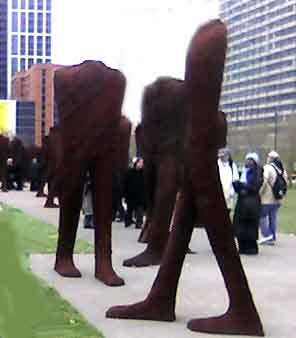
3b. http://www.bigcitylit.com/spring07/images/articles/agora.jpg

“Agora” is an assembly of 106 iron sculptures in downtown Chicago. Each sculpture is a nine foot tall headless body. These sculptures would obviously be considered degenerate because they lack the details that define realistic sculpture – muscles, proportion, and most noticeably heads. The sculptures are made from an “industrial” material rather than traditional marble or bronze. “Agora” downplays the most beautiful parts of the human body by omission. The lack of heads removes personality from the sculptures, and turns it into an almost shapeless and anonymous mob.

Politically, “Agora” is "the most controversial art installation in Chicago in a long time," according to Grant Park Advisory President Bob O’Neil. Chicago residents both praise the work, and complain of its lack of beauty in such a public and visible place. Even more inflammatory is that there is quite a bit of other “degenerate” art in downtown Chicago. Traditionalists bemoan the use of taxpayer money to purchase art like “Agora” and force it into public view. “Agora” was actually donated by the artist.

Sources: http://www.bigcitylit.com/bigcitylit.php?inc=spring07/articles Accessed 9/19/2007

Theresa C., Post 4

Theresa Chu

  1. Art represents a freedom of expression by an individual. Through various colors and techniques, an artist can depict any emotion he/she is feeling; moreover, art can also convey rebellion and protest against a commanding institution whether it is a school or a government. It is this overwhelming freedom that causes authoritarian thinkers or regimes to feel threatened, for any work of art can provoke mass numbers of people to feel a certain way towards government policies, for example. In chapter five of the article “Practices of Looking,” the author emphasizes the significant effect mass media has whether it is through television, newspaper, or magazines. Artists and their art as well as their dissonant views concerning the government can be easily accessible to the public who may begin to harbor the same ideas as the artists themselves. This, then, may cause authoritative figures to fear revolt.

    This may also be the reason why Plato stated his disapproval so adamantly against all works of art except for art that furthers the republic or state. Recalling Plato’s Republic, he clearly states the inferiority of artists and the deceitful nature of the goods they produce; however, the only way art is justified, claims Plato, is if it progresses the state as well as the state’s agenda.

  2. Surrealism began in 1917 and centered in Paris. According to Oxford University Press’ Grove Art Online, this art movement was inspired by Freudian discoveries as well as Marxist ideas. Surrealists, the most famous being Salvador Dali, sought to create art that could not be easily or logically understood.

"My painting is visible images which conceal nothing; they evoke mystery and, indeed, when one sees one of my pictures, one asks oneself this simple question 'What does that mean'? It does not mean anything, because mystery means nothing either, it is unknowable."
-- Rene Magritte

Rene Magritte, the Belgium painter of the infamous The Treachery of Images, dedicated himself entirely to painting in 1926 at the age of twenty-eight (Grove Art Online). He led the Surrealist movement in Belgium and later moved to France in 1940. Magritte’s art depicts simple objects such as trees, chairs, windows, and doors; however, he places them in bizarre positions and “gives new meaning” to each object (CGFA).


Magritte’s paintings portray the “concept of the power of desire and eroticism and wanted to translate this idea through unconventional objects” (Surrealism.org). In the painting Attempting the Impossible, a man is shown trying to paint what he deems is the perfect woman. Because of this, one can assume that he has sexual desires and can only fulfill them through a woman he creates. Magritte also paid no heed to “aesthetic preference” (Grove Art Online). His paintings definitely deviate from “reality,” for it is impossible to paint a perfect woman. His paintings of “common” objects are really not common at all: the painting The Window shows an oversized translucent hand reaching up to catch a bird and his painting Woman Bathing shows a distorted woman with unrecognizable facial features.

a.) Degeneracy describes a flight from the norm. According to Hitler’s view, anything that was not traditional or Aryan was degenerate: Jews, Bolsheviks, mental patients, erotic art, indiscernible art, art depicting objects as they are not, dissonant music, and everything unconventional.


b.) Hitler saw degeneracy in Magritte’s art because Magritte’s paintings did not depict things as they are. The deformed woman in Woman Bathing does not look like a woman in reality. As we saw in the film clip in class, a smiling, yellow cow was labeled as degenerate because a real cow on a farm would not truly look like the one in the painting. In the same way, Magritte’s “common” objects are portrayed unrealistically.
The “body politic” is threatened by these images because the public may begin to analyze the meaning behind each of the paintings, and the meanings may not be in support of the government. They may even begin to believe that a perfect woman really can be molded.


c.) The body in art was the main site for accusations of degeneracy because the body has the ability to be sexual and diseased. A nude body in a painting may immediately register erotic thoughts in the mind of the viewer unless crafted to the extent of godliness (as in the art displayed in the House of German Art).


d.) Mosse’s argument that beauty with sensuality is a threat to the social order deals with the fact that normal everyday life cannot go on if everything beautiful has an underlying sensuality about it; moreover, a society must have respectability in order to function correctly without chaos. The issues discussed in our readings that spiked conflict generally involves sensuality and disturbs the respectability of a society.

3. The projected Freedom Tower is an image that communicates to the world that, although the US has been hit, America will still continue to live and thrive. The building will be built over the area where the Twin Towers once stood as a symbol of rebirth from death and the steadfastness of the America and her citizens. The ideologies of perseverance and strength are especially prevalent in the US; also, the building of this skyscraper is helpful in gaining support for the government and its agendas, for it provides hope for those who will look upon it.

sources:

http://cgfa.sunsite.dk

http://www.magritte.com

http://www.groveart.com

http://www.surrealism.org

Morgan, Post 4

Morgan Frost

  1. Art is so threatening to authoritarian thinkers and regimes, that even the definition of the word “authoritarian” is challenged by the ideals of art. Allowing people to express themselves is giving them individual power, a contradiction to the subjection to authority and sacrifice of personal freedom that constitutes authoritarian control. Offering this freedom through art, people can form and express their own opinions. But as authoritarian Hitler mentions in his speech, the people should all believe in one set of values that is “everlasting” and “German.” He denounces “modern art” for its ever-changing values. Here we see that it is in the authoritarian’s best interest for everyone to be of the same opinion. In this way he has control and has unified the nation. When people do not have individual power, they are suppressed from questioning authority and initiating changes in the social or political structure and therefore undermining the authoritarian method. Plato also supports a nation’s unity and progress, and recognizes that art can cause people to stray to “disharmony and conflict.” He holds the view that only the educated should be ruling, and this authoritarian thinking has no room for free-thinking artists or the free thought they might incite in their viewers.
  2. Expressionist artist Otto Mueller often depicts the human body in nudity and within a nature setting. The paintings are not realistic in the sense that one could ever mistake them for reality (due to slightly distorted shapes and blending of color), but human bodies are distinguishable. His work also portrays sensuality between women. Their bodies are depicted very smooth and flowing into one another and into the landscape, as if to say the emotions captured and the relationship between them is natural. The homosexual nature of the paintings thus comes across as beautiful, and the calm nudity beautifies the women’s bodies.
    1. Degeneracy is in layman’s terms the opposite of generating, which is creating. So the concept of degeneracy deals with the backward movement of any thing away from progress. This concept can be applied to progress of virtually anything toward its product, and specifically in this class we see the term “degenerate” used by Hitler and the Nazis. The product being referred to is a unified Germany under authoritarian rule of Hitler and his Nazi party. Hitler’s method for achieving this Germany is to eliminate that which is deemed “degenerate.” In his view, the creation to strive for is that of a nation free of “degenerate” or abnormal people (“the mentally ill, Jews, homosexuals, habitual criminals,” etc.)(Mosse). Not only was this new Germany being physically generated to Hitler’s ideals, but politically as well. Art and the media were heavily monitored to influence the people to succumb to the political views of the Nazi Party. People not on board with the Nazi ideals and supportive of war were a threat and thus considered “degenerate” to the new Germany.
    2. The first thing that I see in Mueller’s work that Hitler would have viewed as degenerate is the obvious deviation from a realistic portrayal of people. As discussed earlier, these pieces are examples of expressionism, and the paintings are not made as if a direct representation of what Mueller saw. Hitler might refer to this as a “misinterpretation” and account it to “eyesight-deformation” (Hitler). The other aspect that Hitler might see as “degenerate” is the nude sensuality of the women. Art that was accepted into the Great German Art Exhibition could be nude if it lacked sensuality (Mosse). These pieces, however, show an intimate connection between the women that suggests more than mere nudity—but a sensual connection. And though “lesbianism (was) ignored as a punishable crime” while male homosexuality was persecuted, homosexual activity was still deemed degenerate (Mosse). Heinrich Himmler, leader of the SS, even refers to “homosexuality as a sickness that poisoned both body and mind” (Mosse). And so the homosexuality portrayed in these paintings are another aspect that make them “degenerate” to German art.

i. Hitler viewed his nation as an organism, with him as the brain and center of control of the society. Therefore his opinions and political agenda was also that of the people. They should think as he does. The body is one, and there are no individuals except that work for the good of the body as a whole. With an “abnormality” such as homosexuality being beautified in Mueller’s works, they are a direct threat to the status quo that Hitler was trying to uphold for his “body politic” free from “degenerate” people and ideas. Himmler, who viewed homosexuality as an “illness,” also used the body complex to show that the riddance of an “illness” such as homosexuality is positive, just like curing an actual physical ailment (Mosse). And so extinguishing these abnormal people becomes like removing a wart from your skin, it is for the improvement of the body as a whole, and what is being removed is worthless “degenerate” material.

    1. The body in art was the main site for accusations of degeneracy because it is easy to observe degenerate traits through visual manifestation. The Germans even had nude art that was considered what a model German should look like, among these Greek art and pictures of Olympic athletes (Mosse). These are used as standards by which to compare the human shape, and provide the sample that all human art forms should strive to portray. The body, especially in nudity, is also connected to sexuality. And one of the main criteria for art to be considered “degenerate” by National Socialism is sensuality (Mosse). Many artist’s depiction of the human body involved sensuality, and this was considered a “danger to society” because it posed a “revolt against respectability” and the uniform German ideals the Nazis were pushing on the public (Mosse).

i. As discussed earlier, the body was also used as a metaphor for the structure of Hitler’s authoritarian regime. In his speech he connects the abnormalities he wants to eradicate from the German population with such things as “diseased bodies” and “deformations” (Hitler). And curing the society of these “degenerates” is the same process the body goes through: a “purge” and “purification” (Hitler). So here we see that the body in art is not important only because of its connection with sensuality and readily identifiable abnormalities or deviations from reality, but also as a representation of the political structure Hitler and the Nazis envisioned.

    1. Beauty with sensuality in art can justify what Mosse claims it causes: “a danger to society” through “a revolt against respectability.” The reason for this is that the sensuality of a piece of work can come between the viewer and the message of the art. This especially depends on the culture. For example, an American might be taken aback by a painting of naked women and the shock and embarrassment from the sensuality can cause a biased perspective on the piece as a whole. Instead of seeing value in the work, this American might only see it as inappropriate and pornographic. A tribal African, however, can look at the same painting and see past the body, without connecting it to sensuality whatsoever. Instead he or she can look at the content of the painting and find meaning without a socially caused lens changing the vantage point. So as Mosse talks about the modern German society, it is true that beauty portrayed with sensuality can threaten social order. One example that comes to mind is the Gabbana ad that Christopher McCauley used in a previous post. Mosse would see this as a rejection especially of sexual norms, with its portrayal of male homosexuality. (Though in today’s America, the purpose of this advertisement actually is to revolt against a social norm, and help evolve it to include different perspectives.)
  1. b: This image displays a “monstrous” portrayal of the possibilities in the future of stem cell harvesting. The designer Michael Burton envisions Future Farm, where people can turn their bodies into stem cell harvests. This presents an argument about the views on stem cell research. Burton ventures into this imagined realm where he can answer the questions, how far might we go with stem cells? Can we cross a line that we shouldn’t? This image helps us ponder our own values about stem cell research, and holds its own value that the human reach into the tinkering of our production can extend too far. The picture comes across as monstrous and even somewhat comical, but the underlying tone is that of a warning. Even though it seems ridiculous, and possibly because it seems ridiculous, we should question our journey further into the scientific exploration and alteration with stem cells.