Wednesday, November 14, 2007

Ruth D. Post 11

Ruth E. Day

1.

Images become “official” because they do something to further a certain cause. In the context of war imagery, official images tend to work to further the idea that the war is just and having positive affects. They tend to be patriotic and glorify the soldiers fighting on our side of the war as heroes. They also bay depict the soldiers fighting for the opposition as evil and sometimes terrorists. I have found two images that have achieved official status regarding the war on terror. The first is an image of a statue of Saddam Hussein being taken down by American soldiers in Baghdad amidst the cheers of Iraqi natives. This image has achieved official status because it furthers the idea that the war in Iraq has accomplished its goal. It has freed Iraq from the tyranny of an evil dictator and has caused much rejoicing among the Iraqi people who were subject to his rule. It leads people who see it to believe that the war has made the world a better place. The second image is a photograph of Sgt. 1st Class Paul R. Smith as he is serving in the field during the war in Iraq. Sgt. Smith was the first soldier who has served in the war to be awarded the Medal of Honor. He was given this award for his role in the Battle of Baghdad Airport. This image has received official status because it glorifies the soldiers who serve in the military during times of war as heroes. The light around him gives him a sort of halo that makes him look angelic and he is looking at the camera as if he is about to do something important. The gruesome details of his job are not touched upon. He appears very clean despite his very dirty situation.


2.

I believe that images can be harmful, beneficial, or neither depending on who is looking and them and what is in them. For example, the image of the Saddam Hussein statue being toppled can be considered as both beneficial and harmful. It can be beneficial in that it elicits pride in being American and relief over the end of a horrible Iraqi regime. However, it can also be considered harmful in giving Americans a skewed idea of the Iraqi response to American soldiers’ occupation of Iraq. This image shows Iraqis who are happy about their presence but that may not be the case for all citizens. Some may resent the United States Occupation and may have even mourned the fall of Saddam Hussein. This image is could mislead citizens of the United States into believing that all Iraqis hated Saddam Hussein and that the war being fought over there is completely just and in agreement with all other Iraqis. The image of Sgt. Smith can also be beneficial. It honors a very brave man and could help garner support for our troops. Our troops definitely need and deserve support and respect and that is what this image helps spread. This image could also be harmful however because it glorifies the lives of soldiers who are on the front lines. It shows Sgt. Smith clean and about to fight a noble battle. It shows nothing of the gruesome reality of soldiers’ lives. This could lead those thinking about enlisting to believe that all soldiers live a glorious noble lives and some die noble deaths. It could lead them to believe that they are all always honored as Sgt. Smith was and give them a false idea of what to expect when enlisting themselves. Obviously, the purpose of both of these images is to further war ideology but their function is not always harmful. In “Regarding the Torture of Others” argues that we should ignore images as ideological and harmful and focus on the events depicted by them. I agree with this stance in some situations. Such a situation would be one in which images could serve as evidence that a certain event took place. The picture of the falling statue tells us that a statue was there and that it was taken down. That is the event behind the picture. However, in situations where images are not needed solely as evidence that a certain event took place; their ideological and possibly harmful possibilities should not be ignored. Images are powerful and that power should not be taken for granted by ignoring those components.

3.

I do not believe that images should be kept from public view during wartime. Images can both garner support for a war and reveal the harsh realities of it to the public. That is what the Abu Ghraib photographs did. They showed Arab prisoners being abused and even tortured by American soldiers. They opened peoples’ eyes that it isn’t only the terrorists who are capable of evil acts. American soldiers are as well. They show war as something that is not always glorious and noble but as something where people get hurt and abused and exploited. It leads normally good people to commit evil acts. I am a strong believer that situations such as war and tragedy bring out the best in some and the worst in others. It is important to have representations of both sides. Yes, war does cause some to do many heroic things, such as in the case of Sgt. Smith. However, it can lead others to do evil and to lose their sense of morality and their sympathy for other human beings. This is what happened to the American soldiers at Abu Ghraib. War caused their view of right and wrong to be blurred and to rationalize evil acts. This is why I believe that the Abu Ghraib photographs should have been exhibited at the International Center of Photography. If such images are not made public, those of us whose sense of right and wrong have not been skewed by the experience of war can see both sides of the picture: the side that produces people who we can admire by showing the best of the themselves in times of hardship and the side that produces people who, once they have seen the atrocities that human kind is capable of turn to committing those atrocities themselves.

Image sources:

Statue: http://www.nature.com/doifinder/10.1038/446366a

Medal of Honor: http://www4.army.mil/ocpa/read.php?story_id_key=7091

Kim Post 11


Kim Hambright

1. In times of war, countless images are captured via digital cameras, camcorders, cell phones, and other sorts of electronic devices. The images are sent back to the United States and shared with friends, family members, and often times millions of strangers through their placement on the World Wide Web. The more the images circulate, the more people see them, and the greater chance they have of becoming “official” war images. “Official” images, by social definition, are images that are well known to a large audience. In this case, “official” images of the Iraq war would be easily recognizable to a majority of the American public. Without captions or explanations, the images would be understood, and given meaning. Though the particular meanings of each image will vary person to person, an undeniable understanding of the patriotism, terror, and destruction of war is undeniable in the images.

In the first “official” image, a number of American soldiers form a line in anticipation of some sort of attack. The faces of the men are clearly visible, easily recognized as someone’s son or brother. The interest and intent of this picture, whether conceived purposefully or not, is to gain support for the war. Since the figures are personal, the viewer feels connected to the soldiers, sharing their anticipation, their worries, and their pain. One feels as thought the soldiers are innocent; with their gentle faces and almost timid appearances, these men in uniform can do no wrong. Even amidst what the public knows to be a cruel and harmful place, the viewer sympathizes with the soldiers of the Iraq war, remembering their ties to fellow Americans.

The second image depicts an Iraqi child and an American soldier. Clearly an anti-war image, the photograph contrasts the stark and barren ground with the chaos of war. The soldier standing on the left with the gun is not immersed in battle, nor can the viewer detect any immediate harm in his proximity. In spite of the current lack of necessity for the soldier to don any extreme means of protection, the photographer captures this American soldier with a gun. Several feet away from the soldier stands a young Iraqi child. He appears to be both enamored and afraid of the grandiose adult standing before him. The viewer cannot help but wonder what is taking place in this image, is the soldier threatening a young and innocent child? Or is the image just a cropped version of a larger scene? Whatever the case, the image appears to capture inappropriate behavior on the part of an American soldier. Anti-war activists would look and the image and be horrified; after all, what is an armed American soldier doing anywhere near children?

2. When answering the question, “Can images be harmful?” one must take into consideration the context of the word harmful. Who or what is one worried about harming? Surely the images of the American soldiers at Abu Ghraib were harmful to the reputations of the soldiers and their families, and likewise the images of the planes hitting the twin towers on September 11 are harmful to America’s overall opinion of Middle Easterners. Who though, does one wish to protect from harm?

I agree with some of the statements made by Libby, Gogan and Sokolowski that images can be harmful. Surely images of war and violence can be demoralizing and shocking to the public viewer, though I tend to agree more with Sontag. I feel that people are often too caught up with their immediate reactions and emotions when viewing a photograph that they often forget it actually happened. Ignoring the image mutation possibilities created by programs such as Photoshop, I feel that the raw truths of images are often forgotten or misunderstood when viewers focus on their own reactions to the photos. Whether one is afraid, excited, horrified or unsure of an image is irrelevant. In my opinion, artists of war photography rarely take photographs for the sole purpose of indulging the viewer’s emotions. Instead, photographers attempt to capture real life actions, telling genuine stories of the soldiers overseas and their lives. Though the images may be “harmful” or “offensive” to the masses, I feel that it is the duty of war photographers to capture and expose war as it factually happens. Photographs are meant to bring the truth of an event, regardless of how one feels about it.

3. Looking at war images as a whole, and understanding the power they hold, I still feel that the most important thing is education. Censorship in times of war may be necessary, especially when concealing graphic images of deceased American soldiers; however, I do not feel that it should be used to an extreme. The most important aspect of war photography is informing the public. Thousands of miles away from the action, it is nearly impossible for anyone in the United States to begin to comprehend what the war is like without media venues such as photography and television. It is the responsibility of the people involved with such venues to provide accurate and unbiased information on the events taking place overseas, whether or not said information reflects positively or negatively on the United States military. In order for everyday citizens to make informed decisions and opinions about the war, especially when Presidential elections and other voting situations roll around, it is necessary for them to be accurately informed. The images depicting torturous events taking place at the Abu Ghraib prison may or may not affect the way a particular individual feels about the war; though, it is his or her right to be informed about what his or her country’s military forces are doing overseas, with or without the government’s permission.

I feel that censorship is warranted when concealing situations that would undoubtedly evoke an uprising in the public. In these cases, censorship, controlled by the government, should not only be acceptable, but encouraged. Along with the responsibility to inform the public, comes the responsibility to protect the governmental structure. It is not this way in all cases though. For example, images of destroyed cities, distraught soldiers and unfair treatment of prisoners have no reason to be censored. Granted, I do not believe that images similar to the ones from the Abu Ghraib prison should be displayed in a museum gallery, I feel that is of the utmost importance that all people of America be informed as to the way the soldiers, supposedly fighting for their country, are acting.

Fatema, Post 11. The Last One!

Fatema Kermalli

1) Images become official when they serve the national interest during a war and are thus shown over and over again in order to solidify the country’s stance and reassure the people that they are in the right. As mentioned in the PowerPoint Presentation, four messages which are perpetrated by these “official” images are:

  • War is a national endeavor
  • War is an American Tradition
  • War is manly
  • Winning is everything

They all put a positive spin on war, depicting it as a courageous and patriotic act.

One image that fits into the category of “winning” is the toppling of Saddam’s statue in Firdos Square which helped perpetrate the false idea that the war was about to end. Showing such a “victory” scene helped to downplay the fact that battles were still raging throughout Baghdad during that same week… and even that same day. A dramatic decline in war imagery and war stories followed the appearance of victory (70% on Fox News and 26% on CNN), making it seem as though the situation was actually improving within the region (Aday). This was the interest that was served: the image helped to placate the American people by making it seem as though an end were in sight.


Another example of an “official” image relating to the Iraq war is that of President Bush in gear, an image which was usually accompanied by the words “Mission Accomplished”. The picture shown here of a TIME magazine cover doesn’t support the administrations actions at all. But, it does play off of the fact that that very image had been used before much in the same way that the image of Saddam’s statue toppling was used: to prove that everything was going well in the region and that the US was going to win (or already had won) the war.

This last image of another TIME cover shows “The American Soldier” as being the person of the year. Three soldiers are seen standing together in uniform, upright, unyielding, and proud of the work they do. This particular image fits into the category terming war as being “manly”; it also, especially with the help of the wording also present, makes the soldiers who represent the war a source of national pride because of the positive way in which they are represented. Such an image that brings soldiers into the pictures really helps to further the interest of the country because the military is one aspect of war that most everybody agrees about: nobody would want to say that they don’t support the military when the people in the military are losing their lives for the protection of others.

Overall, the images work towards gaining a national unity in favor of the war that is occurring. It is also important to note, however, that these pro-state images are not the only ones that make it to the front covers, even if they are the majority and the most likely to do so. Other images, sometimes precisely for the reason that they were first censored and thus caused an uproar, also make the covers (such as the image of a detainee with his head covered by a sack, or about to be “electrocuted” and even to an extent the flag-draped coffins). These, I suppose, are never really “official”, however, as they work to the detriment of those leading the charge.

Aday, Sean, John Cluverius and Steven Livingston. “As Goes the Statue, So Goes the War: The Emergence of the Victory Frame in Television Coverage of the Iraq War.” Journal of Broadcasting & Electronic Media. 49 no. 3 (Sep 2005), 314-331.

2) I agree that images have a lot of power which, like all power, can be used for good or bad (depending on how you look at it). This notion goes all the way back to Plato’s use of images to further the state, as well as Hitler’s, and the differing ideas regarding modern art during times of fear and war.

But in the photography of real-life events – photography which was not even done with the idea of propaganda, such as was be the case with the other examples seen as either helping or harming “the state” – should we ignore the images (to an extent) and focus on the events?

First, let me quote Sontag herself and clarify her position: “So, then, is the real issue not the photographs themselves but what the photographs reveal to have happened to ‘suspects’ in American custody? No: the horror of what is shown in the photographs cannot be separated from the horror that the photographs were taken – with the perpetrators posing, gloating, over their helpless captives.” Sontag does not appear to be arguing at all that we should ignore the images at all; rather, she ties the fact that the images were taken to the actions, and then focuses on the fact that these actions occurs. And I totally agree with her.

Torture was occurring even before these pictures “came out”… and there were people who knew about it (as proven in greater detail in part 3). This maltreatment, even if it wasn’t of the same type as the posing which was done for the images that we see today, still existed and was still deplorable. The actions themselves solicit the responses of disgust. The images main role was really in making the actions available to the view of the public… without which, people would not know what was going on in the prisons.

As Sontag said, fact that these people would actually smile at the camera behind the naked detainees and regard the whole event with humor worth saving in the form of a picture is indeed quite horrific; however, the acts themselves can stand alone as being horrific occurrences whilst the pictures are as disconcerting as they are because of the fact that the things depicted therein really happened. The response against the pictures is not one calling for the stop of photography in prisons as much as it is a call for the stop of torture itself. The torture is what is inhumane, and it remains so even if no picture is taken of it occurring.

3) Images of war definitely should not be kept from public view during wartime because doing so deliberately misleads the population into believing things are much better than they really are. People have a right to know what is going on, not only because they are the ones going or being sent off to war, but also because they have the responsibility, if it is wrong, to change it.

So should the Abu Ghraib photos have been exhibited? Unequivocally, yes. These images brought to light for many people some of the atrocities that were occurring within US prisons. It forced the administration/military to own up a bit more, to do something about what was going on. As Sontag states, the pictures were “…necessary to get our leaders to acknowledge that they had a problem on their hands. After all, the conclusions of reports… about the atrocious punishments inflicted on 'detainees' and 'suspected terrorists'… have been circulating for more than a year… Up to then, there had been only words, which are easier to cover up… so much easier to forget.”

This idea that the human rights violations were simply ignored before the pictures came out is mirrored in the report by an independent panel headed by Schlesinger, “…the first to assign responsibility for the abuse of prisoners… to senior Pentagon officials including Defense Secretary Rumsfeld.” In the Abu Ghraib Timeline presented in “Inconvenient Evidence”, it says: “The report states that officials were aware of the problems at the detention facilities and failed to address them.”

The purpose of showing these images is thus to raise awareness of the occurrences and help to wake the people up to the truth of this war and its costs… not just to us, but also to the rest of the world. And it seems that the administration is aware of the power of these images to force change… which is precisely why they are afraid of them. Sontag in her article says that Rumsfeld acknowledged the existence of many more photographs and videos, and said: “If these are released to the public, obviously, it’s going to make matters worse.” Presumably, as Sontag states, it would be worse “for the administration…not for those who are the actual – and potential? – victims of torture.”

Not only can exhibiting these pictures help bring justice in the present, it can also provide the force to stop even more injustice in the future.

So while I don’t know about everyone else, I’m most assuredly willing to trade a bit of dissent for the safeguarding of justice and human rights.

Christopher Post 11

Christopher McCauley

Question 1

Most everything has an image or multiple images associated with it. War especially has images associated with it because it is such a huge thing in today’s world. The War on Terror or the War in Iraq (or whatever they are calling it these days…), has been going on for several years now. It has had a huge impact on the globe. One reason that it has had a huge impact is the fact that we have images that can show us the horrors of war, rather than just a few words to describe it.

What does it mean to be an image of war? And just because an image may be of war, does that mean that it is “official”? An official image is one that has become “standard,” or incredibly recognizable. There are certain images that people think of when they think of the War on Terror. Several of these images are of the attacks on September 11, 2001, on the World Trade Center in New York City. If these attacks had never happened, there would not be a war going on right now, in my opinion. Therefore, such images are highly relevant in the history of the War on Terror in Iraq.

Sometimes we can also see parallels between two wars, and images associated with those wars can show this. A famous photograph from World War II shows a flag being raised by soldiers amidst the clutter and rubble of battle in Iwo Jima (a small island in the Pacific). There is an image from 9-11 depicting a flag being raised amongst the rubble of the attacks as well—there is an eerie similarity between the two photographs. Each are beautiful images, which are highly recognizable as photographs of war.

During this war, the Iraqi government has been reformed into a crude democracy. Within the past few years, the first elections have occurred in Iraq in its entire history. When Iraqi citizens voted, they were required to stick their finger in purple ink, to signify that they had voted. An image of this (shown below), has become official because of its widely recognizable symbolism of increasing freedom in Iraq. This photograph depicts what little triumph US involvement has triggered in Iraq, and may also symbolize future advancements.

Question 2

“Sontag argues that we should ignore the images as such and focus on the events depicted in them.” I would absolutely agree with this argument. Yes, content in images can be dangerous; however, sometimes it is important for these images to be seen to get messages, themes, and news across. “Photographs have laid down the tracks of how important conflicts are judged and remembered.” In the modern world, photographs have become an integral part of history, and are extremely important. Take for example, the photograph of Mary Ann Vecchio kneeling over the body of a dead student at Kent State in 1970. It is a horrible image, and beautiful image, and at the time (and even still today) a necessary image. This shows what horrible things war can do. Even in peaceful protests, a “war” erupted, and killed a human life. Someone in that picture died. The look of pain, sorrow, and despair on Vecchio’s face embodies this completely and beckons to the viewer, for help, and for answers. We are in a way, included in this photograph. Sontag even said, “Photographs are us.”

Question 3

I am not a proponent of censorship of war photography; therefore I do not think it is right to hide war images during wartime. If a war is going on, people need to know about it. They best way to know about it is to see it. Photography has given our society that advantage. Whether or not such photographs are damaging does not matter. Being able to view these images, such as the photographs from Abu Ghraib, is such an asset to our society. It helps us see what war can do to our people, and to humankind. It is an atrocity, and yes these pictures paint a group of American soldiers and beastly and barbaric, but these photographs serve a purpose of anti-war. These images may prevent war from occurring again, or help resistance to war spread.

http://www.wgerlach.com/archives/disasters/index.html

http://www.britannica.com/eb/art/print?id=71966&articleTypeId=0

http://teachpol.tcnj.edu/amer_pol_hist/thumbnail399.html

http://www.fairvote.org/blog/?p=20

http://www.worldsfamousphotos.com/kent-state-1970.html

Theresa C, Post 11

Theresa Chu

Part I

War images become “official” when they serve to represent the government’s interest on the war. The “official” images convey ideologies of patriotism and honor in order to garner support for the government’s agenda; therefore, we can see that many, if not all, of the “official” war images contain subjects along the lines of proud soldiers in uniform standing with the country’s flag billowing in the wind in the background or government officials giving a sweeping look of satisfaction over organized troops.

http://www.talkingpointsmemo.com/images/2007-01-10_Mission_Accomplished.jpg

In this image, George W. Bush is seen holding a thumbs-up sign in front of a sign reading “Mission Accomplished.” A crowd including soldiers can be seen cheering for him. This image conveys how the goals of the war have been met as well as the amount of support the crowd is giving the president; furthermore, the troops are in support of a president who is sending them to war.


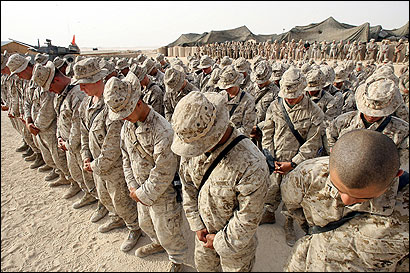
http://cache.boston.com/bonzai-fba/AFP_Photo/2006/09/28/1159438877_9412.jpg

Soldiers can be seen bowing their heads in prayer in this image; thus, furthering the message that the Iraq War is a moral war that is being fought with honor and integrity and that God is on the side of the “good” guys.


http://blogs.trb.com/news/politics/blog/Bush%20Marines%20Iraq%20%20jim%20watson%20afp%20getty%20images-thumb.jpg
George W. Bush can be seen speaking to a group of what appears to be hundreds of soldiers who appear to be listening intently and respectfully to everything the president is saying. By displaying this image, the government wants the American people to see that the troops who are giving their lives for their country support the president; therefore, those who are safe at home should also support the president. This image also shows that the commander-in-chief does care about those being sent off to war.

Part II

Images wield significant power and can thus be ideological and very harmful. Looking at the pictures in Inconvenient Evidence: Iraqi Prison Photographs from Abu Ghraib disgusted and shocked me more than reading the accompanying text. Inscribed in these images is the potential to completely ruin the efforts the government is trying to make in Iraq; furthermore, with each new “unofficial” image emerging from the war, the reputation of the United States becomes even more tainted.

Sontag argues that the viewer should be more focused on the event occurring in the photo rather than the photo itself; however, the photo IS the evidence of the event. Without the images, the viewer would not be able to associate as much with the event than if an image was available. The image also serves to bond those who view it together: “Vernacular photography also serves a bonding purpose in its ability to create a sense of community and group identity among participants in events and between the participants in events and between the participants and the viewers” (Libby 45). Knowing this, if Sontag wants the viewer to focus on the event, then it would be more efficient to have the viewer focus on an image of an event. By concentrating on the images from Abu Ghraib, for example, the viewer can then center better on the events being depicted in the images.

Part III

Although they may be graphic and disturbing, images of war should not be kept from public view during wartime. It is the right of the people to know everything that is occurring as a result of the choices made by the leaders they elect into office. Photos that portray the cruel and dishonorable side of war, such as the Abu Ghraib photos, should definitely have been exhibited. Citizens must be made aware of the events occurring outside the borders of their respective countries. Many people harbor ideas of superiority in comparing their country to others. To say the least, many Americans instill in themselves the belief that they are untouchable when it comes to morality, honor, integrity, courage, and every other good virtue; however, because of the Abu Ghraib photos, we, along with others around the world, can see that this is not the case. These photos bring the harsh realities of the brutality and heartlessness of war into view better than any form of text ever could.

Ally, Post 11

Ally Best
Post 11


1. The term “official” brings to mind boy band fan clubs and facebook groups. Why would groups want to use such a term? Most likely, they use the term “official” to add a certain validity to the group; to show that the club or group represents the best interests of the subject. Some war images are considered “official” for similar reasons. Most often images are considered official when they are somehow endorsed by the subject. In the case of the war in Iraq, the military and, ultimately, the government are being portrayed, so they are generally the ones who, through the media, determine which images are deemed “official” and ok to represent the war. Several magazine covers depict such images. One “Times” magazine shows a woman wearing a combat hat and gazing off into the distance. If this does not spark patriotic vibes in a person, I don’t know what will. This image portrays not simply an American soldier, but a woman. By picturing a female, the magazine has accomplished two goals. First of all, as the caption reads, and her gender seems to imply, she is a mother. She has a family. Her role as not simply a soldier but a family member draws attention to all of the sacrifices members of the American military have been forced to make. Viewers tend to rally behind individuals they can relate to and sympathize with. Once the public supports the soldiers, they begin to support the war itself, or at least that’s what the government hopes will happen. The government, while not directly telling the media what to produce, is able to influence them by promoting certain images and stories. Another example of an “official” image appears on yet another “Times” magazine cover. The title boldly advertises “The Sinister World of Saddam,” and, by the look of the image, “sinister” is the perfect word to describe the image. The photograph portrays a tile mural in Baghdad depicting Saddam. With his hat pulled low, dark sunglasses, thick moustache, and unsmiling face, he seems to exude a sense of evil. This representation helped viewers see Saddam exactly as the government wanted them to: a mysterious monster. By picturing Saddam, the media also succeeded in providing a face for the people’s hatred. Most people would have had trouble hating an entire country they knew very little about. However, when the media began showing pictures of Saddam, he became a symbol of terrorism and corruption. US citizens were able to unite behind their common hatred for him and give more support to the war in Iraq.

2. “Practices of Looking” discusses the effect mass media can have on public opinion. As the article argues, the results of certain images can be incredibly powerful. We see an image of five happy people sitting around a dinner table and suddenly we know what a family is “supposed” to be. We see advertisements of women dressed in tiny clothes and wearing loads of makeup being followed by attentive male stalkers and we know what a woman is “supposed” to look like. The danger with such images is that they cause us to forget that we are “supposed” to be individuals, not clones of the images we see. The world is made up of many different people with many different beliefs and views. This diversity adds beauty to the world and makes it a better place to live by pulling on the strengths of a wide variety of people. Imagine how utterly meaningless life would seem if you walked out of your house one day to see that every woman had turned into Paris Hilton and every man had become Patrick Dempsey. Yet, so many people attempt to emulate the images they see that portray the “ideal” ways of life. Images tell us a lot of things about life that we are better off discovering ourselves. The visual has the ability to ignite emotions that the literal can barely touch. However, while images can have very powerful consequences, the real power is a result of the event or theme to which they refer. As the “Culture/War” article explains, image controversies “erupt along existing fault lines dividing highly polarized positions on social and political issues.” In other words, the “wars” that center around images are not “created” by the images themselves, but rather by some other issue already present in society. Sontag refers with frustration to peoples’ tendency to act “as if the fault or horror lay in the images, not in what they depict” (“Regarding the Torture of Others”). She is entirely right. Images are like telescopes. Their power is in allowing us to view certain phenomena, but they themselves are really quite unremarkable. In other words, images are powerful not because of what they are, but because of what they allow us to see.

3. “These pictures will not go away” (Sontag, “Regarding the Torture of Others”). These are perhaps the most powerful words in Sontag’s essay. Referring to the Abu Ghraib photos, Sontag is discussing the inability of the influence of the photos to be silenced. Once released, they had such an immediate, appalling, and memorable effect on the American public that there was no way to simply recall them and forget about them. They were already burned into the brains of millions of people across the globe. Some people argue that such images should be kept from the public, especially in times of war. They argue that the images will only create anger. They are entirely right: the images will create anger. In a war against terrorism, “some of our own” are terrorizing “the enemy.” This event SHOULD create anger. People SHOULD get mad. By exhibiting the photos in the International Center of Photography, people got angry; they grew passionate, as they should have. Nearly every great change in American history is the result of people with passion. When there are injustices in the world, people have a duty to stand up for humankind. If that means people have to see images that they are not “comfortable” with, then so be it.

Amy I post 11

Amy Iarrobino

Post 11

1.


March 31, 2003
Marines from TF Tarawa hand out needed food and supplies to Iraqi citizens near An Nasariyah, Iraq, while in support of Operation Iraqi Freedom, March 31, 2003. (U.S. Marine Corps Photo by Lance Cpl. Nealy)

March 30, 2003
On March 30, 2003, in Umm Qasr, Iraq, a group of Iraqi people wave at the passing coalition forces who are in support of Operation Iraqi Freedom. (U.S. Marine Corps Photo by Lance Cpl. Matthew R. Jones)

April 8, 2003
An Iraqi boy holds a humanitarian food ration given to him by U.S. Army soldiers during an effort to distribute food and water to Iraqi citizens in need. (U.S. Navy photo by Photographer's Mate 1st Class Arlo K. Abrahamson)


President George W. Bush and President Jalal Talabani of Iraq, shake hands Tuesday, Oct. 2, 2007, as they meet in the Oval Office. White House photo by Eric Draper


The four photographs are clearly official as they are taken and sponsored by the U.S. government. Despite the fact that the Abu Ghraib pictures were also taken by military personnel, the above official photographs were meant to be published and used to depict a positive image of the Iraq War in favor of the government. In the first three pictures all of the images indicate that the United States troops are having a positive impact on the Iraqi people. Official simply means endorsed by the government.

The first image has no reference to actual warfare involving deaths and fighting. Rather, the image makes it seem that the U.S. troops are in Iraq simply on humanitarian mission. In direct contrast to the unofficial images of coffins, torture and road-side bombs, these photographs focus on peace and the altruistic motives of the United States.

The second image indicates Iraqi men waving in joy to the American soldiers. Once again the image indicates that the Iraqi men see U.S. soldiers as helpful. Their exuberance indicates the soldiers to even be rescuers. The way that they are waving is similar to the cliché visual of castaways signaling for helpwaving in joy to the American soldiers. Once again the image indicates that the Iraqi men see U.S. soldiers as helpful. Their exuberance indicates the soldiers to even be rescuers. The way that they are waving is similar to the cliché visual of castaways signaling for help in desperation. Iraq is thus depicted as a depraved and war-ridden land from which the people need to be saved.

The third image is the quintessential heart-jerking pro-Iraq War image. The main focus is the little child, representing innocence and dependence. Notably, in this official image the child is holding a food package clearly marked in English: “Food Gift From the People of the UNITED STATES OF AMERICA, Humanitarian Daily.” The positioning of the child and clear visibility of the source of the humanitarian aid indicates that this photograph was taken purposefully. The words are in English indicating that the target viewing audience is the American people.

The final image is the first image to appear on the screen when clicking on the Iraq topic link on the whitehouse.gov website. Thus, this is the official image that the government wishes to portray as the face of the Iraq war: cooperation. The image is of the leaders of the United States and Iraq presumably finishing a discussion and making an agreement in a cooperative manner, as indicated by the hearty handshake depicted in the image.

The White House website includes several photo galleries of official Iraq War images: http://www.whitehouse.gov/infocus/iraq/photoessay/essay1/01.html.

2.

Images can be ideological and harmful because they are subjective. Subjectivity affects the interpretation and creation of the image on the part of the viewer and the photographer/artist respectively. For example, Libby stresses the importance of the social relations in which an image exists (Libby, 44) and its “external relations with spectators and with the world” (Libby, 45). These relations determine interpretation and effect of an image on the viewer through various gazes. For example, the several gazes studied in this course and discussed in “Practices of Looking”: male gaze, feminist gaze, political gaze and numerous others. The perspective or mindset of the viewer thereby determines whether the image is ideological and harmful. Each gaze may assign a different ideology to the image. The potential for an image to have a harmful effect is based on this ideology. If the image challenges a firmly held ideology it may be harmful to the believer and solidarity of a group. Also, as indicated by the Bobo experiments in psychology mentioned in a previous blog, images can induce violence. Children who watched an actress on screen behaving violently with a stuffed doll they were more likely to behave in a similar fashion when presented with the doll.

The subjectivity when creating the image attests to both the ideological nature of images as well as the importance of focusing on the image rather than the actual event. The subjective and interpretive nature of image-making presents problems when determining the reliability of images as depicting true events. Libby directly negates Sontag’s argument in focusing on the events and ignoring the image as Libby states, “With all due respect to Sontag, I propose that much of the fault and horror [of the Abu Ghraib photographs] does in fact lie in the images, precisely because images are not transparent screens through which the viewer can see some truth beyond” (Libby, 44). Photographs are not transparent screens depicting all of the realities of that moment as pictures can manipulate “looking relations and line of sight among the pictured subjects and between the pictured subjects and the camera/viewer” (Libby, 46). Thus, framing is a major factor in the message an image sends to the viewer. For example, “the photographer chooses what to photograph, the vantage point, the proximity to or distance from the objects in the photograph and” what not to include in the picture (Libby, 46).

However, although I disagree that the only focus should be the events depicted in the image, I do agree that there is some truth in the photographs. The fact that the photographs were even able to be taken and at times posed is extremely disturbing. The fact that a smile appeared on a soldiers face as he looked at a person being tortures is undeniable.

3.

Images of war should be shown to the public. Limiting such freedom is a violation of freedom of expression and should thus be unlawful to limit if it does not reveal military intelligence that would endanger troops. Also, if Americans are to make informed decisions they must be presented with as much evidence as possible so that they can know the consequences of their decisions. The more information decision makers have the more likely the plan of action is to be successful. However, when referring to information, this includes images that equally represent all areas of war: the fighting, the death, the humanitarian aspect and accomplished missions. Knowing both sides of an argument ensures that the best analysis is undertaken and an educated decision is made.

Abu Ghraib photographs can acceptably be displayed in the International Center of Photography as long as the positive aspects of the war are also properly represented. One-sided arguments are dangerous to the public due to the psychological availability heuristic “in which we use the ease with which we can recall instances of an event in memory to help us estimate the frequency of the event” (Pastorino & Doyle-Portillo, 313). Thus, if the media is flooded by only negative images of the Iraq War, when a viewer is asked about the war a negative outlook will be most easily available and thus adopted. The negative portrayals are so frequent that they are easily recalled from memory. The availability heuristic explains the reason why opinion of the Iraq War declined after the mass distribution and media frenzy of the Abu Ghraib images. Due to the availability of these images of torture, viewers most likely determined that such torture was frequent in Iraq. In order to minimize the bias that results from the availability heuristic, images must be equally represented from all angles of the Iraq War.

Pastorino, Ellen, and Susann Doyle-Portillo. What is Psychology. Belmont: Wadsworth, 2006