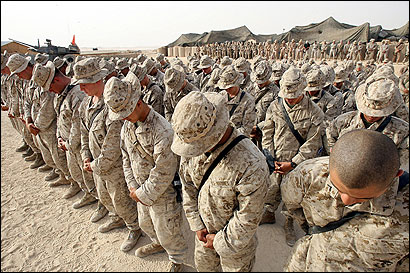
1.) It seems that, in today’s society, images of war, as well as those depicting/representing any significant cultural/political issue, are deemed “official” within American minds when they are given mass media display and commentary. Though one could certainly argue that any explicit photographic images of America’s most recent war with Iraq, such as those taken by American soldiers during their occupation of the Abu Ghraib war prison, are in some way “official” images of the war (being that they specifically depict the actual goings-on of the multinational conflict), these images were only given their “official” status after being widely exposed and explicated on national television and in national news writings. Much of the reason for media exposure being the main qualifier for war images being considered official is the simple fact that only through such exposure are the images able to be viewed by a significant enough amount of people so as to be associated with the particular war that they depict. Another possible explanation for why this method of exposure is a means by which images can gain “official” status is that, by being presented with “professional” commentary concerning the images and their connection to various wars, the viewer subconsciously assumes that such images must be official images of a war if they are given so much attention so as to be made note of by those men and women assumed to hold high places of political knowledge and power.
http://clubtroppo.com.au/wp-content/uploads/2007/05/whoops.jpg
The above image could certainly have been considered by the American public (following its being displayed on television screens across
the mission having been “accomplished” came just a tad too soon, considering the fact that this image was taken in May of 2003, and that even now, on the very cusp of 2008, the American Military’s occupation and “liberation” of Iraq continues. An interesting side note is the fact that this very image is used for a decidedly opposite purpose by various comedians (i.e. The Daily Show’s John Stewart) today, that being satire regarding the Bush administration and its many follies and false foresights, most notably those concerning its dealings with Middle Eastern nations such as Iraq.
http://theredhunter.com/images/Saddam%20Statue%201-thumb.jpg
Above is an image of an Iraqi statue of Saddam Hussein being uprooted by American soldiers amidst an elated crowd of Iraqi citizens. This image and many others of the same scene were, shortly after their being created, proudly displayed in various forms of American news media. The purpose of the photographs of this scene being shown as “official” images of America’s war with Iraq could very well have been to send the message to Americans that, by invading Iraq, the American government was seeing to the overthrow of a tyrant, hated even by his own people (Iraqi citizens could be seen in video footage of the spectacle happily dragging the remains of the statue through Iraqi streets) and thus pursuing justice within another, less liberated nation.
2.) In regards to the difference of opinion between articles such as Libby’s “Culture/War” and Sontag’s “Regarding the Torture of Others” on whether or not images hold harmful ideological power over the viewer, I must admittedly place myself in a moderate position, with an err towards the views expressed in Libby’s article. I believe it is undoubtedly true that images, in the way by which they are intentionally constructed (by the photographer for instance), in the gaze that they assume, and in the limited amount of space/time that they represent, do depict reality with certain biases, and thus perhaps are not accurate references when searching for the absolute truth regarding any situation, such as that having occurred at the Abu Ghraib war prison. As stated by Libby, “…images are not transparent screens through which the viewer can see some truth beyond.” Thus, no matter how shocking or horrifically inhumane the actions depicted within a photograph may appear, one must consider the setting in which the image was created, the intentions of the photographer, as well as many other technical aspects that go into the immortalization of a moment via photography. Though, because of a certain amount of involuntary human emotional reaction, one is undoubtedly inclined to immediately assume sympathy for people being abused or victimized in images and to likewise assume a disgust for the abusers seen in the same images, it is nonetheless detrimental to the objective viewing/assessment of an image to lose sight of the simple fact that it is an image, and should not, again, be assumed as an absolutely unbiased depiction of an actual happening.
On the other hand, when photographs of inhumane torture such as those taken by American soldiers during their occupation of Abu Ghraib are publicly exposed, a certain number of assumptions concerning the images can and should be made. Being that these images depicting decidedly unnecessary and heartless abuse of war prisoners were taken with a seeming sense of pride by the very abusers seen within them, one can assume that such instances of torture were not staged, and were in fact deemed by a number of soldiers and military officials as acceptable and even humorously entertaining treatment of war prisoners. Thus, when the obvious fact is officially established that the images of the American Military’s treatment of Iraqi prisoners are relatively accurate depictions of what happened in reality, what is subsequently most important is how those seen within the images as committing such atrocities are dealt with, as opposed to close, meticulous philosophizing on the ideological nature of the images, and what that nature might imply. The fact of the matter is that these images were created by American Soldiers as a glorification of their incredibly hostile treatment of other unarmed, and thus defenseless human beings. The moment that images of this nature are presented to the American public, and perhaps most importantly, to American government/military officials, the most important issue on which to focus becomes a swift end to such abuse, and just punishment of those having taken part in it. To focus more intensively on the photographs as images rather than what actions they are evidence of can, in fact, be used as a way of avoiding actually addressing the obvious problem within
3.) It is my strong opinion that war images such as the Abu Ghraib photographs, as well as countless others having been taken of many wars since the dawn of photography, should be made open to public viewing both during and after times of war. Though many might believe it unpatriotic to show any negative images/photographs of American soldiers and their discourse during a time of war with another nation, the result of not making such images open for public viewing is, in my humble opinion, far more detrimental to
Sources:
1.) Sontag, Susan, “Regarding the Torture of Others”, The New York Times, May 23, 2004
2.) Libby, Susan, “Culture/War”, The International Journal of the Arts in Society, Vol. 1, No. 5, 2007
3.) Gogan, Jessica; Sokolowski, Thomas, “Inconvenient Evidence: Iraqi Prison Photographs from Abu Ghraib”, at The Andy Warhol Museum, text by Hersh, Seymour M., September 11-November 28, 2004