Wednesday, October 31, 2007

Jessica D., Post 9

Jessica Duran

“Why is it that, as a culture, we are more comfortable seeing two men holding guns than holding hands?” -Ernest Gaines


Over a hundred years after those two men danced together in Thomas Edison's studio, movies still continue to be an integral part of our society and have the influential ability to touch our hearts, minds, and souls. Movies have the dual ability to both mimic and distort our world and people’s perception of it. They have played an active role in shaping and challenging our opinions and beliefs about life, love, sexual orientation, and gender identity. As people sit in darkened cinemas they are given the opportunity to “escape” from the drudgery of everyday life. Regardless of gender, race, ethnicity, sexual orientation, or social class; the movies provide an outlet for individuals to self-identify through. The movies allow people to live vicariously through the characters; they feel their joy, their pain, their sorrow. Everyone has their favorite movie, character(s), and movie lines that will forever continue to tug on their hearts. Movies have also greatly influenced straight audiences on how to treat and view homosexuals and gay audiences how to view themselves. Film has documented society’s changing attitudes towards homosexuality during the 21st century (Barrios 9). At times films have portrayed homosexuals exactly as they were viewed and treated by society; at other times they have blatantly misrepresented and distorted this view (Barrios 12). Throughout the past century, cinematic portrayals of homosexuals have run the gamut from comic pansy to cold blooded villain to psycho maniac to everything in between. Even though these portrayals rarely ever shed a positive or realistic light on homosexuals; they still stand to be living testaments of acknowledgment that homosexuality has been a visible (always controversial) part of our society and culture since the dawn of the film industry (Barrios 365). Watching these films through 21st century lenses allows us to reinvestigate and experience the cinematic portrayals of homosexuals and homosexuality on the silver screen from a new perspective.

The roaring 20s ushered in an era of raw decadence, “loose” morals, and high living that was also reflected in the films produced at this time. It was a time in people in which people reveled in the desires of the flesh. Films were oozing with racy sex, daring sexuality, graphic violence, and so much more. During this time, gay and lesbian characters, allusions, and situations, were more visible in American Cinema then they would be until the late 1980s (Barrios 10). The silent film era was saturated with arguably pseudo-queer flashes, from the comical drag performed multiple silent comics, to the infamous kiss between Richard Arlen and Buddy Rodgers in the film, Wings (1927). The “sissy” was one of the first homosexual stereotypes to appear and probably the most enduring; “he” has remained an easily identifiable, often constant presence from the silent era to today. There were always codes to highlight the presence of a gay or lesbian character. Words such as dearie, whoops!, lavender, fairy, Clarence, or pansy, were queerly teasing messages for the audience. To depict a gay man OGT’s (Overly GayTraits) such as: a flower in the lapel, a thin moustache, pursed lips, waving hanky, “lose” wrists, a high pitched voice, or overtly effeminate mannerisms did the trick. For lesbians, manly clothing, a cigar, or the sure fire monocle were utilized (Barrios 63). Though these characterizations of gays and lesbians often mocked or utilized them as a source of comedic relief; they would pale in comparison to the dangerously grotesque characterizations they would face in later years. These stereotypical roles and representations of gays and lesbians were fairly accurate to how they were viewed and treated in society (barrios 16).

Cecil B. DeMille’s salacious biblical epic, The Sign of the Cross, succeeded at being a formulaically scandalous movie that gave the public what it “wanted” and got away with much more than was normally permitted (Barrios 93). The highly controversial and “obscene” content of this film featured the overtly lavish bacchanalian excesses of Ancient Rome including: orgies, blood-soaked violence, nudity, skimpy costumes, and suggested lesbianism. This scandalous film featured an overtly gay Nero and a lesbian dance with “whore-of-Babylon hip swings” that Barrios calls "jaw dropping." (Barrios 88) It highlighted the decadence and immorality of Rome by contrasting it to the solemnly pure lifestyle of the Christians; the ultimate juxtaposition of vice and virtue. This erotic vehicle was saturated with homosexual innuendos, situations, and double entendres. From Claudette Coulbert’s titillating bath in asses’ milk to Charles Laughton’s slave-boy hook-ups to Joyzelle Joyner’s lascivious “lesbian dance”; it is quite evident that this film oozes with gay and lesbian references. This film’s utilization of overtly gay elements and themes would ultimately demonize homosexuality and cause it to be viewed as a direct threat to sexual “normalcy” and therefore added to the long list of “Hollywood evils being fed to innocent filmgoers” (Barrios 94). The cost of Demille pushing the envelope and creating this homoerotic film would go on to affect the entire movie industry and ultimately lead Martin Quigley, Joe Breen, and the “watchful eyes of the Hayes office” to enforce the “sanitization” of movies in 1934 (Barrios 83).

In 1934, all the unrestrained decadence and “degeneracy” of the movies came to a screeching halt when both the Legion of Decency and the newly enforced Motion Picture Production Code left their marks on the film industry and changed the face of movies. As the Jazz Age had faded away, the code now reigned over a film industry that was trying to alter itself to appeal to the public’s changing taste. Films needed to be sanitized to preserve public morality and uphold American “traditional” values. The code greatly aided in “ridding the public sphere” of “sex perversion” and preventing the public from being exposed to “degenerate” material. It would set puritanically strict standards that would prohibit couples from occupying the same bed, murder or rebelliousness to go unpunished, drug use, the depiction of women’s navels, and the open discussion or depiction of homosexuality (Barrios 128). Under the code, gay themes and messages had to be camouflaged; “The gay codes operated on screen in much the same fashion as a red necktie would function on a metropolitan street, conveying gayness to those in the know, often past the eyes of outsiders” (Barrios 61). Hollywood soon learned how to slyly write movies between the lines; leaving them open to interpretation by “intelligent” audiences who had learned how to watch between the lines (Barrios 58). Since “all in Hollywood seemed streamline-shiny, sterile, and censor-proof”, gays and lesbians would now have to look much harder to find some sort of identity in post-code movies (Barrios 142).

In Tea and Sympathy (1956), a diluted take on Robert Anderson’s Broadway play, Tom (John Kerr) plays an overly “sensitive” boarding school student who is relentlessly teased by both his class mates and macho father for being gay. Feeling sorry for Tom’s cruel treatment, the headmaster’s wife “offers” her own body to Tom; uttering the memorable line, “Years from now when you talk about this… and you will… be kind.” (Barrios 241) Naturally at the end of the film the headmaster’s wife writes a letter to Tom lamenting the “wrong we did” and how it ultimately ruined her husband’s life (Barrios 244). The subtext of this film blatantly condemns the vileness of adultery and clearly shows the audience the consequences individuals face when they indulge in the immoral desires of the flesh. On the same note, the film also shows the audience that homosexuals or “sensitive” individuals could be easily “rescued” and “cured” by the right woman (man).

During the 1950s, the "pathology" of homosexuality, parallelling the medical establishment's negative attitude toward it, erupted in American cinema in the late 1950s and beyond (Barrios 225). Movies during this time condemned immorality; homosexuality connoted evil and homosexuals were socially dangerous ( Barrios 248). Crazy psychotic queers were the driving force in films like The Strange One with Ben Gazzara playing a crypto-homosexual sadist at a military school or Compulsion with Bradford Dillman and Dean Stockwell playing the psychotic gay killers Artie and Judd. Homosexuals were portrayed as murderous, mentally depraved, and/or emotionally unstable individuals who posed a direct threat to society and therefore needed to be “cured’ or better yet tragically killed off (Barrios 248).

In The Children’s Hour (1961), Audrey Hepburn and Shirley McLaine portray two headmistresses at a private school in New Egland who are accused of having a lesbian relationship by Mary Tilford (one of their students), a spiteful little girl. Upon Karen’s (Hepburn) engagement to Dr. Joe Cardin, Martha (McLaine) passionately confesses her undying love for Karen. In the anguish saturated line, “I feel so damn sick and dirty I can’t stand it any more, Martha expresses the self-loathing and hatred that homosexuals were shown was the way they should feel (Barrios 308). Later in the film Martha eventually commits suicide by hanging herself in her room and her body is discovered by Karen. This film propagates the belief that homosexuality is immoral, depraved, dirty, and wrong. The subtext of this film speaks clearly to the audience blatantly stating that since homosexuality is evil and homosexuals are villains posing a direct threat to our “social order” and “traditional” values; therefore, homosexuals must die in order to restore order, purity, and normalcy to our society.

During the 1960s, the Production code had become a mere anachronism, many producers constantly pushed the limits and willingly risked not receiving the seal of approval (Barrios 294). As the time for the Stonewall riots drew near and the code continued to deteriorate, a change in the wind would finally cause it to crumble. Finally, in 1968, two Supreme Court cases “would change the way the country could police the sale and exhibition of adult material; one involved selling an adult magazine to a minor, the other the disputed ability of local censorship board to ban young people from a movie. The outcome effectively curbed censorship” (340). From then on films would now be rated on their final cuts and were freely allowed to depict previously taboo topics such as sex and violence. They also reveled in the freedom of being able to openly depict homosexuals and homosexuality. Unfortunately, most “gay films” from 1962 on did not target a large enough percentage of the population to rake in sizeable profit and thus the film industry wasted their opportunity to help the public accept homosexuality and sadly made gayness more “irrelevant and unappealing that ever” (Barrios 316). Gays and lesbians once again would have to “glean whatever good they could from the projected images, while attempting to avoid the negativity hurled at them” (Barrios 316). They would ultimately need to turn to television or independent/foreign films as sources if they wanted to see a positive or at least more “realistic” portrayal of homosexuals.

During the 1970s, American cinema would eventually “go back into the closet for several years” (362); homosexuality was something “shunted over onto the side or ridiculed or disapproved. The awareness and visibility homosexuals had gained since the Gay Liberation movement failed to be reflected onto the silver screen (Barrios 363). The road to depicting “real” portrayals of gays and lesbians in American cinema has been a slow evolution and is still a work in progress. The film industry still has a ways to go to finally grant homosexuals the “real” portrayals of gay and lesbians that they have so long yearned for; finally acknowledging them first and foremost as human beings and therefore realizing the truly amazing diversity and uniqueness of all humanity (Celluloid Closet).


This image is an ad for Dolce and Gabbana’s spring 2007 line. This gay “eye candy” ad depicts perfectly tanned and toned chiseled male bodies. These half-naked men have rippling six-packs, hairless physiques, and perfectly airbrushed features. These four male models are very much like the narcissistic, body obsessed overtly homosexual hunks depicted in the classic movie, Gentle Men Prefer Blondes (Barrios 234). This ad is blatantly super saturated with sexual undertones and utilizes sexually eye-catching homoerotic images that are geared towards gay men who are generally the male demographic that buys expensive designer label clothing. The homoerotic scene in this ad is utilized to capture this niche audience's attention and therefore entice them to buy Dolce and Gabana products. Though normally in our patriarchal society the female is the sexually objectified object of the male gaze; this ad features the male as the sexual object of desire of the gay gaze. Unfortunately, this ad actively propagates a one-dimensional, self-destructive stereotype of the gay man as being a vain, superficial, sex obsessed individual. The fact that this image is a culture industry product makes it all that more powerful in having the ability to the influence the public’s perception of homosexuals. The exploitation of sexualized images to market and sell products and services has become alarmingly commonplace in our society. By overtly and blatantly attaching hot bodies and sexy faces to products and services, advertisers and corporations equate their products with sex. Consumers are deceived to believe that if they buy—(insert any material object)—they will also get the hot woman/man that is associated with the product or service. The lesson that Cecile B. Demille learned early on in his filmmaking career is still applicable to our modern day society; “carefully packaged sex sells extremely well” (Barrios 23).

Though this ad features the very same depictions of perfectly toned and chiseled human bodies that the Nazis exalted and glorified; the Nazis did not view the human body as a sexual object, but as an immortal symbol of “Aryan beauty” (Mosse 28). They also labeled homosexuals as degenerates because they deviated from the sexual “norm” that was “enforced” by the Nazi party. Thus, Hitler deemed it necessary to “purify” his nation of these homosexual degenerates, who did not help to reproduce and perpetuate his master race, but instead corrupted public “morality” and marred Germany’s eternal beauty and respectability. Therefore, the Nazis would label this ad as degenerate because it promotes “immoral” behavior and “abnormal” sexuality and therefore would be seen as a direct threat to all German “respectability” (Mosse 25).

This ad only serves to perpetuate the stereotype of the modern gay male as being a sexually addicted individual who is hyper-obsessed with body image and physical perfection. As Adorno States, “The more stereotypes become reified and rigid in the present setup of cultural industry, the less people are likely to change their preconceived ideas with the progress of their experience.” (229). As long as the culture industry continues to produce images that perpetuate the stereotype of the modern gay male as being a sexually addicted individual who is hyper-obsessed with body image and physical perfection; society will continue to accept this stereotype as a realistic portrayal and fail to recognize the great diversity and uniqueness of homosexuals.


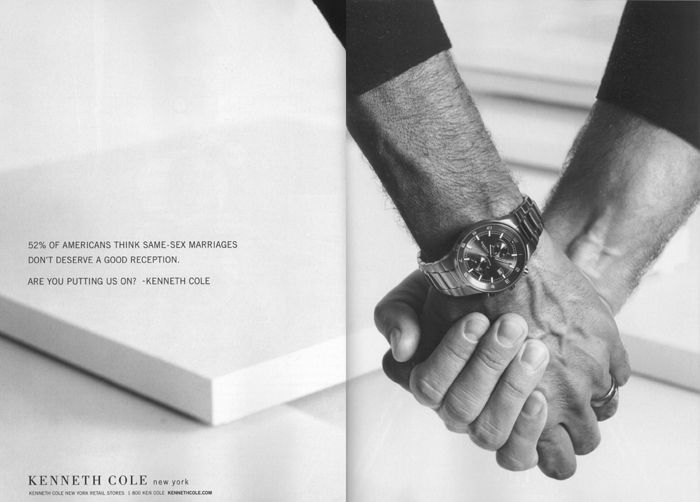
The image above is a Pro-gay marriage print ad by Kenneth Cole that appeared during the 2004 election year. During this time gay marriage and equality were both hot topics and many corporate advertisers including Kenneth Cole jumped on the debate. Since the early 90s, Kenneth Cole has made ads that are sensitive to gay issues and rights. This particular ad depicts two males with wedding bands tightly holding hands and features the caption, “52 percent of Americans think same-sex marriage doesn't deserve a good reception. Are you putting us on?” The double entendre in this ad makes it seem as though this image is solely a C.I. product that targets the gay community and entices them to buy Kenneth Cole products by tackling gay issues. This ad promotes Kenneth Cole products by having the two models sport chic black knits, rings, and a trendy watch all by the designer. However, it is unfair to view this ad solely as a formulaic C.I. product. This image is not an object solely created for profit, but is an image with the power to make people aware of gay issues and rights and ultimately bring about social change and justice in our society and alter the status quo of gay individuals (Adorno 220). It has the ability to promote the change of giving homosexuals the equal rights and humanized identity that they yearn for as was vocalized by many individuals in the book, Screened Out, and the film, The Celluloid Closet.


Sources:

http://www.matchflick.com/flickimages/3171.jpg
http://imagecache2.allposters.com/images/pic/MG/197426~The-Sign-of-the-Cross-Posters.jpg
http://www.queerty.com/queer/fashion/dolce-and-gabbana-do-it-again-20070309.php
http://www.thegully.com/essays/gay_mundo2/wilke/img_closet/700x502cole.jpg
http://upload.wikimedia.org/wikipedia/en/thumb/5/5f/53_1.jpeg/200px-53_1.jpeg


Fatema, post 9

Fatema Kermalli

1) Beginning all the way from Algie, the Miner (1912), gays were portrayed as “sissies”, with all the mannerisms identifiable with them to this day: “the dandified air, fluttering hands, pursed and apparently rouged lips, sly smile, and eyes that he bats while fondling the barrel of a pistol” (17). Such representation may well be attributed to the psychiatric myth prevalent in the day that gay women were men trapped in female bodies (16)… or perhaps, that gay men were women trapped in male bodies. Though different, these characters were nonetheless accepted within their own circles, as is depicted in The Matinee Idol (1928) where the “sissy” Barrymaine is valued by his own theatrical family (30).

This depiction became even more prevalent due the advent of sound in movies, such as in The Broadway Melody (1929): “for audiences to hear the wardrobe woman’s steely tones juxtaposed with the breathy outrage and harrumphing of the costume designer was a whole different and audible proposition” (38). Musicals, which arose from the sudden ability to utilize sound within the films, were another place where gays could thrive, especially considering the fact that the stereotype for such a character was being “excessively aesthetic” anyway (31),

According to Barrios, such depictions were “fairly matter-of-fact” (43), which would make sense since the ideas of gays at the time were actually rooted in reality and the idea at the time that they were simply trapped in the body of the opposite sex made them less foreign and different. Still, difference arouses curiosity… which accounts for the Dude Wrangler ads that drew attention to the “pansy” aspect of the story (52).

Adding sound, however, also erased any illusion or misunderstanding of what was intended in the films, thus making some people uncomfortable (56). The code which came into existence (though it was not strong) may be seen as a result of this. It in turn, along with the fact of the depression, made for starker, franker, and more subtle portrayals of gays in the media (60). This change can be seen in such films as The Sign of the Cross with its “alluring” (not at all comical) lesbian “Naked Moon” dance (87) in which the characters fulfill a serious role, and not one of a jester. This did not happen all at once, of course, and the comical genres of the past did still exist, but they were now coupled with a new, more real way of looking at gays. The change came about as a result of political forces: the national mood resulting from the country’s bad economic state, as well as the protesting of certain groups against the content of some films.

Looking at the films that address homosexuality, it is possible to find many such directors, actors, and actresses that may be said to have played a role in their own depictions on screen. One such example of this would be The Sports Parade (76-8). Overall, however, the trend seems to follow the current of politics. The people themselves, for most of history, didn’t actually stand up in opposition to the codes; they didn’t go against the current. What they did do was make sure the current didn’t run them down, by passing depictions of gays and lesbians through the codes themselves. The fact that these had to actually escape the view of those such as Hays ensured that the inclusion of gays would be subtle… and appear normal (because they could not stand out). An example exists in the scene in Cavalcade where “a pair of women… sit dreamily, one taking the other’s hand. The camera then picks up one young man clasping a slave bracelet onto the wrist of his young male partner” (98).

The year 1933 saw the return of a few more “womanly” men, such as Ernest in Our Betters (100) and certain cartoon characters, due to the high expectations for the country that came along with Roosevelt’s presidency (95). Following this, however, an even harder Code Administration struck due to the Legion of Decency, which was formed in response to the growth of explicitness in the movies (125). Barrios states that, indeed, “In some ways they were abusing their freedoms…pushing to see just how much they can get away with” (135). This strict censorship of material may be said to have helped ensure that the portrayal of gays stayed on the path of having a more serious, integrated role that was necessary in order to pass such characters through the Legion of Decency.

Once again, here, it is politics that is said to affect the movies. “Those insiders wishing or needing to locate [gays] in the movies would… need to work quite a bit harder” due to the political action of a group of Christians. This fact is also proven by the fact that pop culture at this time (and before) mirrored the lives of real gay people, both having to be hidden at the same time (146). The code had thus already seen to it that life would be more like movies… both being influenced by the same politics. If gays had taken their own strides in another direction, the two would not be the same.

The depictions of homosexuals were thus shaped through the need to be underground, as can be seen in the changes that were made to various films in order to get past the code. For example: “a costume designer shows a fabric… and he murmurs the surefire pansy signal, ‘Divine, simply divine!’” or the man in Bringing Up Baby who says, “I just went gay…I’m sitting in the middle of 42nd Street, waiting for a bus!’”, 42nd Street being “the primary cruising strip for the city’s male prostitutes” (154-5).

Then came the depiction as “stern women with a more gothic mien, willowy neurotic young men and acerbic, sexually ambiguous sophisticates” (168). Gays began appearing in film noir and having “scarier” roles. This may have been a result of the new way of understanding homosexuals. No longer were they simply in the wrong body; now, more complex questions were being asked, which led to “increased distrust, even demonization” (184-5). Such was the time period during which Rebecca (186) and The Uninvited (190-2) emerged, both showing lesbianism in the sense of one woman almost “owning” another, whether in life or death, due to the amount of attachment and control over them. And of course, in each there is death, for lesbians were not allowed to go uncured and unpunished.

In 1945, Will Hays retired, leaving in his place a new and less strict head of the MPAA (198). This coupled with the fact that filmmakers were learning more and more “tricks” led to more mature portrayals of gays. They were not merely the comics of before, but had an air of superiority. “He “was not a subject for ridicule in most cases. In fact, he did much of the mocking himself” (201). This superiority complex (and the negative portrayal of gays) can probably most clearly be seen in Rope (likely based on the case of Loeb and Leopold) where the two villains try to commit the “perfect murder” (211). Many other movies since then have also followed suit in showing homosexuals to be the evil people, such as Strangers on a Train and All About Eve and Suddenly, Last Summer.

Then in the 1960’s, the tone became a bit more synthetic and condescending towards gays, as can be seen in Stage Mother where the character must be coddled, coaxed, and even lied to (in order to work; 278). They were no longer even appreciated within their own circles; rather, homosexuals were to be pitied and brought back, as seen in A Very Special Favor (290).

Even though the negative portrayals continued, as people became more open in real life, and gays started to fight a bit more and organize, some films did show hope… such as The Gay Deceivers. In it, “there was the indication that maybe there would be a place where two men could live together and share a real, not a mock, relationship” (355).

2) Subtext of matinee idol (29): In its presentation of Barrymaine as an integrated and happy member of the theatrical company (even though he is slighted by others), the movie may be read to advocate the complacency of those who are shunned as outcasts. It promotes the idea of staying in ones “place” where you are safe, and being happy with where you are and what you have; it does not at all bring up the notion of change, or “fighting” against such prejudices. This is similar to the story that Adorno looks at on page 224 and says promotes the adjustment to humiliating conditions by presenting them as comical.

On the contrary, Barrios states on page 43 that even though gays were “used for occasional laughs”, they were usually in on the joke. The fact is, however, that they weren’t always. His manner of writing seems to actually support the subtext of this movie that, in its silence, advocates leaving things just the way they are. He says it was not done with malice (59), yet such portrayals may still be derogatory. Like the character analyzed by Adorno, it seems as though gays are told to accept being laughed at by the fact through the fact that the main character does nothing about it (and the others aren’t punished) and yet he is still shown happy at the end (to justify inaction).

Rebecca 186: The message sent is that lesbians will be punished in some way or another, just as Mrs. Danvers, who still retains a “relationship” with the dead Rebecca through keeping sacred all her things, dies in the burning building Manderly. If one really looks deep at this, the subtext, or message that could be given out here is not to just follow your hear, or love? Mrs. Danvers doesn’t fit in with society (remember that views had changed regarding what caused homosexuality, that made gay people seem even more strange). The message is now to do whatever it takes to be like everyone else, including giving up your love… or else you will come to a sorry end.

Stage mother 278: Here we see that the depiction has once again changed. The gay person is no longer simply funny, nor is he evil. He is almost to be pitied. “Leonard must be a target for the kind of condescension that would become increasingly frequent in the cinema of the 1960s. It’s necessary for Day to coddle him, coax him, and downright lie to him to get him to work” (278). The message being sent here is that of treating such people as children, and indulging them. What’s even more interesting is the last part, “to get him to work”. Reading into this could show that such films actually advocate using others to one’s own benefit, without regard to morality. It sounds as though doing as such to a gay person does not matter at all.

3) Find two contemporary images of a gay or lesbian person—one positive portrayal and one negative—and discuss how the images get their respective points across. Referring to Screened Out and the film The Celluloid Closet, as well as to Adorno and the class material concerning the Nazis, art, depictions of the body, and degeneracy, explain how your selected images can be construed as “positive” or “negative.” Are they “art” or “culture industry products”? How does this context affect their message?

http://www.artmajeur.com/?go=artworks/display_mini_gallery&image_id=15928&login=rafiperez&serie=1&artist_id=1285&mini_gallery_id=1320&disp_m=normal

This is an art image which depicts a couple in a room together, almost embracing. They are close, and not being held apart. The red colors/tones suggest passion between the two subjects, who are near the center and actually bathed in light (as opposed to being obscured in darkness. Because of this, it may be construed to be a positive depiction.

(Another example would be a poster for Brokeback Mountain, which shown the two characters almost "embracing". This would be a culture industry product positively depicting gays in the picture itself)

http://www.foxnews.com/story/0,2933,250575,00.html

http://www.youtube.com/watch?v=JHkoZ7ngAM0

This ad is a culture industry product which negatively depicts gays through the fact that being misconstrued as a gay is shown as something horrific and unmanly. In order to rid themselves of such association, the men (aften mistakenly kissing) actually rip out some chest hair (in an act of macho defiance).

Maxine R. Post 9

Maxine Rivera

Part I
It is common knowledge that the American views on homosexuality have changed over the past hundred years or so. What intrigued me as I read Richard Barrios’ Screened Out, was just how the views have changed. The path towards tolerance and acceptance was not a smooth, constant road; conditions did not simply shift from poor, to decent, to good, the nation went through phases and did, on occasion, regress. Barrios analyzes these periods in the American stance on homosexuality through film, “For film has depicted homosexuality for a century in all manner of ways.” (p 3)
To say that the changing views of homosexuality are all due to the efforts of homosexual population would be completely inaccurate, and depending on the circumstance, insulting. This is because while there has been obvious progress, there have also been periods when support of the homosexual community has deteriorated, to no fault of the homosexuals. Often, during such periods, the change in opinion is due to some historical event, or the actions of some political force. One major social-political force that stunted progress of gays in film (and in American society) was the Catholic Legion of Decency and the Motion Picture Production Code in 1934. This was an effort of the part of the Catholic Church to clean up the films presented to the American public, to rid them of such evils as “sex perversions” which included homosexuality. In class we discussed how this conservative influence contrasted to the liberal 1920s, due to the fact that many people blamed the Great Depression on the collapse of morality characteristic of the ‘20s. Thus people became more skeptical, less accepting, quicker to judge and condemn, on page 9, Barrios states “Seldom, until the 1940s and beyond, were gay characters presented with overt malice.” On page 11, Barrios explains that after the Code “Gays and lesbians were demonized, vilified, ridiculed.” Other influential social/ political events that caused change in the public view of gays, lesbians, bisexuals and transsexuals include the era of McCarthyism, were homosexuals were persecuted as communists, (even though some of the members of the federal government were found to be homosexuals) and the spread of the AIDS epidemic which was, for a while, blamed on the homosexuals. These events did not help improve the nation’s attitude towards the gay community and it was reflected in movies where characters who exhibited OGT were brutally punished.
While there were many social/ political events working against homosexuals, let it not be assumed that they were just taking the hits. Even through the censorship and persecution gays made moves towards progress. This can be seen in the creative efforts made by gay (and straight yet supportive) directors, screenwriters and actors to make the gay presence known in films despite the strict Code, they pushed the boundaries until the Code was “stretched to the breaking point.” (p 11) They also branched out to gain publicity in other media like television, on page 12 Barrios comments that in the ‘70s television “began to outstrip film in a forward-looking view of gayness and has continued that course without cease over three decades.” A hugely important move on behalf of the gay community came in 1981 with Vito Russo’s The Celluloid Closet, this book which was later adapted to an HBO series opened up discussion on the (under-/mis-) representation of gays in cinema. Yet another example of gays taking action is the Stonewall Riot which is often referred to in Screened Out. This occurred when a gay bar was raided by police and the gay community decided to fight back. Large numbers of gay men and women came out to fight against the unjust brutality.

Part II
In How to Look at Television Adorno says that “Mass media also consist of various layers of meaning superimposed on one another, all of which contribute to the effect.” (p 221) This applies to the point Barrios makes about gays being present in film, even when they were not called out by name. “The relation between overt and hidden message will prove highly complex in practice.” (Adorno, 222) On page 225, after providing examples of how to analyze subtext, Adorno brings up an interesting question; are these subplots that we find intentional? “Is such a sinister effect of the hidden message of television known to those who control, plan, write, and direct shows?” He suggests that perhaps some of what we read into subtexts are “presumptions” based on past experiences with other plots, and texts familiar to us.
The first film I will examine is Algie, the Miner produced by Alice Guy-Blache in 1912, long before the Legion of Decency and the Code. Algie had a girlfriend, which implied that he was heterosexual, but his mannerisms, gestures, personal style, and make up were all effeminate traits, what we might refer to as OGTs. “Algie’s queerness shows through in everything is says, does and is.” (Barrios, p18) This does not sit well with his future father-in-law and so Algie is sent off to become a man, which after a slew of shenanigans caused by his OGTs, he finally does. Algie became a sort of prototype for gay characters, they would bat their eyes, fondle pistols and canes, wear a flower, etc. The latent message I see here seems to be that homosexuality can be fixed, Algie returns successful in more ways than one, he is rich, manly, gets the girl and is therefore happy, however, who is to say he wasn’t happy before? Future gay characters would not only follow Algie’s mannerisms, they would follow his plot line, or face the consequences, as seen in the next film.
While I do not think the message of Algie, the Miner was to spread homophobia; I do feel it is the message in The Children’s Hour. This horribly depressing film does not flat out accuse the two women of being lesbians, it is alluded to through out the film. Martha (Shirley MacLaine) despises herself, she feels “dirty” and “sick” and eventually hangs herself. Unlike Algie, Martha cannot seem to cure herself of her affliction and ends her life, this movie takes a much darker approach to homosexuals. The “good/ straight” Audrey Hepburn survives the movie, she had all the fixings for a happy life ([male] fiancé, work helping children, friends, etc.) until Martha’s homosexuality destroyed it. The message here is that homosexuality destroys lives, if you are homosexual it is something to be ashamed of, it will hurt not only you, but those around you.
Finally, Tennessee Williams’s Cat on a Hot Tin Roof is a third film with homosexual subtext. Brick is a young man who is haunted by homosexuality. Again we see the theme of homosexual suicide in Brick’s friend Skipper, and Brick’s fears about his own possible homosexuality plunge him into alcoholism. This film/ play completely ignores the option of acceptance as a possible way of dealing with homosexuality and provides suicide and alcoholism as possible alternatives. Brick’s personal struggle’s bring grief to those around him (his family, particularly his wife) and the theme of homosexuality bringing universal misery comes into play again. Barrios makes note of Williams’s own struggles with homosexuality and suggests that they influence his writing, (p 258) which I feel they clearly do, yet this brings up Adorno’s point of presumptions.

Part III
Talking Back (1990)

by Lynette Molnar


The text reads "WARNING: Senator Jesse Helms has determined that looking at this picture is hazardous to your health and may cause homosexuality."

I feel this image is a positive one for the homosexual community even though the text sounds negative. There is clear sarcasm in the message of the text, Molnar is poking fun at Senator Helms while simultaneously speaking out for the homosexual community. The image is clearly attention grabbing, two women are kissing, which will make most people double back, then they will read the message and see how ridiculous it is, a straight person who sees the photograph does not instantaneously feel a surge of homosexuality run through their body, and obviously (as has finally been accepted in the rational world) homosexuality is not an illness or health concern. The Nazi's would call this degenerate art, it in no way conforms with "respectability" that Mosse mentions over and over in Beauty without Sensuality. Women showing sensuality, especially homosexual sensuality was absolutely out of the question. "Himmler's obsessional regard for respectability and his fear of all sensuality encouraged him to magnify the homoerotic and homosexual potentialities... he regarded homosexuality as a sickness that poisoned both body and mind..." (Mosse, p 30) Barrios and those interviewed in The Celluloid Closet (and modern, sane people) would disagree with Himmler, who also lamented the fact that homosexuals could no longer be "drowned in the swamps," and argue that homosexuals should be seen, they are a part of the world and should not be tortured and hidden. I would call this piece an artistic statement, rather than a culture industry product, as far as I have seen it was not mass- distributed for the purpose of making a profit, and it was created by an artist, not a team of people who studied the population dynamic and created an image that would manipulate the thoughts of as many people as possible. There are also formal aspects such as symmetry and contrast to take into consideration.

This is an example of negative contemporary images. This sign, adapted from popular "Beware Of Dog" signs that people put on their houses to scare off intruders, is bold and offensive. In The Celluloid Closet several of the interviewees commented on the role of lesbians in film as either victims or psychotic killers/ vampires. This sign reinforces those negative stereotypes by calling lesbians out as a threat/ danger to society, like an aggressive pitt bull. Though there are no bodies portrayed here, the absence of a body alone calls body images to mind. Obviously a "dyke" is something to be feared, one might think of a big, butchy woman, or a cunning evil woman, either way, the message is not good. I would call this a CI product because it lacks the artistic creativity that Adorno requires in considering a piece as art, it was probably mass produced for profit and could easily be transformed (for greater profit) to key chains, bumper stickers, magnets, mugs, etc.

This is an advertisement for a television show Queer Eye For The Straight Guy, where the five gay men pictured at the left help a heterosexual man clean up his act for a date, or so he can get a date. This involves personal appearance, decorating tips in the home, manners, etc. This would be an example of gays portrayed in a positive light, not only are out gay men the stars of the show, they are to be admired for their good taste and overall good sense. Straight men actually take their advice and follow their orders, it is a good example of progress for the gay community. Of course, the show is not without its stereotypes, the men often use mannerisms characteristic of Algie the miner, but they are not being ridiculed for these. The Nazi's would obviously disapprove, they would probably search for a swamp big enough to drown the five stars and the show's producers, but Barrios and the people interviewed in The Celluloid Closet would greatly approve of this exposure. These men are gay, out and happy, no suicide, alcoholism, denial, or torture. There is no doubt that this is a CI product, it was made to appeal to mass audiences and draw viewers and was created by a team of marketing experts, but I do not think that takes away from its positive portrayal of gays.


These images are from the hit television sitcom Will & Grace. This show is a testament to how far homosexuals have come, it centers around four main characters; Grace is a heterosexual woman, Will and Jack are gay (though not partners) and Karen who is heterosexual though she often exhibits lesbian tendencies. The image on the right is to show how far we've come from the Legion of Decency and the 1934 omissions of "women's navels, occupied double beds, getting away with murder without being punished, any sense of a bedroom as something other than a sleep chamber, drug use, the attractiveness of lawlessness and, essentially, being an out gay man or lesbian." (Barrios, p 10) Here not only is the double bed occupied, its filled with out gay men! Jack who dabbles in theater is reminiscent of The Broadway Melody's Del Turpe, and of course stereotypes that date back to Algie are ever present, but they return to being a comical addition to the show, rather than a point of derision. This show portrays gays in a positive light, they are witty, funny, caring, they are real people who the viewer would love to have as friends. Obviously the Nazi's would find this program and its advertisement wholly unacceptable,
clearly "the chaos that seemed always to threaten society." (Mosse, p 25) However after Will & Grace's run, I feel that it only helped with acceptance and that has far from destroyed our society. Again this is without a doubt a CI product for all the reasons previously stated, but once again I do not feel this takes away from the positive aspects of the show and its images.

Kelly Blog 9

Kelly Gordon Blog # 9
1) Throughout the 20th century, gay oppression fluctuated from decade to decade. The movies and film productions during this time reflect the level of acceptance, or rather the rejection, of such lifestyles. Before the 1920s, gay and lesbian characters in films were near impossible to find: “People who were bold enough to consider themselves gay and lesbian existed either behind locked doors or in the most ghettoized sub areas of the population.” (Barrios, 15) Because sound was not an option so early in the age, the few silent films that did address homosexuals were filled with subtle insinuations that a character might be gay. Mannerisms were certainly responsible for any revelations or implications: a flower in the breast pocket of a man’s suit, a minute mustache, the springy handkerchief. Lesbian giveaways were jackets and ties, masculine hairstyles, and the smoking of a cigar. Gender confusion was also popular in this age. It’s easier to concentrate on the visual differences between a man and a woman, along with their mannerisms, in silent films because the things they say and the way they say them cannot be interpreted by the audience. Charlie Chaplan’s famous silent films were responsible for most of the queer films before the 1920s. Additionally in the teens, women dressed as men was thoroughly accepted as interesting comedy, however, a double standard existed that prevented the same entertainment to arrive from a man dressed as a woman.

Contrastingly, the 1920s brought an era dedicated to the enjoyment of life and all of its luxuries. Alcohol and sex were newly discovered activities used to incite entertainment among the masses; with flapper girls and the boom in the economy, sex and personal pleasure were no strangers to moviegoers. Because of the state of America and its culture at the time, more homosexually provocative films were accepted and enjoyed by audiences than in the teens: “Some movies don’t appear to have a straight bone in their bodies.” (Barrios, 24) Same-sex couples were still rarely depicted, but characters maintained extremely effeminate portrayals that couldn’t possibly leave the audience guessing. Sexuality was a generally popular topic during this time, and it was no stranger to the cinema: “So it was also with some of the portrayals of gay/effeminate/sissified insert-adjective-here characters who started appearing onscreen in the mid-twenties.” (Barrios, 27) In 1927, audiences even had the pleasure of viewing the first on screen male kiss. In Wings, although the characters are in a very dramatic situation whereupon one falls to his demise, a great achievement has come about in Hollywood cinema. A same-sex kiss has occurred, and the people of America have witnessed it. You can only imagine the future of film as sound makes its bearing.

As we dive into the late 20s and 1930s, sound becomes a great tool for the directors, actors, and producers in the filmmaking world. Now effeminate actors are able to adopt a more feminine voice and manner of speaking in order to convey their sexuality. Contrastingly, sound also becomes a challenge for many homosexual actors playing heterosexual roles. Voice pitch and tone become a new aspect of the acting world that actors, directors, and producers now have to take into account. Essentially, sound revolutionized the world of Hollywood. Words began to have a specific connotation to them: “By 1929 the word lavender, like fairy or pansy, had one principal connotation. (Gay was also in use at that time, but not as widespread as these.)” (Barrios, 40) Sound also enabled Hollywood to go too far. People began objecting to the morals in films concerning alternative sexuality. In mid-1934, the Motion Picture Production Code and the Roman Catholic Legion of Decency created a barrier for films and their context. The Production Code Administration crackdown prevented anything “indecent” or “immoral” from reaching the red carpet. As a buildup since 1929, the code existed to as a strict and rigorous way to censor the American public from gay scripts: “The movies, this reasoning continues, were as shielded from gay forces as the rest of “normal” America; only a few slight hints of it crept in here and there to taint the respectability of clean pictures. Not until somewhere in the mid-1990s was there any sort of public (or cinematic) acceptance of it.” (Barrios, 59) With the code still loose in 1933, many lesbian and gay characters that were portrayed were used by conservatives as reasoning to create a stricter code.

In the 1940’s, the strictness of the code ensured that men and women depicting a homosexual disposition reached a pitiful demise by the end of the film. As seen in The Razor’s Edge (1946), House of Horrors (1946), and Rope (1948) shows the suffering of characters depicting homosexual qualities. Their oppression became a part of the plots -- whether or not this was a conscious intention is unknown. In a post-code world homosexuals were considered bad, and bad people must be punished. Thus many movies ended with the homosexual character or the character portraying homosexual mannerisms dead.

A decade later, in a time of post-war prosperity, despite the many injustices occurring, people maintained their positive outlook. In liberal cities, people even began discussing the need for oppression of the homosexuals to end and liberal equality to triumph. Concerns about what was on the film screens began to diminish as more important issues took center stage. For example, in the film Caged (1950), the MPAA allowed for intense homoerotic tension between two of the main female characters claiming that it was simply a reference to their friendship. In Johnny Guitar (1954), the women appear more masculine than the men as they provide for the main physical conflict throughout the film. Emma is dead-set on seeing Vienna dead. At Vienna’s hanging, the men refuse to follow through and Emma is forced to take the masculine role and attempt to kill Vienna. Of course Joan Crawford is saved just in time by her male counterpart who mainly listens to whatever she says – similar to the way a dog follows directions from its owner. The 1950s really allowed for a change up in roles of gender and masculinity/femininity. In 1955, teen culture emerged. Along with this era came the days of Elvis Priesley and drive-in movies. Sex exploded in the teenage film culture because at that age, hormones must be satisfied or else attention spans waver.

Again in the 60s, homosexuality on film became was difficult to find: “The sex in sixties comedy was disingenuous from the word go, gay sexuality most of all. Lesbians did not exist in this world, and male gayness served most conspicuously to highlight the red bloodedness of the straight heroes out for a conquest. Sometimes homosexuality would serve as a cheap disguise assumed by the hero, while at other times it was given over to supporting characters, expendable weaklings unworthy of penetrating the heroine’s enameled façade.” (Barrios, 275) Doris Day took the screen and altered the view of a once good girl into a glossed-up Barbie who was motivated by sex. The sixties were a liberal era for the younger generation of the time, and the movie industry took advantage of that. It was a time of change and confusion for our government, politics, social norms, and expectations as a country.

The existence of gay cinema generally changed along with the liberal/conservative fluctuations of the eras. The fifties involved looser reigns on the film industry while the 30s disabled their creativity and freedom to produce whatever type of film they wanted. Since the 1990s, however, portrayals of gay characters on film and even homosexual relationships have been much more accepted. Many recent TV shows and movies show positive portrayals of homosexuals where they are accepted in the society they are depicted in: “Will and Grace”, “The L Word”, and “Ellen.”

2)
The Uninvited (1944) managed to squeeze past the Legion of Decency’s radar. After the film was released, it raised question among the public due to its “erotic or esoteric implications.” Every scene that caused an issue among was centered on Miss Holloway and Mary Meredith’s relationship: “Miss Holloway gazes at Mary’s portrait and apostrophizes her beauty thus, ‘…her radiant hair, milk white skin, charm…’ and says something to the effect that it was in this room ‘…that the two of us dreamed and planned our lives…what we would do together.” (Barrios, 192) Miss Holloway’s character is more masculine while Mary’s character is very feminine. This plays into the whole butch/femme stereotypes that arise later in the century. Lesbians accepted the film with gaiety. They viewed the film as a support system; it was both something they could relate to and something that explained their inner emotions to the rest of the public. This film helped individuals identify and liberate their sexuality even though they were still in an oppressive environment. Viewers became more aware of their own desires, needs, and the lesbian community.

In Calamity Jane (1953) starring Doris Day, Calamity is a severely masculine woman living in the Wild West. She lives in an isolated cabin and has zero interaction with any female characters until an extremely beautiful “actress” by the name of Kate is brought to town to entertain the men by singing and dancing on stage. In reality, Kate is merely an actress’s maid and only impersonates the actress in order to have a true adventure. Kate helps Calamity to become a woman by providing “a woman’s touch.” After a couple of songs, Calamity is dressed up in the appropriate women’s attire and all of a sudden, the man who she doesn’t know she’s been in love with all these years marries her. Simultaneously, Kate gets married, and they all live happily ever after. Essentially, the point of the story is that Calamity’s unnatural masculinity is cured when a woman comes into her life and explains and of the things she’s supposed to find interest in, all the ways she’s supposed to dress, and all the way she’s supposed to speak. The audience then receives the idea that it’s unnatural and needs to be corrected if a woman is a tomboy or more masculine than she is feminine. For some reason, that woman is seen as less of a woman because of her attire, manner of speaking, and hobbies. All of this can be corrected however, with “a woman’s touch.” This also insinuates that homosexuality can be “cured” or “fixed” if done the right way.

In The Children’s Hour (1961), Audrey Hepburn and Shirley McLaine portray two school teachers who are accused of being lesbians by one of their students. Upon Audrey’s engagement, Shirley confesses her true love for Audrey: “I've been telling myself that since the night I heard the child say it. I lie in bed night after night praying that it isn't true. But I know about it now. It's there. I don't know how, I don't know why. But I did love you! I do love you! I resented your plans to marry. Maybe because I wanted you. Maybe I've wanted you all these years. I couldn't call it by name before, but maybe it's been there since I first knew you.” Shirley’s character eventually commits suicide. Her body is discovered dangling from a rope by Audrey. This film suggests that it’s disgusting, immoral, and inhuman to be gay. It suggests that it’s essentially evil to be homosexual, and evil people must be punished. The punishment that Shirley’s character receives is her suicide. The audience is then taught to believe that gay people are innately evil and should be punished. It encourages harmful actions and disrespect towards homosexuals. This film didn’t intend to support homophobia, but its intention was most likely overlooked by an audience that had been “protected” from gay cinema for years due to the Production Code Association.

3)

This image of two boys from Iran who were hanged for being gay is, obviously, my example of a negative portrayal of homosexuality. The two boys themselves have done nothing wrong to earn a negative portrayal, but the fact that they were killed for their sexual preference is the worst possible thing that could be done. For supporters of this awful crime, this image probably incites pleasure and victory over a "degenerate" group of people; a group of people who have chosen to be gay against the wishes of God (depending on their religion). For individuals who condone homosexuality, this picture inspires anger towards those who don't accept homosexuals. Why would someone commit such a hate crime simply because two people chose to live their life in a different way -- a way that harmed no one. Along with Barrios' theory and the theory explained in The Celluloid Closet, gay people are sinners and sinners must be punished. This was depicted through Hollywood films that commonly have gay or lesbian characters who die by the end of the film. This image is affective art: it inspires people in one of two ways. Either they become angry with the decision of those individuals to commit a hate crime or it inspires people to feel as if they've conquered the gay community that "deserves" to be punished.

This image inspires friendship, loyalty, and trust. It is affective art that shows how liberal and accepting our culture has become -- or is attempting to become. This is an example of positive homosexual art. The bonded hands could be brothers, a father and son, or two best friends. It is, however, intended to depict a homosexual couple grasping at each other for protection from the evils of an unaccepting world. In many of the films that Barrios discusses, simple hand-holding was enough to cause an issue with the MPAA. Today, many more people accept this action. The message is that two hands, of any kind, can hold each other and depend on each other the same way that a man and woman's hands can. It suggests equality among a group of people who have chosen an "alternative lifestyle" along with a community that has chosen a heterosexual lifestyle.

Amy I. Post 9

Amy Iarrobino

Post 9

1)

Historical forces were essential to the development and messages of films. History affected the American public whom the filmmakers aimed to please. Films began around the 1920s during the jazz era and the discovery of worldly pleasures such as booze and sex (Barrios, 22). As such, the film industry portrayed high living and was fraught with scandals in emulation of the Warren Harding presidency. The 1930s were dominated by the Great Depression and “In a reflection of Depression anxieties, and to lure cash-poor spectators into movie houses, the movies became rawer and racier, sometimes more adult” (Barrios, 55). Such films even portrayed people of the same sex romantically and sexually drawn to one another (Barrios, 55).The historical influence on film is seen in the rebirth of America and correspondingly American cinema in 1933 (Barrios, 95). Restoration of cinema began “between Roosevelt’s election and inauguration” (Barrios, 95) in which expectations were high for revival from the Depression. Thus, films became a means of escaping reality. Prior to 1935, policies began to change in which “government officials and moralists bent on suppressing homosexuality came out in force” (Barrios, 127). What advances were made by the pansy craze towards the acceptance of homosexuality were reversed and the Production Code became more strict in the same high-moralist time as the Prohibition (Barrios, 127). Just as the 21st amendment boost national morale and was seen as a step forward, so too was the New Improved Full-Strength Production Code perceived to symbolize “supposed national well-being” (Barrios, 128). This trend coincides with the historical religious movement of the 1920s and 1930s in which the Roman Catholic Church and evangelists like Aimee Semple MacPherson and Billy Sunday gained force and extended into the political arena (Barrios, 131). Later the “strictures surrounding the repeal of Prohibition were one of the leading factors…[in] visible gayness being far less acceptable” (Barrios, 146-147). Escapism of the 1930s changed to negativism by the 1940s due to historical influences. In the 1940s cynicism dominated and was evoked by “the post-Depression and then postwar and nuclear ages” (Barrios, 184). The 1950s were a hypocritical time in which self-deceit and denial of anything/anyone different was predominant (Barrios 213). McCarthy purges began “of gays in government offices” (Barrios, 229). Such anti-gay feelings were reflected in movie censorship. However, the forces of the approaching conflict in Vietnam and the sexual revolution led to the morphing of gay roles in film. Movies at this time featured “struggles to retain virginity, feigned gayness as a tool of seduction, revenge and deceit beyond reckoning” (Barrios, 292). Turmoil in the nation ran high with social revolutions, political upheaval and war, drawing attention away from the monitoring of movies. The Celluloid Closet focused mainly on the period from 1967 to the 1980s (Barrios, 330). The 1970s was indicated to be a time of greater visibility and awareness of gays in correlation with Gay Liberation. However, in this case such liberation was not transferred to screen. Revival of gays on screen did not occur again until the 1980s. Although, “through the 1980s, with a gay-unfriendly administration and a health crisis of devastating gravity, the emphasis continued to shift to independent films and television, where the economic factors [were] more favorable to creativity” (Barrios, 363). Thus, the clear correlation is demonstrated between happenings in history and the metamorphosis of gay portrayal and censorship in film.

Effort of gay people also had an affect on the changing portrayal of gays. During the era of the talkies, or films with sound, “gay men were far more in evidence onscreen… [and] behind the scenes” (Barrios, 49). For example, the successful lesbian film director Dorothy Arzner used a common theme in all of her work of female bonding. Also, in the 1930s the development and enforcement of the Code led to disputes between Code officers and the studios. These disputes would be settled by a board of arbitration “made up entirely of studio executives” (Barrios, 57). With the gay influence off-screen, decisions tended to not favor the Code. However, by the 1930s “appeals filed against Production Code Administration decisions would no longer rest in the incestuous hands of the producers” (Barrios, 134). In the 1930s Hollywood duplicity remained despite the effort and frustration of the Code enforcing moralists (Barrios, 102) such that by the end of the decade the cartoonish image of gay men and women became one of a more naturalistic approach with movies such as the Wonder Bar which included a male-male dance between a “serious romantic couple” (Barrios, 123). Despite the strict moral code, efforts were still made to include gay characters. In movies such as The Picture of Dorian Gray the [gay-indicative] subtext “is evident to any viewer with half a brain, a circumstance which may or may not have included the moral and critical observers at the time of its production and release” (Barrios, 196). During the 1950s, even with the strict background of McCarthyism and anti-homosexual feelings, a few Hollywood movies used “subtle or sneaky insertions of gayness” (Barrios, 229). In addition, emerging groups of gays and lesbians started to prepare to “stand up for their identities and preferences” (Barrios. 248) in combination with the young culture of rock and roll and the civil rights movement. Overall, the consistent presence of gays within the film industry allowed for the continued drive to change the portrayal of gays in film. These advocates pushed and continue to push the limits of censorship and public opinion to eventually bring about change. Such efforts were made by all of those involved with the film industry, including viewer-opinion. Without their efforts little could be done to promote progress.

Evaluation of social and political forces is closely related to the force of history in changing the portrayal of gays on screen. Social and political influences seem to branch from historical happenings. Early sound films of the 1930s took advantage of the pansy craze and filmmakers used portrayals of gay people as a way “to cause talk and be novel and make a buck” (Barrios, 53). Although a code did exist, its strongest effects were not seen until the 1927 release of The Callahans and the Murphy’s which directly offended the Irish Catholics and thus the Roman Catholic Church, creating the social environment fertile for the development of the Code (Barrios, 56). The 1933 Roosevelt election attitude caused the Depressionist images of reality in cinema to transition to an escapist view. The trials and tribulations of the American people led to a need for escapism through film. As such, movies became “cheap, fast, sometimes funny, and above all vulgar” (Barrios, 97) and by February 1933 gays were again seen but this time in “prestigious projects as well as run-of-the-mill-fare (Barrios, 99). The Code on the other hand took a nominally more strict approach in which it became the American design of living, eliminating all vice (Barrios 126). The new Code was justified by the argument that the “new American generation was emotionally damaged” (Barrios, 129) and thus easily influenced and prone to emulate behaviors in movies. However, “the 1930 Production Code… had precisely the same effect as the ban on alcohol: it existed to be defied” (Barrios, 127). During 1935-1940, portrayal of gays became more secretive although much like gays in real life. They were well integrated and only perceivable to one another and sympathetic others (Barrios, 146). By the end of the 1930’s society also began to take interest in Freudianism and psychoanalysis. Freud advocated sympathy towards homosexuals which heightened tolerance and understanding but “there was also increased distrust, even demonization” (Barrios, 184-185). The films of the 1940s focused on expressionism and by the 1950s gave way to pessimism in contrast to the “purported national mood” (Barrios, 222). The mid-1950s was a time in which society was split with the change in race relations and the activation of the sexual revolution. The youth were sexually driven and “asserted itself for the first time in music, film, and other public forums” (Barrios, 236). The increased laxity in movie censorship led to increased visibility of homosexuals in 1960s and 1970s films. However, gays in these movies were portrayed as “more irrelevant and unappealing than ever” (Barrios, 316).

In summation, historical influence led to social and political change which created the opportunity for gay advocates to pave the way of change in the portrayal of gays on screen.

2)
Adorno emphasizes the multilayered nature of media in his article “How to Look at Television.” Adorno explains that hidden meanings in the subtext are conveyed “on the surface in jests, off-color remarks, suggestive situations, and similar devices” (Adorno, 222). Thus, these factors act as flags for scenes in need of special attention as they may contain a hidden meaning within the subtext.

The start of gay images in film can be seen in the early example of Algie, the Miner (1912). On the surface the main character, Algie, is heterosexual and has a girlfriend. However, Algie’s mannerisms demonstrate the OGTs of the time: “dandified air, fluttering hands, pursed and apparently rouged lips, sly smile, and eyes that he bats while fondling the barrel of a pistol” (Barrios, 17). Algie is sent to a mining camp to be “fixed” and become manly. A tougher, without makeup, rich Algie later returns to claim his bride (Barrios, 18). Thus, although homosexuality is indicated in the subtext, the ending of the film is indicative of the societal beliefs of the time that homosexuality is something like a disease which needs to be cured. Algie is cured and everyone lives happily ever after.

The film Why Bring That Up (1929) indicates the growing trend that although gay characters are present they are more necessary to “the general ambiance than to the drama” (Barrios, 43). In the film, the camera pans to show two chorus boys conversing. One says to the other, “And my new drapes are the most lovely shade of lavender.” The discussion of drapes and even the color lavender can be considered effeminate and homosexual subtext. The discussion, however, is barely audible and is “as if director George Abbott felt he had to do it but didn’t want it to provide too much of a distraction from the main plot” (Barrios, 43).

The portrayal and message sent about homosexuals continued to transform in the mid to late 1930s in which stereotypes of gays would be used for laughs or exotic sophistication. For example, in Morocco (1930) the main character, Amy, dresses as a man, kisses a young woman on the lips and throws a flower to Gary Cooper (Barrios, 63). The subtext suggests bisexuality in the OGTs of cross-dressing and kissing of a person of the same sex. Again, the gay character is used for laughs and the message is sent that gays are comic.

This message about gays changes by the late 1940s in which gays are portrayed as villains. For example, in Alfred Hitchcock’s Rope (1948) two men conspire to and commit the perfect murder together for the sake of thrill-seeking. The men are indicated to have refined taste in food and attire. Farley Granger plays the submissive “wife” and John Dall the dominant “husband” (Barrios, 211). Such subtext indicates the false belief that gay relationships must include one dominant and one submissive partner. Also, the film exemplifies the way in which films of this time shed negative light on gays as sinister and twisted.

Notice that all changes in cinema seem to be reflections of the dominant social beliefs about homosexuals. Just as the argument was made that the illusions presented by Reifenstahl’s Triumph of the Will helped to create the reality, so too it may be argued that the attitude towards gays portrayed in movies helped create the real attitudes towards this group in American society.

3)

A positive image of a gay person can be found in Father of the Bride (1991) and Father of the Bride II (1995). In these films the character Franck Eggelhoffer played by Martin Short is homosexual. He is portrayed to possess positive qualities such as loyalty, creativity and enthusiasm. Franck and his male assistant help the Bank’s family move through the life challenges of planning a wedding, giving a daughter to marriage, expanding the home for a baby and delivering two babies. He and the Bank’s family become friends and Franck always does all he can to help them when he is called upon. Franck has the OGTs of his designer attire, weak wrists, fluttering enthusiasm, male partner, higher tone of voice and emotional personality. These qualities are similar to those indicated in Screened Out to be OGTs; Franck is especially similar to the 1912 character Algie in Algie, the Miner. The difference today is the Franck does not need to be “fixed.”

A negative image of a gay person is conspicuous in the television series Prison Break. The character T-bag played by Robert Knepper is a homosexual who is the dominant partner that forces the weaker male prisoners into submission. He even attempts to make sexual advances on protagonist Michael Scofield. His status as a villain is established in his acts of cold-blooded murder, torture, bribery, cheating, blackmailing and near compromise of Scofield’s escape plans. The villainous nature of this character is reminiscent of the duo in the late 1940s film Rope. In a similar fashion, the homosexual T-bag in Prison Break is portrayed to be sinister and dangerous.

In comparison to the Nazi ideal masculine body, neither Franck nor T-bag meets standards. Both lack the athleticism and structure of the ideal male form. Thus, in the physical sense these images may be seen as degenerate. Both Father of the Bride and Prison Break can be considered products of culture industry as they are marketed and produced for profit to be sold to the masses in theaters/television and on DVD. Prison Break’s commitment to culture industry may be more strongly seen in the way in which the writers use cliff-hangers and producers run commercials in an attempt to ensure continued audience.

Shea post 9

1)

The portrayal of could-be (?!) homosexuals has been around since before the dawn of film. When the stage was all there was to be had, and when women were forbidden from strutting and fretting their hour upon it, talented cross dressers were in high demand. It is unclear whether playwrights held in mind the thought of each passionate exchange ultimately to be delivered between two men as they put pen to paper and fleshed out scenes, but certainly the audience was not left in the dark. There is no evidence of outrage over this kind of blatant gender impersonation, nor was the passion thought to be of a less moving caliber. With this in mind it is easier to credit Richard Barrios’s assessment that the progression of time does not always guarantee the progression of open-mindedness, particularly in the case of homosexuality in the entertainment business.

Much of the pre-code film portrayals of questionable sexuality focused on men and women who just needed a little straightening out. I think it was Mrs. Gustav Ketterer who, in The Celluloid Closet, said “There is no crime like being a woman.” For this reason characters like Algie, The Miner, with their frilly attire and flailing wrists, were laughed rather than gasped at. The thought of a man voluntarily choosing effeminacy over machismo was so ludicrous that it could only inspire mirth. Even a decade later, the fact that “female gender bending is more tolerable than male” (Barrios, 21) allows Clara Bow to indulge in a little Greenwich Village as My Lady of Whims before being rescued by the right man “before it is too late.” Her experimental inclinations are made even more acceptable by the 1920s “go to hell enthusiasm” (Barrios, 127) which stemmed from prohibition. Characters such as these are merely confused or silly, they are not threatening.

The theory of homosexuals as members of a third sex which preceded the Freudian psychoanalytic fad of the forties certainly contributed to the depiction of gay characters as isolated in their weirdness. The struggle of a man trapped within a woman’s body or vise versa was not something the average movie-going American could readily relate to. Usually pegged with prim attire and a career in interior design (and with the advent of talking movies in 1926, high pitched effeminate voices), these actors were given supporting roles which added quirks and laughs to the script but certainly not depth. They were more tools than characters and not only at the hands of heterosexual writers and directors. Homosexuals cast stereotypical pansies in their films as well, most probably because they were likable characters that often made the paying customers chuckle.

“In a reflection of depression anxieties, and to lure cash poor spectators into movie houses, the movies became rawer and racier, sometimes more adult.” (Barrios, 55) The New York and Los Angeles bans on drag queens and female impersonators of 1933 made the important statement that real life was not going to tolerate any open displays of sexual deviance, regardless of what might be seen on screen. The Legion of Catholic Decency and the Motion Picture Production Code then took action in 1934 against what was seen as the film industry’s moral depletion by naming Joseph Breen as head of the CPA, whose enforcement would become mandatory. This, according to Barrios, “discouraged diversity, exalted conformity, and cast judgment ruthlessly” none of which boded well for the gay community.

The fact that Joseph Breen was a racist, bigoted, anti-Semite who referred to the film industry’s Jewish contributors as “the scum of the Earth” (Barrios, 138) made for endlessly destructive battles between movie makers and the CPA which ultimately resulted in the botching of many a potentially important film. Although many directors felt encouraged to push the limits, exploring just how much they could get away with, most efforts were thwarted by Breen’s strict policy of no-pansies-allowed. The sort of cat and mouse game that ensued made for the development of some very clever and illusive techniques of masking homosexuality which often employed gay codes, recognizable only by members of the gay community, in spite of “The Code”. Furthermore, dialogue became more advanced, often with the intention of flying over the head of the Breen office. This method unfortunately worked toward a perception of homosexuals as high class, socialite intellectuals, which of course meant that they were also arrogant and condescending.

The forties brought a slight loosening of code restrictions partially because of the threat of World War 2. Under the apparent notion that there was only so much films could actively not mention, film noir provided a new role for gays: villains. Films like Alfred Hitchcock’s Rope which, despite his denial, was most definitely based on the Leopold Loeb case of 1924, and The Seventh Victim made homosexuals out not only to be crazy, but crazy (satanic) murderers. This work was probably less frequently the doing of homosexual members of the film industry.

As Hollywood and companies like American International Pictures began catering to the culture of the youth in response to rock-n-roll and a sexual revolution, films became less censored and even less valuable. Competition with television brought a gaudiness to the screen that was meant as a one-up on the lower budget medium. As Breen became Shurlock films like Tea and Sympathy represented homosexuality as curable but less for the purpose of relieving homophobic fears than of intensifying the viewers’ anticipation of a steamy, heterosexual sex scene. “The implications, however pejorative, would still be transmitted between those altered lines to an understanding audience by an empathetic director – Vincente Minnelli – whose Tom-like ‘sensitive aesthete’ image in real life was a façade for someone who was really gay.” (Barrios, 243) This example not only demonstrates the incorrect perception of homosexuality that the general public is given by film, it also “teaches gays how to think about themselves.” (Susie Bright, The Celluloid Closet)

With the code amendment of 1961 which read: “In keeping with the culture, the morals, and values of our time, homosexuality and other sexual aberrations may now be treated with care, discretion and restraint” (Barrios, 303) came more films portraying homosexuality as wrong, only now they were allowed to say that they were gay. From The Fox we get another lesbian brought to justice “by the Freudian force of a falling tree” (Barrios, 342) as her partner finds ‘true’ love with a man. From P.J. we get literal and unrestrained gay bashing in mass quantities. From movies like this gays can extract little in the ways of self identification other than self loathing. The other films of the time, primarily the Day/Hudson debacles, offer very little to anyone with their spirit of denial and materialism.

1966 brought the switch to the ratings system in use today along with much more of the flashy glitz and bad taste of years passed. However, as censorship changed form and several celebrities came out, more accurate and favorable portrayals of homosexuals emerged, sometimes in documentary form. Although it is certain that gays hold a more positive position in society now than they did even 20 years ago the process by which this position was gained was obviously not a linear one. It would be my conclusion that political forces drove this progression for the most part until the ratings system took hold.

2)

a) Gita Carteret of The Crystal Cup is defined as “emotionally scarred” by the movie’s advertisements. Her father’s behavior towards her mother is said to have caused her traumatic damage as a child that takes the form of abhorrence for all men as an adult. For this reason, Gita (Dorothy Mackaill) rejects femininity completely, opting instead for masculine attire and behavior. The idea that hatred of men would manifest itself in the impersonation of men is particularly confusing, apparently only to me, since neither the critics nor Barrios mentioned it as odd. It seems more likely that an extreme contempt for her mother’s weakness and submission to the abusive father would result in the adoption of a masculine lifestyle and the rejection of womanish frailty. This diagnosis points more blatantly towards lesbianism than does the original and so perhaps that is why it wasn’t used. After all homosexuality was still being treated largely as a joke in 1927 and so such obviousness on the part of the film makers would not be a wise decision for the integrity and financial success of their movie. I any case, Gita is shown as male in every way, from her emotional detachment from romantic love and marriage to the way she lights her matches. For those who were willing to see it, and with the exception of a female love interest, the lesbian hints were everywhere. Even her reaction to being frightened in the night is stereotypically macho; she does not squeal and flinch away from the intruder, she conquers it with a gun. Unfortunately the intruder happens to be her pseudo husband. But not to worry, murder turns out to be exactly the jolt she needs to straighten out, throw on a dress, and settle down with the right man. The implications here are that gunning down a friend isn’t really all that bad when the alternative is lesbianism.

b) All About Eve seems really to be all about Margo. A renowned theater actress with a bit of a self absorption issue takes in a young and devout fan named Eve as her assistant. Eve’s unnatural obsession and commitment to Margo is emphasized by rapturous praise of her theatrical performance and pronounced gazes of longing. But this obsession becomes mutual as Margo develops suspicion of Eve’s intentions and resentfully jealous of her youth and talent as an actress. Margo’s bipolar behavior eventually drives away all of her companions but Eve as she repeatedly expresses confusion over her own identity and conduct. Both Eve’s ecstasy and Margo’s inner turmoil betray homosexual undertones between the two. Eventually Eve takes to the stage in place of Margot, making passes at her ex-lover and finally, winning the glory, recognition, and trophy that should have belonged to Margo. In this way, Eve’s sexual desire for Margo is actualized by means of impersonation rather than confrontation. The gay viewer is almost encouraged to seek some other vehicle for their romantic interests than that of a relationship.

c) The Children’s Hour is the story of two best friends who start an all girls school together. Their relationship is one of extreme closeness but is not actively romantic. Shirley MacLaine’s character, Martha, reveals hints of an attraction as she gazes at Hepburn and recalls the first time she saw her; “What a pretty girl.” As the school begins to turn a profit Hepburn’s engagement to a doctor ignites jealousy in MacLaine’s character. Later these feelings are expressed in a tormented outburst: “I feel so damn sick and dirty I can’t stand it anymore!” The idea of two single women, living and working independently from men, but dependent on each other is accompanied by suspicions of strange goings on. A student at the school starts rumors of lesbianism after witnessing an emotional moment in which Hepburn innocently kisses MacLaine’s cheek. The word homosexual or lesbian is never uttered, apparently too shocking for the audience’s ears but the damage is done as it is intended to be. The school is closed, the engagement is ruined and Martha ends up dead by her own hand. The message that lesbians cannot function in normal society is easily ascertained but it is slightly less derogatory because the film allows viewers to sympathize rather than simply to gawk and cringe at Martha’s character.


This image is relatively self explanatory. The people portrayed here are not to be thought of as a world apart. The choice of billboard as a medium makes the image readily available to everyone and the message encourages us not to suspend reality as we often must when dealing with advertisements. By employing personal pronouns like “we” and “your” the image incorporates its viewers personally. The people chosen to represent this message are ordinary. Their casual dress and posture do not suggest anything peculiar about them which would make this picture a difficult target for advocates of homosexual censorship or even Nazis. These people are not visually degenerate in any way, nor do they incite action. Looking at this picture does not clue one in one how to become gay or detect gays. Although there is something of a dispute about whether the gay community wishes to be depicted as average or not, this image would qualify as positive because is does nothing to offend homosexuals or heterosexuals. It merely states a fact. Because it is a billboard it would be hard to call this image a work of art. It is an advertisement and therefore a culture product. (source)


As defined by this image, homosexuality is not a good thing. Formalistic techniques of lighting and angles make it a candidate for art, but since this discussion regards negativity it will not be exempt from connotative evaluation. The subject is dangerous, of course, because of the gun but also because of the facial expression and darkness of his surroundings. He looks directly at the camera as though to challenge the viewer. The body is not visible because of the dress but surely concepts of Nazi degeneracy would apply to transvestites. For these reasons, homosexuality is seen as a threat. Because it is art, the photograph might have more to say than merely that gays are not safe. This man almost wants you to think of him as crazy. Whether or not this is because he wants a reason to shoot you or because he wants to bring self reflection is unclear. (source)


This cartoon is not part of the assignment; I just thought it was important. (source)