Wednesday, September 26, 2007

Laura Cleary post 5

Laura Cleary
The American Abstract Expressionism movement was viewed in two very different ways during the Cold War period. Although the outlooks on the genre of art were each distinctive, the foundations for those beliefs were the same. Abstract Expressionism was raw. The artist intended to display his emotions as readily as he could on the canvas and to exemplify the act of painting itself. Brushstrokes were exceedingly important, as was both the use of canvas and the empty areas left over. Never before was the art of the paint on the canvas so vivid and as important as the method that the artist used.

Abstract Expressionism served as the “perfect contrast to the ‘regimented, traditional, and narrow’ nature of ‘socialist realism’…it was new, fresh, and creative.” (Cockcroft 151) This allowed the art to encompass the American ideals of “freedom of expression” and also to be rejected by many within our country based on the art rejecting “the norm” and providing a new and innovative idea of what art can be. Although many of the artists within the Abstract Expressionism movement intended to divorce politics and aesthetics, figures such as Rockefeller decided to promote what the artist freely created for “the symbol of political freedom”, thus “for political ends.”(Cockcroft 154)

Refregier’s San Francisco art project caused much uproar due to its nature of being “artistically offensive, historically inaccurate, and subversive,” while also creating an unreal reflection on the character of the state of California. (Mathews 157) The previous idea corresponds with Nixon’s statement of “…make a through investigation of this type of art in Government buildings with a view to obtaining removal of all that is found to be inconsistent with American ideals and principles.” (Mathews 158) The threat of Communism pervaded countless minds during the Cold War era in American society. We were forgetting the very basic principles America was founded on and allowing unsubstantiated suspicions to create parallels to countries such as Germany during the Nazism period, who wouldn’t allow particular art simply because it was different. The message of various art groups during the period was “regardless of style, subject matter, or the political beliefs of the artist, to destroy a work of art was to destroy freedom of expression.” (Mathews 159) That was the ultimate truth. No one should fear abstract images, violent brushstrokes, and vivid colors of paint on huge canvases, in regards that it’s sending subliminal Communist messages to the viewer. Abstract Expressionism was. Its goal was to be art. Fundamentalists were acting as they should, fearing the modern and contemporary, however not rightly so.

In this painting entitled Seated Woman by Willem de Kooning, we see the use of many ambiguous forms used in order to form a woman seated. There is little contrast between the colors and the shapes have chaotic structure within the painting. One would not normally depict a woman seated as Kooning has, but we are not hindered by his individualistic construction of his interpretation of a woman such as this. The fundamentalist would first notice the irregularity in shape and form of the woman, knowing that actual women do not look like this. Frustration would also stem from the ambiguity of the image as a whole and whether or not the title is trying to direct the viewer’s perspective towards what isn’t reality.

In this 1958 painting, The Windows, by John Ferren, we see the artist’s depiction of what appears to be a room with two windows. There are painted slashes and sponges of abstract colors that decorate the wall, floor, and window. One might say that the room would appear normal if these colors weren’t part of the painting. You cannot help to gaze out of the windows expecting to see something, be it grass, trees, or other images. The vividness of the yellow and red in the painting could be hinting at Communism in the minds of many individuals holding prejudice and traditionalist beliefs. You could go further to suggest that the positioning of the red lines and red abstract shapes allude to Communist symbols and flags.

This painting called Eve, by Barnett Newman obviously screams, “Communism!” Not rightly so, but many fundamentalists would probably argue that since this painting involves two shades of red, being the color of Communism, that it is trying to market the government’s ideals. Viewers might also be frustrated by trying to find the meaning of the title in the painting. One could associate the biblical character of Eve, eve meaning evening, or the period of time that precedes an event with the painting. Regardless, one can understand that the artist was simply creating a duality of shades of red.

This painting entitled, Self-Portrait, by Lee Krasner depicts the artist herself. We can easily make out through comparing the photograph of Krasner with the painting that this is a realistic interpretation of what she appears as. She uses contrasting colors and the use of white to create light within the painting. The green and brown colors behind her form shapes that suggest she might be painting outside. Her facial expressions and defensive pose may seem somewhat threatening to the viewer. Fundamentalist viewers would take notice to the choice in color Krasner chooses her model to paint with and also the red in her cheeks and lips. It might suggest to them that Krasner shares in the Communist ideals and is trying to convey that to others who view her paintings.

In this 1954 painting, Hibernation, by Morris Graves, we are first attracted to the duel red circles and the animal figure in the fetal position. The title allows us to understand that the creature is in its time of hibernation, burrowed deep in the brown earth. The colored rings that surround the animal are what enable the painting to deviate from reality and encompass the abstract expressionism ideas. Due to the use of lighter colors surrounding the red rings, one could say a light is shining towards the animal. The traditionalist might claim that Graves is trying to say that the light shining towards the creature in the darkness is representative of Communism. The red rings providing that light are trying to lead the ignorant, represented by the creature in hibernation, out of the darkness towards the light, being the intellectuality of Communism.

Joe K, post 5

Joe Kelly

American abstract expressionism produced varied responses because the world was inhabited by various peoples at the time, different people all with different beliefs and agendas. Because this style of art is so open to interpretation, different interpretations will obviously provoke different emotions.


Onement 1
was painted by Barnett Newman in 1948. The word "onement" implies a sense of unity, though the painting is clearly divided. Some may have considered this sarcastic reference to the unity as a healthy acknowledgement that the nation was no longer united by war, but had returned to a state of partisan politics. Still, others would have preferred to ignore such separation, fearing that acknowledging it would only make it worse.


Tankotem 2 was painted by David Smith in 1952. It pictures a funky little decoration that only serves to sit on the side of the room and cast shadows. It seems reasonable to think that it could be a criticism of American consumerism, since it portrays a product that has little use other than excess, and since it was painted in a decade in which consumer culture had reached an all time high. However, many would have considered this consumerism a constructive force, and would have considered any criticism of it undue.


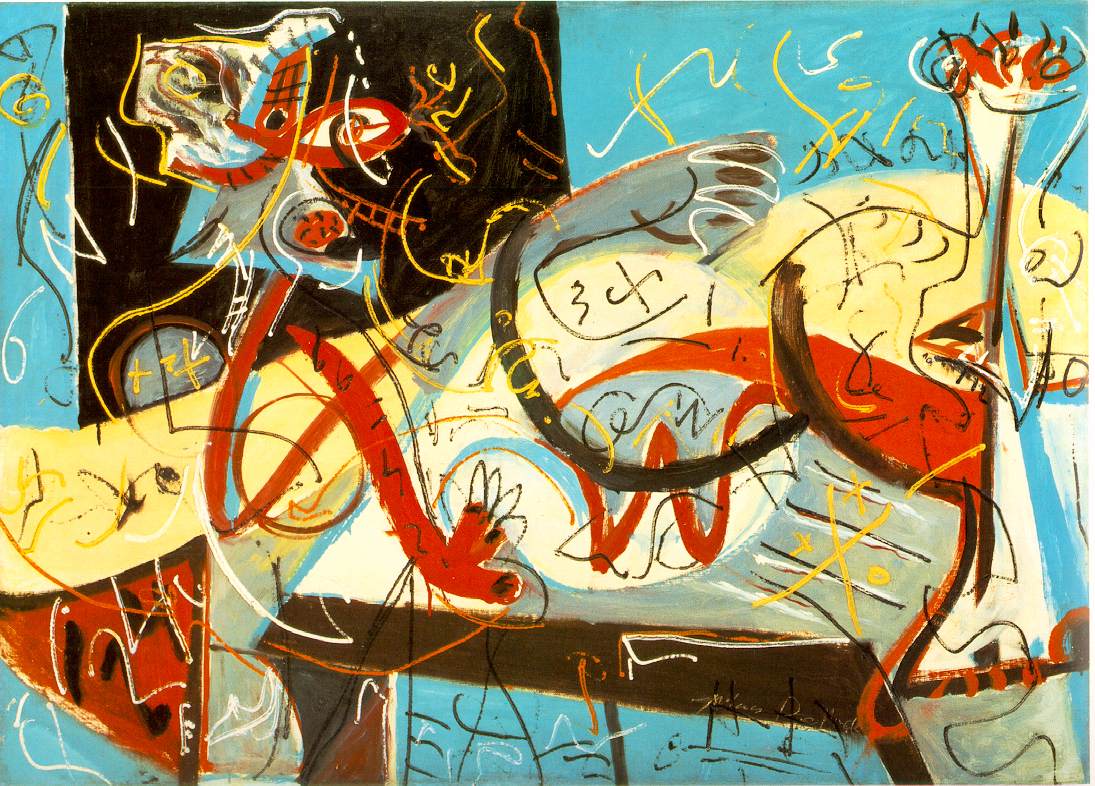
Jackson Pollock's Stenographic is pictured above. People could consider a multitude of meanings for this painting. This ambiguity definitely seems to conflict with the style of American society, which generally prefers subject matter to be explicitly defined in a mainstream way. However, many may support art such as this because it seems to embrace American individualism, and the liberty to enjoy things that do not fit any sort of mold.


The above painting is called Woman, and was created by Willem De Kooning in 1954. Many might find it objectionable because it is indeed a very distorted looking "woman" that is being portrayed, and is outside of the normal archetypes people think of when they think of women. Many others might praise it for that very same reason. As is the case with many of these paintings, the reaction it gets from certain individuals is contingent upon their disposition toward change vs. tradition.


The above painting by Arshile Gorky is titled Composition. It certainly is not reminiscent of classic art, with defined subjects and generally serious tones. In fact, one could certainly argue that, taking the painting and the title into account, it is a very silly painting, and degrades art by not taking itself seriously. Others might, with equal success, argue that art should not be narrowly forced to cover specific emotions, and that the freedom to create legitimate art in this form is very valuable.

Ashley C. Post 5

Ashley Cannaday


Most Americans during the Cold War Era saw American Abstract Expressionist art as completely harmless, whether they liked the style or not. Some argued that Abstract art even promoted American values, as opposed to the belief that it was subversive and Communistic. Abstract Expressionism showed the “American Way” of freedom, creativity, originality, cultural superiority, and anti-totalitarianism. Although some Expressionist artist may have previously had affiliations with socialist organizations, there art could be judged separately from the artist, and this was the ultimate freedom. It reinforces the fact that you don’t have to like or agree with a form of art, but you can fight to defend the artist’s right to create. This is, after all, what America is all about.

Modernism was far from accepted in dictatorial regimes. Hitler labeled this art as degenerate, created by artists who “God has denied the grace of truly artistic talent,” (Hitler Speech Inaugurating the Great Exhibition of German Art, Pg. 2). Abstract Expressionist art and artists in Germany were vehemently persecuted. Ironically, Communist Russia denounced modernist art, and instead promoted social realism. Although it seems odd that on one hand Abstract Expressionism was thought to stand for Communism, and on the other hand, the Communists themselves rejected it, it makes sense when you look at what Communism really stood for. It was dangerous to allow any individual expression, especially abstract expression, as this was the antithesis of Communism. The only acceptable reality was the group or collective. No individual thinking or expression was allowed, as anything else would make the masses think and that was dangerous to Communism. Modernism in America supported the idea that it was the Land of the Free, unlike those nations behind the Iron Curtain.

Modernism promoted the notion that creativity and new ways of thinking not only were accepted in America, but flourished. Abstract Expressionism showed America as culturally superior and artistically up-to-date. During this Cold War Era, many art exhibitions were sent overseas which included modern art. 19 exhibitions were showcased in Latin America, and numerous more were sent around the world, to locations that included London, Paris, Sao Paulo, and Tokyo, all sponsored by the Museum of Modern Art (Abstract Expressionism, Weapon of the Cold War Pg. 149). The aim of these international programs was to show that “America was not the cultural backwater that the Russians… were trying to demonstrate that it was” (Russell Lynes, Weapon of the Cold War Pg. 149). It was used to show that our nation was more culturally sophisticated than Russia. The showcases represented America as the exact opposite of Soviet Russia’s socialist realist narrow, regimented style.

Critics of American Abstract Expressionist art argued that it was dangerous and subversive. Michigan Congressman George Dondero was a very strong opponent of Modernist art during the Cold War. There were three main reasons why people such as Dondero saw this form of art as subversive. The first is the social commentary in the message of some works of modern art. The second was the fact that some Expressionist artists had previous connections with Communist organizations. The last reason was that they saw the art itself as Communist conspiracy (Mathews). It was said to be un-American.

These opponents to modern art objected to their content that sent a message of social past and presents wrongs. For example, Refregier’s murals in the San Fransisco Rincon Post Office depicted the history of California. Some of the scenes included were the California fire and earthquake, Chinese labor, and a strike. Opponents of the murals argued that it emphasized violence, struggle, and controversy, and showed California in a bad light. There seemed to be a theme in many of the works that centered on the worker or proletariat. During the Cold War anything pandering to this was objectionable. The Scudder Resolution to remove the murals argued that they included Communist propaganda (Mathew). A past or even present connection to any organization deemed to be undesirable, such as the Communist Party or any Socialist organizations was excellent ammunition for opponents of Abstract Expressionism. Refregier, as well as many modern artists, was connected to organizations and publications that were listed as subversive. The thought was that if the artist had communist sympathies, his art was bound to portray this. Many argue that all art has an imbedded message, and it is often said that art imitates the artist’s feelings and emotions, so communism would be inherent in the works of artists who supported its ideals. It was also believed that these modernist artworks were subversive because they aided Communism economically. With their works showcased in prestigious museums, Expressionist artists experienced a degree of wealth. This money could be given to Communist organizations (Mathew). The fact that this art was tied to subversive artists and had themes that were socialist in nature led many to believe that this art was Un-American. To critics, Modernist art also represented chaos and rejection of traditional norms. While America relied on certitude and control, abstract art represented a complexity not always understood by the average citizen and was ever-changing. By expressing these un-American values in their art, the artists were obviously promoting their views and beliefs, so it follows that the art itself is a tool of the subversive and therefore is itself subversive.

1) Another Storm by Lee Krasner

Lee Krasner was married to Jackson Pollock, and her abstract artwork has certain similarities to his. When looking at this painting, there is no immediately perceivable subject. The meaning of the painting is open for interpretation and analysis. On one hand, this painting could promote freedom and creativity in America. It would show America has culturally advanced and innovative, and it promotes the freedom of the artist to create works of art that may go against the current norms. It also allows for the viewer to make their own interpretation. On the other hand, Krasner’s painting could be dangerous and subversive. There is an abundance of red in the artwork, a color which is associated with Communism. If one looks closely at the painting, it could be said that it appears to be a mass of writhing people. The critic could surmise that this is an attempt to show the tortured existence of the masses. The ambiguous meaning of the painting could also be dangerous. What does the title, Another Storm, refer to? Could it be a social commentary of some kind? Could it mean that the there will be another uprising of the working class, or is it simply a clash of weather and some sort flora or fauna? Part of the danger inherent in abstract art is that its underlying meaning is not easily determined.

2) Cathedral by Jackson Pollock

Jackson Pollock was perhaps one of the most famous Abstract Expressionist painters of the Cold War era. What isn’t apparent in this picture of the painting is its enormity. It would have easily taken up an entire wall in a museum gallery. The only guess we have as to the subject in the painting is its title: Cathedral. As with the previous Krasner artwork, this painting can be said to represent ingenuity and artistic freedom that define and glorify America. However, from the title it can be said that this artwork deals with religion, or perhaps it is a definition of the enormity of the painting itself. It could also be described as being painted in a very chaotic style, with no apparent rhyme or reason behind it. This could be seen as promoting chaos and going against the traditional order. The message of the painting isn’t clear, and it could lead to the interpretation that Pollock is depicting a negative message about religion. Once again, the danger lies in the various meanings of the painting that can be thought up.

3) Sand Lot Riots Mural by Anton Refregier

Refregier painted this, and many other murals, on the walls of the San Francisco Rincon Post Office Annex. The murals depict the history of California. This in itself is patriotic. The art shows how America has progressed into the nation it is today. It shows all the turbulent events that California managed to overcome and grow from. Refregier’s style of painting is very unique, and for this form of modernist art to be displayed in a public building shows America’s acceptance and praise of new and inventive forms of art. However, it can also be said that these murals are detrimental to America. Many of them depict controversial scenes. This mural depicts the anti-Chinese Sand Lot Riot. Critics would no doubt point out the fact that it shows the Caucasian Americans in a bad light. There are many of them which shows a mob mentality and the painting itself shows the Chinese in a better light, with more definition. The mob has less detail, less humanity, which may be what the artist is trying to portray. It is clearly a look at an ugly time in America and critics could ask why focus on the negative. Another clear them is that of the worker being exploited/violated. This is a central theme of many socialist/communist movements. This could lead to more criticism from those yearning for more “American” art. Many believe that this mural takes away the glory of America, bringing its dark past to light. Critics argued that this mural promoted chaos and violence.

4) Untitled by Mark Rothko

Mark Rothko was known for creating numerous paintings of this same style, with two or three solid colored blocks. As with most abstract art, it promotes the artistic freedom granted in America. This form of art would simply not be accepted in Cold War Russia. However, it could have a subversive meaning. In many of Rothko’s paintings, there is a solid block of red, which is associated with Communism. And once again, danger and subversion can lie in the unknown message of the artwork. The real problem most critic have with anything they are against is they do not understand it. Americans like to understand what they are presented with and when they don’t, some react in a defensive manner. This style of painting completely goes against our preconceived notions of traditional art, and I know many people who would not call these painted blocks art at all. It can be harmful because it can be seen as devaluing American standards of ‘good art’.

5) Vanzetti and Sacco by Ben Shahn

Many of Ben Shahn’s works depicted Vanzetti and Sacco, two Italian-American anarchists who were tried and convicted of murder, and sentenced to death by electrocution. Shahn seemed to sympathize with Sacco and Vanzetti in his artworks. By presenting the two ‘convicts’ in a positive view, this painting represents the idea that opposing views are accepted in America. Thinking outside of the majority is not shunned. On the other hand, this could be seen as pro-anarchist, anti-American propaganda. The critic could muse about why the artist chose these two subject when there are many more appropriately acceptable subjects to broach. Let’s not focus on the negative, think of positive things.

Maxine R. Post 5

Maxine Rivera

It is the American way to stand up for freedom of expression. However, that grants many people the freedom to express that freedom of expression should be limited. Just as Hitler felt that art of the German Expressionist movement was dangerous and corrosive, there were many Americans, such as George Dondero, who felt that American Expressionism was "an instrument of Communism subversion... that blended fact with fantasy." (Matthews, P 155) We have seen that people interpret art in different ways, especially abstract art, however now we will take a look at how different people view the effects of the distribution of that art.


The Cold War was a time of angst and paranoia, while the United States was promoting the appeals of democracy and freedom all around the globe, we were having some trouble putting theory into practice at home. Fear of Communists on the inside led to a modern version of a witch hunt, people who were not perfectly patriotic were hunted down as heretic. It was this fear of the foreign that provoked some more conservative thinkers to speak out against the abstract movement that was Expressionism. Expressionist art tends to distort reality to put a more emotional spin on what the artist is trying to represent. Often, sentiments of chaos and unrest are symbolized by the unclear art. This form of art leaves much open to interpretation, "many artists abdicated responsibility... to the uses to which their artwork was put" (Cockcroft, P 147). While some interpret the art as brilliant, or as expressing their own feelings that they could not articulate themselves, others see a malevolent side to it. Some critics (including politicians and anyone else in a position of power) see stirrings of uprising in expressionism, they see threats to the State. Not only does this kind of "degeneracy" promote civil disobedience among citizens, but if the art is distributed around the world, it gives other people the idea that perhaps our democracy is not the utopia we build it up to be, perhaps there are seeds of discontent in the land of the free just as we all know there were hiding behind the iron curtain. Of course not all abstract art was created to incite revolution, much of it was simply a visual way to voice an opinion about "social injustices" that struck the artist. Yet the vague way in which expressionists chose to convey their message made many people uncomfortable. The ambiguity was not something that already mistrustful people could handle, thus it evoked a reaction of suspicion and often, dislike.

There are, however, two sides to a coin, and for all those condemning abstract art, there were quite a few people fervently promoting it. While those suspicious of subversion looked upon expressionism with a weary eye, others viewed the movement as a beacon of light, shining out for the rest of the world to see. These individuals, such as Alfred H. Barr Jr. did not see expressionist art as an "instrument of Communism" but rather as one of our strongest weapons against it. The imprecise figures in abstract art did not shout "Rebel" they "demonstrated the virtues of 'freedom of expression' in an 'open and free society.'" (Cockcroft, P151) In the eyes of expressionist supporters, abstract art served many beneficial purposes; they believed that supporting expressionism would present America as "culturally up-to-date", "as free as opposed to 'regimented'", provided an opportunity to "influence intellectuals and artists being the 'iron curtain.'" Thus we see once again that it is the ambiguity in this art that allows for such a variety of responses. Surely a realistic painting of a chair would not gain half the attention as an enormous canvas smeared with vibrantly colored lines and seemingly senseless blobs (to Hitler's dismay.) When there is that much room for interpretation there is bound to be conflict between opposing views and therefore conflict as to the merit.


Night


Willem de Kooning


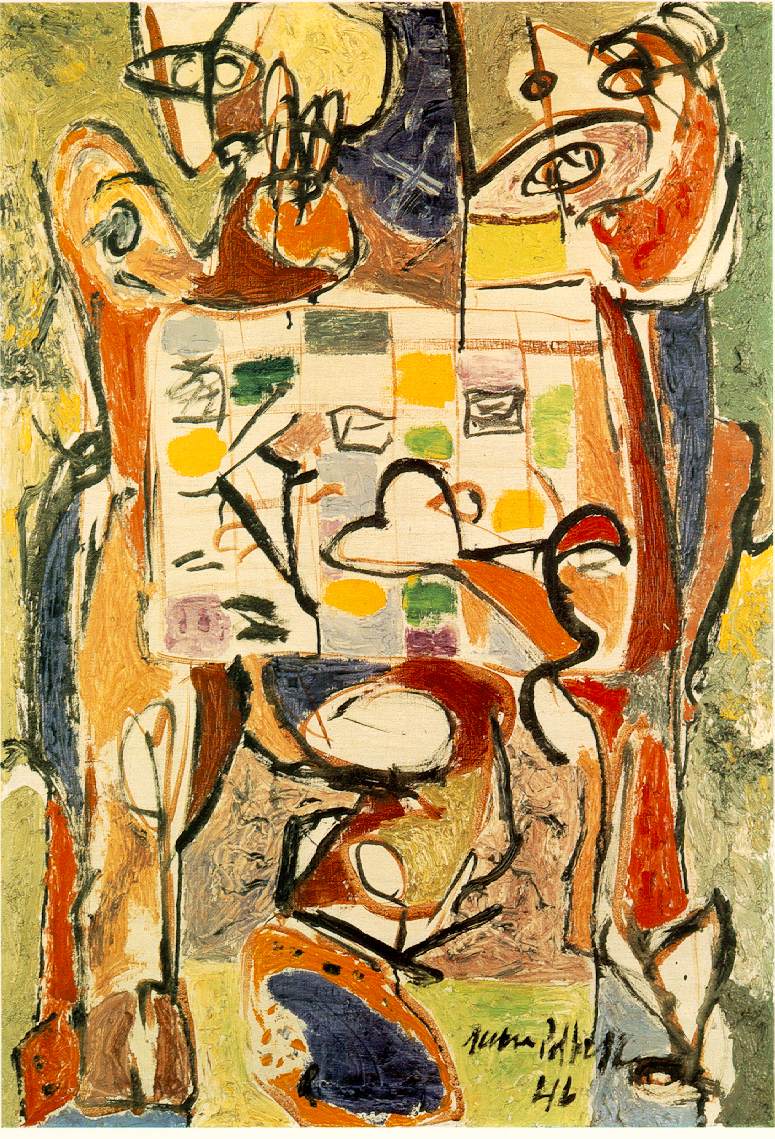
The Tea Cup


Jackson Pollock


Sternographic Figure

Jackson Pollock


The Massacre
Grace Hartigan


Untitled
Franz Kline


In these five works of American, abstract, expressionist art we can better understand each opinion. Willem de Kooning's Night and Grace Hartigan's The Massacre show use dark, steely, colors that slightly depress me. I cannot be sure as to what their original intent was in creating these pieces but when I look at them, I feel a sense of gloom and despair and from de Kooning's piece a hint of frustration. People against the distribution of expressionist art would not want art with this kind of tone representing the American people in foreign markets. They would argue that this does not promote the joyous image we are trying to uphold, they might see this work as subversive because during the Cold War era it was not appropriate to display discontent. On the other hand those who support expressionism might say that these embody our message; it is okay to have emotions, and it is okay to express them, even if they do not support an ideal image.

The works of Jackson Pollock are much more colorful and have more concrete figures, yet they are undoubtedly confusing. It took me a while of examining The Tea Cup to decide that I saw four figures around some sort of table presumably having a tea party (though I still fail to see a tea cup.) In Sternographic Figure I see an ostrich, however it is not built like a natural ostrich, it seems that one of its legs is disconnected. While I am still confused I do not get the feeling of impending doom from these works, they are on the contrary, entertaining. Supporters of expressionism would take pride in the diversity of Pollock's creations, they would want to share with the world the imagination of American artists and how the government attempts to cultivate that imagination with support. People who were anti-abstraction would not appreciate these pieces as they serve to confuse, they also do not seem to make any positive political statement that could serve as propaganda for democracy over seas.

Finally Franz Kline's piece seems to me almost violent. The variety of vibrant, primary colors asymmetrically painted on the canvas comes in sharp contrast with the black lines that harshly create a drippy outline of some shape. While this is a painting I particularly like, I can see how come critics might feel that this is lacking of talent and unfit to represent the American people. The other side would argue that this is the perfect piece to represent the American open mindedness. We allow our citizens to express themselves, no matter how they are feeling. For these people it comes down to promoting the democratic foundation in personal freedom, art that expresses discontent of some kind can be equally effective as art that expresses
patriotism.

Jessica Duran, Post 5

Jessica Duran


From its inception, American Abstract Expressionism art has been both denounced for being a “social hazard” and praised for exemplifying and advocating the very ideals our nation was founded upon (Mathews 161). Unlike the artwork of Norman Rockwell which promoted and idealized wholesome American values or the clearly representational artwork of Andrew Wyeth; American Abstract Expressionist art deviated from formal artistic conventions and American traditions and therefore was branded as being Communistic in nature (Mathews 156). This artwork was also condemned for its lack of concrete subject matter and for portraying a contorted view of reality (Mathews 166). Because of their unrestrained departure from traditional American values and ideals and the unwavering resistance these artists had to conforming to the set standard, many political figures like George Dondero and Richard Nixon adamantly denounced this art movement and its artists and viewed it as a direct threat to all that was American (Mathews 156).

The prominent artists of this era included Jackson Pollock, Mark Rothko, Robert Motherwell, Willem de Kooning, and Franz Kline. Though they all belonged to the same artistic movement, each of these artists was unique in the artistic techniques and mental approaches they utilized in creating and executing their artwork. Their artwork eschewed all forms of traditionailism and challenged the societal and cultural norms of the era. This avant-garde artwork exalted passion of reason, chaos over order, and the individual over community, and for these reasons was viciously attacked and denounced by dictatorial regimes (Mathew 164).

Ironically, it was American Abstract Expressionist art that ultimately designated New York as the epicenter of the art world and would eventually come to embody the American values of freedom and individuality (Cockcroft 168). Though it is nearly impossible to dissect into its individual components, at its most fundamental level, American Abstract Expressionist art is the celebration, exploration, and exaltation of the “inner, subjective, psychological world of self” (Mathews 171).


"Today painters do not have to go to a subject matter outside of themselves. Most modern painters work from a different source. They work from within."
- Jackson Pollock


Jackson Pollock’s famous painting, Autumn Rhythm, is a direct manifestation of what American Abstract Expressionism represented. This painting could be denounced by many for being dangerous and a threat to all social and cultural order and harmony for several reasons. Firstly, it lacks a concrete subject matter and portrays a distorted, chaotic, nonrepresentational depiction of reality; thus failing to provide its audience with any readily identifiable or associable images or depictions (Mathews 168). It does not dictate what the viewer should or should not see, but instead places the responsibility on the viewer and challenges them to interpret the painting through their own eyes. Secondly, since this artwork relies so heavily upon the personal subjective views of the artist; it could be easily misinterpreted or misunderstood. The initial inability to readily comprehend and fully grasp the meaning of this painting could cause individuals to feel intimidated and frustrated and ultimately brand this type of art work as “degenerate” and even elitist (Mathews 171). Finally, this painting does not concretely propagate or glorify American ideals and values, and therefore could be viewed as a Communist conspiracy to eradicate all that is American, and in essence a direct threat to American Democracy (Mathews 162).

On the other hand, this painting can be viewed as the visual personification of artistic freedom and a living testament to the wonder of unrestrained creativity. The inherently defiant nature of the chaotic dance of colors in this painting beckons the viewer’s complete attention. Free from the restraints of technical formality, the intertwining of paint splashes exudes a sense of haphazardness and unpremeditation. It is the viewer’s duty to extrapolate meaning from the ambiguous melding of color, lines, form, and spatial orientation. The viewer is challenged to lose themselves in this massive mural-sized painting; forcing them dive into unmarked territory and ultimately explore the tenebrous labyrinth of their own subconscious (Mathews 170). This painting gracefully epitomizes the ideals of unrestrained self-expression and individuality; two values that are quintessentially American. Pollock’s radically innovative method of painting resulted in the production of artwork that has yet to be rivaled in its uniqueness.

While researching the life and artwork of Jackson Pollock; I stumbled upon the website, www.JacksonPollock.org. This website allows any individuals the opportunity to create Pollock-esque artwork. As I sat at my computer desk creating my own “masterpiece”, a sense of complete liberation washed over me. Creating this type of artwork was in essence pure individualism, a hundred percent unblemished self-expression.


"Every shape becomes an organic entity, inviting the multiplicity of associations inherent in all living things"- Mark Rothko


Mark Rothko’s color field painting, Red, Orange, Tan, and Purple, is an excellent example of artwork that “speaks” to its audience through the use of abstract means. In many ways this painting could be viewed a direct threat to American society. Firstly, it lacks any recognizable representation of American symbols, images, or ideals, and therefore could be considered to be Communist-inspired and an impending danger to our nation (Mathews 171). Secondly, this painting it not easy for individuals to understand or analyze, and therefore could be classified as elitist in nature. Finally, this painting does not clearly represent reality to the viewer, but instead depicts the subjective reality of Mark Rothko. This rebellious act could be viewed by many as both decadent and degenerate (Mathews 171).


On the other hand, this painting celebrates Rothko’s subjective perception of reality and is therefore an ideal representation of pure, untainted artistic self-expression. The dynamic interactions of the solid bands of color engulf the canvas and create a cohesive harmony that subliminally speaks to the viewer. The irregular boundaries of the rectangles express a wild, primitive like quality and the lack of any recognizable subject matter only helps to add to the dimension of the painting. This painting connects the viewer with their inner psyche; promoting deep self reflection and introspection. The viewer is ultimately allowed to extract whatever underlying meaning they wish to subconsciously discover. This is a work of art that glories the inner self and applauds the expression of individual creativity.


"Without ethical consciousness, a painter is only a decorator."
—Robert Motherwell


Robert Motherwell’s painting, Elegy to the Spanish Republic No. 110, is a model example of how American Abstract Expressionist art is an individualistic experience for both the artist and the viewer. Critics could openly denounce this work for the social commentary it makes against war and the horrendous pain and suffering that it brings to all humanity; a main reason many politicians wanted to censor abstract art during the Cold War years (Mathews 156). Though it lacks any discernible subject matter, the use of bulbous, irregular ovals sandwiched tightly between rectangular columns conveys an atmosphere of intense conflict and hostility. The unique spatial arrangement of the ovals also aids in conveying a rebelliously expressive tone to the viewer. I believe the contrasting utilization of black and white paint in this painting may to serve to be a metaphor for the undying struggle between good and. evil, right and. wrong, and the individual against the world. This painting hypnotically entices the viewer and dares them to search the depth of their souls; subconsciously asking the questions that will ultimately lead them to the painting’s innate essence. Eventually, after much introspection and contemplation, the viewer should be able to fuse the abstract images with the deeply embedded concrete meaning of this painting. This painting is not only creative and unique in its design and execution, but is also the visual personification of authentic artistic self-expression and unrestrained freedom; in essence the very type of art that Hitler, Stalin, Dondero, and many other prominent political figures passionately detested and feared (Cockcroft 152).


“An artist is forced by others to paint out of his own free will.”
-Willem de Kooning


Willem de Kooning’s painting, Woman, is an example of American Abstract Expressionism art that uses ambiguous subject matter to convey its meaning. In this painting, Kooning ambiguously represents the female form using his own individualistic perception of what the essence of a woman truly is. This artistic act could be viewed by many as an overt attempt to defy social and political order, and therefore could be classified as a direct attack on American values and principles and ultimately identified with communism (Mathews 162). The manner in which the woman is visually represented could be also be denounced by the viewer as being distorted and degenerate if they are not willing to take the time to fully analyze this painting (Mathews 165). There is a sense of unfinished deliberation and defiance in this work of art. The woman’s breasts are overtly protruding and her arms are defiantly placed on her waist. The voluptuousness of her body is enhanced by the stark black outlines that caress her fluid curves. The bold use of colors and geometric shapes create a wildly, energetic air to the painting. She is a strong, independent, fearless, and confident woman, and she knows it too. This painting attests to the incredible masterpieces that can be produced if artistic ingenuity and intuition are allowed to take their course and be fully expressed.


"The nature of anguish is translated into different forms."
-Franz Kline


Franz Kline’s painting, Painting Number 2, is a dynamic exemplification of how American Abstract Expressionist art can express innate emotions and feelings through the mode of abstract execution. Void of any visibly apparent subject matter, this painting utilizes the contrast of black paint against a stark white canvas to create a dynamic, chaotic atmosphere. The spontaneous, erratically aggressive brush strokes used in this painting also relay to the viewer a sense of internal turmoil and struggle. The chaotic reality portrayed in this painting could be associated by some with the Communist left in its attempt to distort reality and eschew American traditionalism (Mathews 165). The viewer is challenged to try to internalize the chaos presented in this painting and somehow subconsciously apply a unique subjective meaning to it. There is an organic, earthy visual intensity in this painting that inherently attests to Kline’s genuine creativeness and intuitiveness. This painting honors the sacredness of the individual freely expressing his/ her inner self; a concept that we strongly revere and uphold in American society and culture.

Ashley G., Post 5

Ashley Green

Abstract expressionism is likely the most noted artistic movement to be born of the United States during the 1940s and 1950s in New York. The movement highlighted a significant change in American art, and it was the first movement from the United States that influenced other countries, rather than visa versa. Emphasizing broad brushstrokes and strong, dramatic colors, the movement placed a large focus on the emotions being poured into the painting rather than the actual product itself. (WorldWide Art Resources) Because artists within the movement resisted a strong definition of the movement, the assignment of meaning in the artwork resided almost solely on the viewer, creating a broad spectrum of interpretation for the works. Though a broad spectrum for interpretation is available however, there were generally two distinct views for how abstract expressionist art was viewed- it was either heralded as the freest and most democratic of art forms or as the most destructive and manipulative of forms. The central idea behind the latter interpretation is that, “the objection to Modern art [by more conservative parties resides in] the assumption that rejection of traditional ways of seeing form and space inherent in vanguard style of painting implied rejection of traditional world views.” (Mathews 156)

Mathews re-introduced a relevant point that has weaved itself into past discussions; she stated that it was likely that most Americans did not like or understand Modernist art. Though she also stated the most Americans generally had a “take it or leave it” opinion of art, it does stand to reason that censorship of art is easier to accomplish with a public that is either complacent or hostile towards an artistic movement. The idea of fear of the unknown and untraditional appears to have fueled so much of the animosity towards Abstract Expressionist art. In today’s society, we still do have a very powerful fear of the unknown, and use that fear to try to justify current acts of censorship. One must wonder, if we know and can recognize this fallacy, why can we not seem to break this destructive pattern?

A painful correlation is apparent between the treatment of Modern Art in America, in Communist Russia, and in Nazi Germany. To note a previous essayist we discussed in class, George L. Mosse stated that, “Even today, art is condemned if it transgresses the normative morality in too shocking a fashion.” In short, art that is different from what is considered the norm, or traditional, is often the most susceptible to an unfair critique. (Mosse 25) It is somewhat disturbing that the American public supported the ideas on art of George Dondero and Joseph McCarthy so soon after the rule of Hitler, a tyrant who tried to squelch artistic expression using a similar philosophy- out with the new, stick with the old. Furthermore, playing on people’s sense of nationalism was one of the most effective tools in fascist regimes. Yet that is what how many Congressmen justified their crusade against abstract expressionism. They stated that abstract expressionists were a communist tool and that by participating in the movement you were un-American. Using the idea of being un-American or un-patriotic as a justification for censorship is, however, a blatant contradiction.

The discussion of whether or not Romare Bearden was an abstract expressionist is a lengthy and complex one. Bearden experimented in various forms of Modern art, but it is my opinion that his greatest contribution was to the Expressionist movement as a whole. Romare Bearden was an African-American artist who first came to prominence during the tail-end of the Harlem Renaissance. During the 1940s and 1950s, African-American artist faced dual trials in trying to get their work seen. Not only was their work seldom acknowledged or recognized, but it was also often called socialistic because of its supposed social commentary. The painting above, entitled the Prodigal Son, is one of Bearden’s most noted works. I believe anti-Expressionist would take fault in the work for several of reasons. First, despite the fact that it uses a collage technique, the work as a whole does not appear to call on any traditional form. Another problem with the work is that the art forces each viewer to observe and assign meaning based on their own perception of the work. There is no clear definition to what the work may be conveying. Finally, Bearden’s work, in part simply because he was Black, could be considered destructive because it could force the viewer to analyze the roles of Blacks in society. Mathews discusses how there was a general fear that the work of abstract expressionist extended to the broader realms of cultural and social order, threatening ultimately all established norms and values. (Mathews 156) Bearden’s work likely would have been considered a threat to the established norms and values of the time.


Norman Lewis is another influential artist in the Modern art movement, but he also has the clear distinction of being an abstract expressionist. Born and raised in New York City, Lewis also came into prominence during the Harlem Renaissance. In the 1930s, Lewis began to produce abstract works and later joined the Spiral Group, an organization geared to using art as a tool for the Civil Rights movement. The painting above is one of his more famous pieces, called Phantasy. The conflicts anti-Expressionist might have to Lewis’ work are similar to the conflicts held with Bearden’s work. Lewis however held an even greater distinction within the abstract expressionist movement, and therefore was an even greater target for critique. His vivid use of color and seemingly random shapes evoke numerous emotions from a viewer, but what was most striking to me was the pain the work seems to emit. The use of dark colors is what really gives that impression. The ability to evoke such varying emotions in the viewer seemed to be a problem for anti-Expressionist. Though the same stringent route that Hitler took in opposition of Modern art was not taken against Abstract Expressionism, the general idea that it was evil or un-patriotic because of its break from realism was still very much present.


Likely one of the lesser known members of the Expressionist movement was Thelma Johnson Streat. As an African-American female within the movement, her work seems very susceptible to falling into the cracks, which is likely why few critiques against her work were made at the time- no one noticed or cared enough to. Her most famous work, Rabbit Man (above), however is featured in the permanent collection of the Museum of Modern Art. Though lacking some of the basic definers of Abstract Expressionism, the work still leaves a large window to interpret it in many various ways. It is also representative of the movement in Modern art by Black artists to connect on a level with their heritage or “roots.” It is difficult to say how anti-Expressionist would respond to this work. On the one hand, it forces the viewer to take on a personal perception of the work, and relies heavily on emotion. It also does not fall under the vein of “traditional” European/American artwork. The work however, could have been considered positive to some anti-Expressionists at the time because it conformed to a certain ideal of what “Black” art should look like- primitive. Eva Cockcroft stated that the view of art in a certain time deals largely in who is its main viewers and how does it support the ideology of the people in power. The above work would seem to support the ideology of most people of power during the time because of its primitive nature.


In my opinion, African-Americans are not the only under-appreciated members of the Expressionist movement. Artist like Grace Hartigan and Joan Mitchell are often overlooked for their contribution to the movement of Abstract Expressionism. Joan Mitchell and Grace Hartigan were both born in the 1920s and held the distinction of being the generation that succeeded the fore-runners of Abstract Expressionism, Jackson Pollack and Mark Rothko. Both women were also one of a few women who achieved both critical and public success for their work. Both of the works above, Joan Mitchell’s No. 5 and Grace Hartigan’s Incliment Weather, respectively, both embody the spirit and general aesthetic of the movement, and thus would face many of the critique’s by anti-expressionist that I have previously stated. Their works often evoke strong emotions within the viewer and can easily foster the debate over whether or not Abstract Expressionism promotes the truest, freest, and most democratic form of art, or if it is decadent, destructive and manipulative. Today, we generally view abstract art in a positive light and often side with the former view of Abstract Expressionism rather than the latter. Mathews reasons that this is so because in the end, the anti-expressionist crusade was “outmaneuvered by more sophisticated individuals eager to capitalize on the fact that avant-garde art and culture only exist in a society that is liberal-democratic (politically) and bourgeois-capitalist (socio-economically).” (Mathews 167)

Eva Cockcroft stated that a lot to do with the success of an artistic movement resides in the patronage of the movement and the ideological needs of the powerful. (Cockcroft 147) Would the Abstract Expressionist movement have become such a powerful force in the art community if it were not for the George A. Dondero’s and Joseph McCarthy’s of the world? It was their passionate outcries against the movement that even introduced the art to much of America. Without them fighting so fervently against abstract expressionism, it is likely that the movement would have remained mostly relevant to people involved in the art world and mostly irrelevant to the masses who were not. In my opinion, though I think an attack on art is normally painful and destructive, in the end it can have a positive influence on our overall perception of art because it forces us to think and re-establish what our norms are and how we can better function as not just art viewers, but as a society.

All images were found courtesy of Google.

Additional Resources:

http://books.google.com/books?id=2598QQgoRP8C&pg=PA160&lpg=PA160&dq=%22african+american%22+artist+mccarthyism&source=web&ots=Dt2XYjqEYq&sig=MBRA_eeZs4wHK31RhXWXdkrCGSY&hl=en#PPA161,M1

http://americanart.si.edu/1001/2000/03/images/1980.137.32_1b.jpg

http://www.wellesley.edu/WomensReview/archive/2002/11/art204.jpg

http://www.moma.org/images/collection/FullSizes/00293004.jpg

http://wwar.com/masters/movements/abstract_expressionism.html

http://www.groveart.com/shared/views/article.html?from=search&session_search_id=238750267&hitnum=2&section=art.000252

http://www.groveart.com/shared/views/article.html?from=search&session_search_id=238750267&hitnum=2&section=art.000252

http://www.foundationcenter.org/grantmaker/joanmitchellfdn/about.html

http://www.marylandartsource.org/artists/detail_000000124.html

http://www.beardenfoundation.org/artlife/biography/biography.shtml

http://wwar.com/masters/l/lewis-norman.html

Tawny N post 5

Tawny Najjar


Art has always been used as a tool either to define and capture reality, or to twist it and transcend from reality. The American Abstract Expressionism movement took what people knew to be true, and transformed it into something that was unfamiliar, unusual, and distinct. This movement brought about much controversy; in some instances, people saw this form of art as a means of freedom of expression, a break from the regulations and ordinary. Others found the art to be confusing, offensive, and even dangerous. The art work had different implications to people, further severing ties between what is acknowledged, and what is acceptable.

In American Abstract Expressionist art, the artists apply paint rapidly and with force to convey their feelings and emotions. They are ruled by spontaneity, accident, and chance, though they too can have their artwork be highly planned and deliberate. This avant-garde form of art brought about the drip painting, as well as “white writing.” Abstract Expressionism was viewed as rebellious and idiosyncratic, going outside of former categories of styles of art. As Eva Cockcroft stated, the artists “defiantly reject the conventional values of the society which surrounds them” (Abstract Expressionism 153). These abstract expressionists instead turn to “private visions, insights, and most especially the subconscious.” The content “consisted of ambiguous forms with loosely defined, perhaps even subliminal, multivalent associations arrived at not through prior determination but in the actual process of painting” (Mathews 170). An expressionist artist, Jackson Pollock, supports this, stating, “When I am in my painting, I’m not aware of what I am doing…the painting has a life of its own. I try to let it come through" (wikipedia).

There were many who supported this movement, characterizing it as creative, innovative, and artistically free. Abstract Expressionism was a new twist, a rebellion against the ordinary and widely accepted. Certain groups tried to use this artwork to influence and inspire others. MOMA (Museum of Modern Art) was a major supporter of this movement, and had international programs to exhibit Abstract Expressionist art in London, Paris, Sao Paulo, and Tokyo (Cockcroft 149). MOMA was once quoted as the “largest and strangest recruit in Uncle Sam’s defense line-up,” instigating the idea that the Museum could serve as a weapon for national defense to “educate, inspire, and strengthen the hearts and wills of free men in defense of their own freedom” (Cockcroft 148). The CIA also supported the Abstract Expressionist movement, using it to demonstrate the image of the United States as a “free society as opposed to the regimented communist bloc.” The artwork was essential to propaganda movements during the time of the Cold War because it was a contrast to the “regimented, traditional, and narrow nature of socialist realism. It was new, fresh, and creative…it could show the United States as culturally up-to-date” (Cockcroft 150). Many people in the general public supported this movement as well because it deviated from normalcy. Abstract Expressionism made people open their minds to new ideas and concepts; it developed their ability to think outside of the box, and to consider the concept that not everything is what it seems to be. Many of the titles of the artworks either did not explain, or almost contradicted the content of the paintings. Abstract Expressionism focused more on the journey to get to the finished product – the emotional intensity, the relinquishing of one’s power to spontaneity, the battle between the controllable and the uncontrollable – rather than the actual painting. These artists did not always create their paintings with intention, or a message to get across, yet the fact that they were not trying to paint a certain object or idea has a message of its own. The message is about opening one’s mind to the idea that not everything has to be controlled and classified. There is a certain insanity in nature, an irregularity, and to truly understand it, one must also try to let go of reason and cold, hard logic.

However, many people feared and detested this new form of art. This was more of an attack on the world that they knew, rather than an advancement or interesting, new way to experience art. The Abstract Expressionist movement was opposed by people both in the government, as well as the general public. Many people did not want to accept these new pieces as works of art. Before, there had been an ideal work of art, one that was beautiful, deliberate, and easy to interpret. The viewer would be able to look at it and honestly acknowledge that the artist had a great talent, one that the viewer could never replicate. However, as Truman once said about a piece of Expressionist art, “If that’s art, I’m a Hottentot” (Mathews 166). This implies that people thought that this new movement lowered the standards of art. Viewers now had the feeling, “Well, I could do that!” As said in Art and Politics in Cold War America, “these canvases with their static masses of color or tangled surfaces of dripped paint provided no indication of the artist’s talent.” The public also disliked the paintings because there was no longer any easy interpretation. The meaning was no longer black and white. As Mathews stated, it was frustrating to people because their “bafflement reminded them that esthetically they had not yet arrived after all, and might never make it…they were simply unprepared for the sheer effort required in the process of visual analysis” (Mathews 171).

This movement was also considered to be detrimental and dangerous to the government, especially one ruled by totalitarian ideals. “The whole thrust of totalitarian government…is to destroy the boundaries of individual personality” (Cold War Power Point 9/24/07). Abstract Expressionism was viewed as “evidence of domestic subversion” (Mathews 155). Even in a democratic society, the government must keep a firm control over the people, and maintain order. This movement was characterized by complete chaos and freedom. There were no rules, no boundaries. The artists had the power to paint what they wanted, and express whatever emotion ruled them at the time. One man, George Dondero, especially detested Abstract Expressionism. In his mind, “expressionism aims to destroy by aping the primitive and insane. Abstraction aims to destroy by the creation of brainstorms” (Cold War Power Point 9/24/07). Those against this movement were determined to keep American art easily recognized as “American.” They wanted to maintain control by imposing an ideology and esthetic conformity, by having a standardization on what was considered art, and what was considered nonsense. The Expressionist movement defied these social norms, because the very purpose of the art was in fact, to have no purpose, no pre-determined meaning. It gave total control to the artist and to the artist’s emotions. The artists were free to create whatever inspired them.

These five paintings represent the lack of definable meanings. The artists twisted and redefined reality, using colors and brushstrokes that were unfamiliar and unconventional. These five paintings represent the very essence of what a totalitarian government was trying to avoid – a lack of control and order, indecipherable meanings, and unusual use of color. In societies, like the one ruled by Stalin, artists were confined to painting works of art that would be approved by the government, such as paintings of tractors, or of children giving flowers to Stalin. In these Abstract Expressionist paintings, the artists were free to paint what they wanted, and to give their paintings any kind of meaning and interpretation. There is complete and utter chaos, a total lack of order and control. This freedom and chaos would be deemed dangerous to the government.

Abstract Expressionist art was interpreted both as a means of expressing artistic freedom, and as a dangerous weapon against the government, especially a totalitarian government. Instead of trying to capture reality in a clear, discernible way, these artists took what they saw and knew, and turned it into an unrecognizable, seemingly meaningless, chaotic mess of colors, lines, and shapes. While some praised this artwork for being symbolic of freedom and spontaneity, others opposed it, unwilling to accept a change, or to open their minds to different concepts and ideas.

Pieces of Art (going top to bottom, left to right):

1. My Landscape II (by Joan Mitchell)

2. Walking Men Green (by Lester Johnson)

3. Advance on History (by Mark Tobey)

4. Masqued Image (by Jackson Pollock)

5. Fermented Soil (by Hans Hofmann)