Wednesday, September 5, 2007

Ally, Post 2

Ally Best

Some artwork has an incredible ability to evoke passion and strong emotions from viewers. Such pieces of art can sway a person’s opinions and even instill in them a sense of compassion, love, hatred, anger, unrest, or patriotism. One such example is the statue designed after September 11th depicting three men raising the flag at ground zero. This is a very powerful image that has several enormous symbolic values. First of all, the three men working together represents the unity of Americans and the need for the nation to put aside individual differences and act as one. The fact that the statue depicts the men raising the flag at ground zero is also symbolic. Their act is one of rebuilding, or even triumph. The statue seems to be saying, “Even when we get knocked down, we will always rise again.” This image clearly sparks patriotism and, for that reason, I think Plato would approve of the statue. In The Republic, Plato says, “…let us assure our sweet friend and the sister arts of imitation that if she will only prove her title to exist in a well-ordered State we shall be delighted to receive her—we are very conscious of her charms; but we may not on that account betray the truth” (book X). With this comment, Plato is basically acknowledging that imitation (art) can have a very powerful effect and therefore it should be monitored to include only pieces that are truthful and that do not go against the State. The statue of the men at ground zero strengthens the State by uniting the people, while still retaining a relatively accurate depiction of a true event. Thus, the statue seems to fit Plato’s description of “acceptable art.”


Just as some images can bring the people of a nation together and spread patriotism, others can divide the nation and conjure a distrust for government institutions. One such piece of artwork is the controversial sculpture “Loose Lips Sink Ships” by Peter Langenbach, which sparked a huge uproar when it was banned from the California State Fair*. The sculpture illustrates Bill Clinton and Monica Lewinsky in a bathtub together. The sculpture was considered by some to be inappropriate because of its graphic sexual nature. However, I believe Plato’s disapproval would have also been centered around the fact that the sculpture pokes fun at a high-ranking government official and portrays an image the artist has (presumably…) never actually seen. This ridicule creates, for some, a sense of distrust of the government or, at the very least, it seems to enforce the idea that even the president of the United States is far from errorless. Plato’s primary concern would most likely have been that this distrust would spread through the “ignorant masses,” as he describes in The Republic when he says, “…if he is a good artist, he may deceive children or simple persons, when he shows them his picture of a carpenter from a distance, and they will fancy that they are looking at a real carpenter” (book X). In this statement, Plato explains his belief that some people are easily deceived and therefore may take what they see in a work of art to be reality without questioning. The sculpture could have a negative effect on some people’s view of the State so Plato would almost certainly not have approved.

*information about Peter Langenbach statue taken from http://www.your3dsource.com/controversial-artwork.html

Tawny N post 2

Tawny Najjar

Raising the American flag

Years ago, after the disaster of September 11th 2001, a picture was developed that displayed the true nature of the United States of America, Labeled “New York Firefighters Raising the American Flag,” this picture, taken by Thomas E. Franklin, depicts three firefighters raising the American flag on the debris from the fallen World Trade Tower. Since that time, this picture has been used in numerous magazines and newspapers. While this image may evoke many different emotions and interpretations, it was a symbol that was used to help Americans keep going and become stronger and more unified as a country. While September 11th was a tragic event, the weeks that followed showed the strongest sense of unity and collaboration that the United States has seen in many years. People came together to help and support one another, focusing on their neighbor, rather than themselves. Those firefighters in that picture put their lives on the line to help others. That very idea, that concept, is what our country was first founded on. Many men put their lives on the line to fight for an idea: freedom, unity. Our country was built on the backs of common people, not on the rich and powerful. The firefighters in this picture were not of noble decent or of powerful stature, but had humble jobs. The fact that firefighters, average people, were raising the flag, the symbol of our country, states that our country depends on those average people. By raising the flag on the ruins of the fallen building, a building that had previously exuded an aura of power, shows that greatness can only last so long, and many great things must someday come to an end. However, it is what we do with those ruins that determines the future. The flag in the ruble states that even though this tragedy struck hard, this country, this unified group of people, will keep moving on, hoping for the future to bring rewards that will outlast the pain and suffering. This picture, though taken at a time of weakness and sorrow, still shows the power of unity and hope. This piece of art is a photograph, and even though photographs may be doctored and twisted into false realities, they are still initially capturing a real event. The focus of the camera is not on the debris and destruction, but rather on the three firefighters, the true heroes of that day. The flag is fairly small, but the act of raising it in that setting speaks for itself. These firefighters knew what they were fighting for, the ideas that they valued. I believe that Plato would have approved of this photograph as a means of leading our country forward. He spoke very thoroughly of the immortality of the soul, that it is “able to endure every sort of good and every sort of evil.” This picture displays that concept quite clearly. Though the soul can be injured and maimed, no evil deed can totally destroy it. It is like that with the soul of this country. It will be injured, and its strength will be questioned, but whilst the people remain loyal to each other and to the ideal on which this country was built upon, the soul of the country cannot be broken.

We’re Building a New Iraq

This image, a political cartoon, depicts a darker nature of American society. In the cartoon, a man and a woman, both in army gear, are driving a bulldozer, scraping away the debris to clear a path for development and growth. They both have huge, fake smiles of their faces, as they plow on, crushing the debris, which actually turns out to be human corpses. The message that this is sending contradicts the nature of America. The United States has always advocated moving forward and developing new contacts and means of advancement. However, this cartoon shows America progressing, yet not progressing in the way that Americans would want it to be portrayed. In this image, America is moving forward, but it is moving forward by crushing others and demolishing innocent lives, with no regard to the welfare of others. This image leads the viewer to doubt the sincerity and caring nature of this country, as well as to highlight the fact that the development of America may be having an adverse effect on others. However, the man and woman in this cartoon are smiling brightly, as if they do not have a concern or a care in the world. They are not bothered by the fact that they are rolling over dead bodies, for their eyes are only on the benefits to come. They are creating a false sense of security and well-being. However, the viewer may be able to look at this cartoon and decipher it in different ways. Some one who is very much in favor of progress may just focus on the faces of the man and woman, noting how happy they are that they are moving forward. Another may look only at the corpses being pushed away, commenting on how progress can be detrimental to others. Plato spoke of this when he gave the example of the bed. He said, “You may look at a bed from different points of view, obliquely or directly or from any other point of view, and the bed will appear different, but there is no difference in reality” (The Republic Book X). By this, he states that people can try to twist forms of art in ways to support their ideas or statements, but in the end, there is a basic truth, whether people want to see it or not. By creating this political cartoon, the artist was trying to make a statement and display his/her ideas to others. However, Plato spoke about artists and their ability to imitate what they see, yet they lack the knowledge of what it actually is. An artist, he says, “is like a painter who…will make a likeliness of a cobbler though he understands nothing of cobbling; and his picture is good enough to those who know no more than he does, and judge only by colors and figures” (The Republic Book X). The artist of this cartoon created an image that shows America’s progress in a negative light, yet his knowledge of the war in Iraq or the intentions of the American government is probably very limited. The audience to which he is trying to reach, the general public, also has a limited knowledge of what is really going on, so they are easily swayed and manipulated to agree with the artist’s point. I believe that Plato would view this piece of art to have a negative effect on the forward motion of America, because while it shows the progress of America, it highlights the negative results.

Amy I

Amy Iarrobino
Post 2

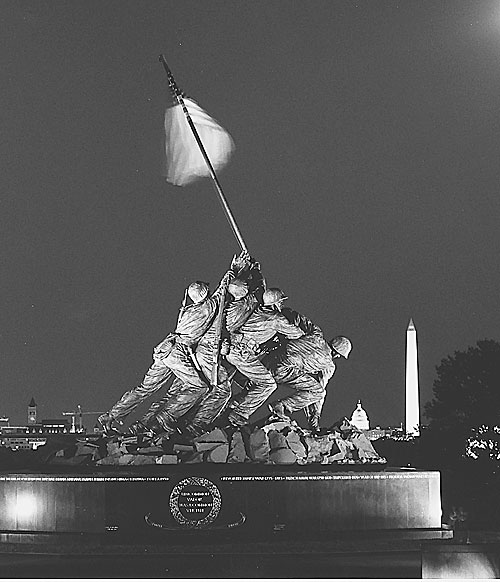
The Iwo Jima memorial serves to commemorate the soldiers who fought in the Battle of Iwo Jima in which 30,000 people lost their lives. It serves as a unifying force, bringing the nation forward by promoting the ideologies of camaraderie and bravery. In fact, the sculpture of the soldiers planting the flag was cast in bronze through donations from the American people. The ability of the statue to draw so much support is a clear indicator of its unifying effect and promotion of U.S. patriotism. Plato would approve of such displays as promoting the nation as he would like to believe that art would have “noble States… appear at her best and truest.” (Book X) In this display, the State indeed appears in a positive light.

A museum in Tampa, Fl featured an exhibit called “Bodies” in which dead bodies were used as artistic medium after being preserved, dissected and posed for the viewing public. Included in the exhibit was a room featuring fetuses at each stage of development. The exhibit caused controversy and disharmony in the community due to its questionable use of the human body. More specifically, the fetus aspect of the exhibit brought attention to the national issue of abortion. In order for such a display to be made, the zygotes and fetuses had to be aborted. Thus, pro-life advocates strongly objected to its display in the museum. However, pro-choice advocates were also fearful of it as those who saw the exhibit often left with anti-abortion feelings. Therefore, the display was kept in a closed-off area with black curtains partitioning it from the rest of the museum. This example proves Plato’s point that interpretation of art as good or bad is “relative to the use for which nature or the artist has intended them.” (Book X) However, the artist is not aware of “what makes a thing good or bad.” (Book X) The artist caused conflicting feelings on both sides of the abortion issue although his purpose was geared towards scientific awareness. The artwork had different effects on viewers depending on the viewer’s opinion on abortion and scientific interest. Due to the many interpretations of the artwork Plato would consider this example as harmful to solidarity.

Ted Henderson post 2 first half

A piece of relatively current artwork that I find to support the idea of the state which we, as a nation, continually move forward towards is the film American Beauty, directed by Sam Mendes. Certainly, upon first glance, this film would appear to in many ways go against many of the qualities which are associated with the pursuit of an ideal state or nation. The film's focal characters involve themselves by choice in the use of illegal drugs, adultery, verbal abuse, physical abuse, extreme arrogance, selfishness, and towards the close of the film, even murder. Why would I choose a movie that seemingly glorifies the people who take part in this type of disorderly and immoral behavior as a piece of artwork that supports an ideal state of being? In order for me to answer this question, I must first make known the fact that the Sam Mendes' American Beauty in no way glorifies the aforementioned actions of its central characters. These immoral thoughts and actions which are depicted in the movie are not, in fact, meant to be seen in a light which deems that acceptable and appropriate, but in fact are used to give the message that such a style of living destroys individuals, families, homes, careers, marriages, friendships, and so much more in the lives of those who act in such ways. The consequences of the wrongdoings which the characters in the movie take part in are plainly shown, and all move toward the central idea by the end of the movie that such a dishonest lifestyle will not provide any sort of happiness in the grand scheme of one's existence. Dishonesty such as a wife having an extra-marital affair. Dishonesty such as a husband with blatant homosexual tendencies ruling his own home with the iron fist of an ultra-conservative blindness so as to try and counter his own guilt caused by his underlying desire for a same-sex relationship. Dishonesty such as a middle aged, married man secretly lusting after the seventeen-year-old friend of his daughter, while repeatedly denying thoughts and desires of such a perverted nature when questioned by his family members. Dishonesty such as a man waking up every day to the very same beat of the very same drum, driving to the job he hates, arguing with the wife he has lost nearly all connection with, and yet continuing on in this existence he so vehemently despises so as to avoid conflict or change, perhaps a true cowardice or sloth on his part. This movie is about honesty to one's self, and honesty between loved ones, and between neighbors, between friends and coworkers. This movie does not glorify the dark, unhappy lives of its main characters which are utterly riddled with secrets and deception, this movie glorifies the breaking free from such a dishonest existence, and the realization that life is simply to damn short to live in fear of change, and in fear of truth. That is why I believe that this film is a work of art that without a doubt encourages a state of mind and lifestyle which promotes a general state of well-being for any who were to subscribe to it. Certainly, the movie American Beauty is not in any way the answer to all questions of morality and how to live happily, but in my opinion, its writer and director certainly had an important moral message to portray through cinema with their work on the film.
I make absolutely no hesitation in assuming that, were I to send American Beauty back to the time of Plato and were he to watch the film, he would find it to be anything but art that supports movement toward an ideal state. I'm quite sure that he would find the many immoral acts and thoughts displayed in the film to be absolutely detrimental to the pursuit of ideals in the actual realm. I also believe that the philosopher would find the use of such exaggerated and dramatized emotions in the writing of the film and subsequent performances of its actors entirely unnecessary. In Book X of The Republic, when speaking of a poet who uses "lamentation" and seeming emotional "impatience" as reactions to painful circumstances in his art, Plato states that:
"...we may fairly take him and place him by the side of the painter, for he is like him in two ways: first, inasmuch as his creations have an inferior degree of truth -in this, I say, he is like him; and he is also like him in being concerned with an inferior part of the soul; and therefore we shall be right in refusing to admit him into a well-ordered State, because he awakens and nourishes and strengthens the feelings and impairs the reason."

Thus, Plato would certainly deem the use of extreme lamentation and lack of control of their emotions that the characters in American Beauty display as unacceptable to be shown in a "well-ordered State". I must admit that, in this particular instance, I completely disagree with Plato. Even if it is true that this type of overly-emotional reaction to painful life circumstances is not what we as human beings should strive for in our own behavior, it is something that every single person since the beginning of mankind has stooped to many times over in his or her lifetime. Not any one of us reaches the "ideal realm" in our behavior, and for the love of God, I'm quite certain even the beloved Plato himself at one point or another reacted emotionally to an unpleasant event or circumstance that affected his life and comfort. Thus, I believe, there is absolutely no need to try and ignore these reactions in the art that we create, and in fact, such display of human imperfection can, as I believe it is in American Beauty, be used to teach a moral lesson to the viewer, and can therefore be a very effective tool for an artist.

Tuesday, September 4, 2007

Amanda D. Post #2

Amanda Dhillon

http://rache-engel.deviantart.com/art/god-b-lessamerica-41869712

There is an interesting image entitled .god.b.lessamerica. that I found on DeviantArt that, in my opinion, represents the type of artwork that will hinder any progress in moving the nation forward. Personally, I feel like the provocative components of the image and their connotations of the country’s lack of intellect and backward actions that will eventually lead to its demise are enough to cause a sense of failure in the nation and, at least to me, a sense of irritation toward its people’s and government’s actions/ governing behaviors. The representation of the “cross” scale and the heaviness of the bible in comparison to the human brain is agitating, implying that the people of this nation do not think with their minds but rather with their religion, and when this happens, the lack of innovation and ability to solve national problems stops the state from being led forward. I feel that Plato would agree that this image will indeed hinder any forward progress primarily because an image, based on the Republic: Book X, seems to only be an “imitation” of the truth , and according to Plato, “imitation … [has] no true or healthy aim” (Plato Republic Book X). This statement in itself assumes that most images are predisposed to stop any forward progress of a state through misleading its people. This is especially the case when the people only know what is shown to them and “judge only by colors and figures,” making themselves as “ignorant” as the painter him or herself, who creates his or her imitation in a state far removed from any “reality” (Plato Republic Book X). Based on this belief, artwork like this is mis-informative at best, but people do not know any better and take it for truth as it stands. This type of uninformed and misled mindset can pose quite a threat to the progress of a nation when it evokes an irrational, emotional reaction in the people, especially over something that shows no real truth, and the people act in accordance with those feelings. This is especially troublesome to a state if the imitation that is the image is actually made as an imitation of “the actions of men” (Plato Republic Book X). Some may take offense to this “accusation” made by the piece and subsequentially disharmony will trickle out among the people, particularly if there are those who act on their strong feelings for one side of the conflict or another. In this image, the “backward” actions of the government shown through the upside down flag (probably concerning war, as the flag is mounted on a gun) can strike the emotions of many people to either agree or disagree with the artist’s opinion. This difference of opinion, when coupled with strong feelings for each side of the matter, instantly causes disharmony and provides great potential for open conflict. As Plato states in the Republic: Book X, artwork such as this emotionally-charged piece does not do any positive service to “a well-ordered State, because it awakens and nourishes and strengthens the feelings and impairs the reason” (Plato Republic Book X). The “[indulgence of] the irrational nature” (Plato Republic Book X) and consequential conflict and discord among the people of the state is not the type of attitude or quality which leads a nation forward, but rather holds it back.

http://www.kinkadecapitola.com/Heading%20Home1.jpg

This image, Heading Home by Thomas Kinkade, can be considered artwork that leads the nation forward. It inspires what Plato himself would seem consider “good” virtues for the people of a state to possess, including perseverance and unity. It is true that the painting does create somewhat of an emotional response, but in my opinion, it is hardly anything in comparison to the feelings evoked by the previous image, and as far as I know, there is no art that does not brush the emotional part of the soul. Based on this, Plato seems to conclude that almost no artwork could ever truly be a positive force for a state, as it “feeds and waters the passions instead of drying them up,” (Plato Republic Book X) but this painting comes close to being something that would inspire virtuosity as it appears to do (in my opinion) that which Plato feels is acceptable for art of the state. In a way, the painting does sing “hymns to the gods”(Plato Republic Book X) with the rays of sunlight, which often represent something holy or divine, acting here as thanksgiving to God for bringing the soldier home safely (though some may argue that it is irrational to believe in a God or gods, and therefore Plato himself does not use reason). Additionally, it “praises . . . famous men” (Plato Republic Book X) in some manner by portraying the returning man as a sort of war hero. He survived the battle and now represents hope for the war to end soon while the flags on his bag and jacket, bright and whole, present the viewers with a sense of patriotism and unity within their nation, which is usually a formula for progress and success. Surely Plato could see how this type of positive image displays good virtues and therefore “ought to be admitted into [the] State” (Plato Republic Book X) and how it does not do anything to tarnish reason and law, but rather gives people the hope to continue to lead the nation forward using such reason and law so that more soldiers can come home safely.


Friday, August 31, 2007

Post 2 ASSIGNMENT

Blog Critical Reflection #2
Plato (and Ancient thinkers generally) understood the arts to have tremendous power, insofar as they depict some reality or can create a new one. To keep a fledgling state safe, Plato reasoned, this power of the arts should be marshaled and used for the good of the state—to empower the state and lead it on a prosperous path, toward unity and glorification rather than toward disharmony and conflict. Identify (1) some current artwork that you (or others) suggest leads the state or nation forward, and (2) some other example that you (or others) argue does the opposite. Give what you think would be Plato’s view on these examples, drawing on relevant passages in his texts (and, if you want, points made in class discussion).

DIRECTIONS:
TITLE: your name, post 2 (ex: Joe K., post 2)
FIRST ITEM IN YOUR TEXT: your full name
LABEL: post 2

Thursday, August 30, 2007

Laura post 1

Part I


Image 1) Pellegrino Sparkling Water


http://www.mintat.co.uk/images/jobs/SPell-water.jpg

This S.Pellegrino ad consists of five different manners in which the sparkling water is packaged. I see the company as hoping to show consumers how versatile they can make their product in the way it is contained. The first and fifth S.Pellegrino images could be closely compared to alcoholic beverages, such as wine and beer. It could be assumed that S.Pellegrino is trying to market to the higher class constituency who enjoy such beverages and appreciate the foreign European appearance. The S. Pellegrino Company is trying to market its sparkling mineral water so that customers will recognize its Italian origins and to many Americans, European products are attractive to us because they seem to be of higher quality and are generally different than what we are used to.

Image 2) American History X movie cover


http://www.impawards.com/1998/posters/american_history_x.jpg

My second image displays the cover of the movie American History X with its main character, Derek Vinyard, played by Edward Norton. He has his right hand over his heart, assuming the pledging position accompanied by his furrowed brow and scowled face. What is more apparent though, is the large swastika tattooed on his left breast, externally over his heart. We also catch glimpses of his other tattoos on his arms and soldiers. Norton’s shaved head may also lead others to assume that he is a member of the subculture known as the Skinheads who share in ideologies that embrace racism and violence. His appearance leads us to believe that his character encompasses these kinds of racist and violent principles and that the movie will consist of him rebelling against society and playing the villain figure. However, the movie demonstrates his ability to change and the struggle he has with his younger brother and fellow Skinhead members once he is released out of jail with extreme alterations made in his social and political positions. I believe this particular movie’s distributor is taking a chance in acquiring its maximum profit in sales from the general public. Most may assume it says nothing beyond anything racist or projects nothing beyond violence based on the cover, therefore many people would not purchase it. Only those who are attracted simply by the appearance of Edward Norton’s character and their assumptions of his beliefs or those who see a deeper meaning behind what is initially portrayed will desire to purchase the film.

Image 3) Thread for Thought tee on model

http://www.urbanoutfitters.com/urban/catalog/productdetail.jsp?_dyncharset=ISO-8859-1&_dynSessConf=-5128165047196212904&itemdescription=true&itemCount=-1&id=13482096&parentid=W_APP_TEES&sortProperties=%2Bproduct.marketingPriority%2C-product.startDate&navCount=4&_D%3AnavCount=+&navAction=poppush&color=&_DARGS=%2Furban%2Fcatalog%2Fcommon%2Fitemlink.jsp

(2nd link) http://www.synaptic.bc.ca/gallery/BombingForPeace.htm

This Thread for Thought tee shirt displays the quote, “Bombing for Peace is Like F*cking for Virginity”. Many consumers of Thread for Thought tees will also know that this company donates some of its profits to various charities and makes their clothing articles out of organic cotton. Many may find this shirt’s message to be too outspoken or detrimental to morality for its obscenely humorous message. The majority of people would assume that the individual who wears this shirt associates themselves with the anti-war, anti-Bush, and liberal democratic political side. While this would most likely be the case, some consumers of this product may simply appreciate its wittiness as a statement since virginity cannot be maintained through fornication, just as peace doesn’t seem like a goal that can be achieved through violent acts, such as bombing. The second site link provided shows the same statement on a sign in a pro-peace rally during the Vietnam War period in the 1960’s. This shows the versatility of the statement and how it is still used today in comparing Vietnam and the War against Terrorism.
The shirt is also worn by an attractive model whose defiant and independent gaze to the left lead the consumer to believe that by wearing this item, you too can be more independent and display your opinion about political issues or against the contrary statement of “bombing for peace”.
Semiotic Analysis

The message displayed across the front of the shirt, bold print, and use of suggestive language – signifier

The model’s capability of wearing the shirt that demonstrates the importance of taking a stand confidently and displaying a message that may not be fully accepted by society, no matter where the consumer’s intentions may lie – signified
The total image of the model and the shirt leads consumers to believe that they too can be an activist for the statement and promote the contradictory statement of “bombing for peace” by comparing it to fornicating in order to achieve or maintain virginity. The overall declaration is to promote an active and young feminine society that can seize self-belief.

Semiotic Analysis

Image 4) Rage Against the Machine CD


http://i142.photobucket.com/albums/r113/laurac423/rcc003.jpg

Music is a very important means of media in our society and many musicians and bands focus a lot of their music towards speaking out about their country and government. Rage Against the Machine uses this image of Thich Quang Duc as the cover of their 1992 self entitled album. This scene shows the Buddhist monk, Duc, setting himself aflame in order to protest his South Vietnamese government’s persecution of his religion of Buddhism. This CD is a great representation of the true nature of Rage Against the Machine’s music and its purpose. Just as Duc took a stand against his government, RATM provides a radical message in their music and are public activists. You can see from the Parental Advisory sticker assigned and also from the band’s name that they provide politically charged lyrics that aren’t intended for any particular sort of easy listening, but rather to ignite, as the cover shows, some sort of passion within its listeners to fight apathy, become informed, and take action. This band is trying to appeal to consumers who wish to listen to music that possesses evocative lyrics and those who want to be inspired by what plays in their headphones.

Image 5) Scion xD advertisement


http://i142.photobucket.com/albums/r113/laurac423/rcc001.jpg

This 3d poster displayed in my room was recently taken from and alternative music magazine that was advertising the 2008 Scion xD. You can see that the ad contains the quote, “Fall with the Herd”, which can be representative of why you should invest in the new Scion vehicle. You see the majority of the figures in the ad are sheep like people who are all stumbling over the monster character’s rope set out to trip them. This ad, due to its appearance and origin of the alternative magazine, will appear to the younger generation who may be investing in a vehicle in the near future. The Scion xD according to its own website offers particular specs that would appeal to the younger constituency and costs only around $16,000. I think the ad does indeed engage younger viewers who may be trying to stray away from normalcy and stand defiant apart from “the herd”. This ad implies that by being independent you will not “fall with the herd”. This indeed may be true because this is a reasonably priced vehicle that has an efficient gas mileage packaged in an alternative looking car that most teenagers and young adults are looking for.
Semiotic Analysis
The monsters tripping the sheep as the entire image – signifier
“Fall with the herd” message demonstrated by the image – signified
The sign is the collective promotion that by purchasing the Scion xD you will stand independent and therefore make the successful choice, while watching all the others choose the lesser alternative which will serve them less efficiently.

High vs. Low Art

Low


(Hard to see – the bottom left corner displays: “Best Before End Of/The/World”)

http://s142.photobucket.com/albums/r113/laurac423/?action=view&current=rcc002.jpg

(2nd link) http://www.linkvending.co.uk/Images%20NaturalFoods%20Snacks/SunmaidRaisins.jpg

(Please ignore me in this pictureJ)
I walked by this poster attached to a phone booth every day while I was in London, UK this summer and appreciated its transformation of the Sunmaid Raisins symbol into an artistic political statement. I noticed the basket of grenades the woman in the gas mask is holding as planes are dropping bombs in the background as to show the end of the world approaching. This inventive means of art demonstrates the somewhat satirical message that Air Raid Sirens would best serve the public before the end of the world, but would probably not really be as effective as hoped to be. By viewing the 2nd link posted above you can read even more into the image by comparing it to what it was initially based off of. This work is representative of “low art”only because of its lack of aesthetics in regards to those innovative of high art and its pop culture art classification.

High


http://www.if-art.com/spic/sdali/sdali43.jpg

The Average Bureaucrat by the Surrealist, Salvador Dali shows the innovative techniques the artist possessed during his time and more importantly his ideologies. He spoke out against the bureaucrats of his time and made clear his opinions about them. The painting can be interpreted as the mustached man is representative of the bureaucrat of his time and the two holes in his head are left to collect dust and shells, where his brain should be. Dali portrays the bureaucrat as lacking any intelligence or depth of thought and therefore stands out during his time because of his confidence in speaking out about political issues. His technique and connotative meaning of this artwork lead to this painting being classified as “high art”.

Part II

Mass media can serve both a democratic and oppressive function in our society today. We see that it can do both in particular by considering news broadcasting and when it first began to publicize the Vietnam War and the media’s continuing to publicize the wars and violence in years following. It had the positive effect of showing people what was really going on thousands of miles away to American soldiers and changed many people’s perspective on the idea of war. Due to its initial publication, many made public their aversion towards war and demonstrated against it. Today, however, the media and government has turned this tool around to serve a more negative purpose in some cases by twisting actual events around through various video and image editing, and therefore the truth is not always apparent.