Wednesday, September 26, 2007

e tibbetts post 5

Erica Tibbetts
Abstract Expressionism, social realism, surrealism, modern art; all of these genres have a few things in common. For one, none of them attempts to capture reality exactly as the eye sees it. All of these forms of art try to convey some sort of emotion or message along with the scene, not just a pure representation of the subject matter. This is not to say that there is any undue bias towards on interpretation of the work or another, but there is usually some way of reading each painting other than the literal. This could mean that the works of art also have an undue sense of politics and/or that each painting is trying to do something other than “be art”. This last possibility is what makes non-realistic art so problematic. Either side of the political spectrum can claim that the art pertains to their message or can claim that the art is “degenerate”, unpatriotic or subversive. These are all possible because the message is not clear. If art is literal it can be understood more easily, not to say that realistic art cannot have deeper meaning, but it is often easier to read realistic art and easier to give it an everyday, mundane sort of meaning, whereas non-realistic art usually takes on some sort of political message.
The two camps that wrestled over the meaning of abstract art were the CIA, the Museum of Modern Art, the USIAA, and the artists themselves against the Conservative, right wing politicians and art critics. The former saw abstract art as a slap in the face of the Totalitarian, communistic regimes that required strict realism and literalism in the work of their artists, theysaw Abstract Expressionism as a waving the flag of artistic freedom and liberalism. Meanwhile the latter considered abstract art a homage to the communist organizations which some of the artists belonged to and which some of the subject matter “seemed” to pertain to, and they saw the rejection of traditional esthetics as a rejection of traditional American values.
On the liberal side of things, Eva Cockroft mentions the “similarity between “American Cold war rhetoric” and the way many Abstract Expressionists phrased their existentialist-individualist credos.” (Cockroft) The abstract expressionists were looking for a way to be independent, unhindered by the restraints of realism or of politics. Cockroft says of A.E., “It was the perfect contrast to the ‘regimented, traditional, and narrow’ nature of socialist realism. It was new, fresh and creative, “artistically avant-garde and original.” (Corckroft) These qualities, this ability to create without restriction, and steer away from the realism that was mandated by Hitler or Stalin gave abstract art a very powerful ability to display the freedom of America. The MOMA capitalized on these qualities when they sent exhibition abroad to show the world how free and creative American art was. Crockroft says, “CIA and MOMA could provide the well-funded and more persuasive arguments and exhibits needed to sell the rest of the world on the benefits of life and art under capitalism.” (Crockroft) Clearly, to these organizations, Abstract Art was the answer, not the problem, due to its freedom of form, content and style. Yet this very freedom was what made some people so uncomfortable. A collection of work portraying sporting events was cancelled “because the patriotic Council had objected to the exhibition on the grounds that four of the artists included had once belonged to communist-front groups” (Crockroft). This example demonstrates one of the problems that conservatives had with art of the period. They thought that if any artist was connected to any sort of left wing or communist group then that person was a danger to the country. Matthews explains the fear that, “exhibitions in a leading museum gave the artists standing that could be translated into monetary terms. And money, of course, could be contributed to Communist causes that in turn would harm America” (Matthews). Apart from having problems with organizations the artists were in, Dondero and other right-wingers also had trouble with the subject matter. They saw any content depicting racial strife, worker strikes, past conflicts, and any sort of discontent as “disloyal” or “subversive”. In a way, they were advocating a sort of unquestioned patriotism. This element is not necessarily unique to Abstract Expressionism. Realism could easily be as critical of American culture as Abstract Expressionism, but the latter chose to be when the former tended not to.
The third element of A.E. that certain people objected to was the very subjectivity of the form, “the assumption was that rejection of traditional ways of seeing form and space inherent in vanguard style of painting implied rejection of traditional world views.” (Matthews). To conservatives, a movement away from controlled structure, form, content, etc was a movement away from capitalism, democracy, and other things American. Thus, abstract expressionism was a movement that embraced chaos, anarchy, and communism, simply because it did not use a traditional set of esthetics, and as Matthews points out, “politics not only became esthetics but esthetics became politics.” (Matthews) So, anything with differing esthetics ideals was deemed to have different political ideas, and was thus, subversive.
So, Abstract Expressionism, due to its very desire (in some cases) to avoid overtly realistic, political, and literate meanings became ammunition for liberals trying to fight against communist and totalitarian regimes and became the very epitome of communism against which to fight, for the conservatives. It was simultaneously the a beacon of freedom and the enemy.
In the following 5 paintings I will look at elements that could allow the works to be interpreted as either liberal examples of the freedom of art in the US, or examples of communistic art.


. This piece is called “Homeless”. Completed in 1938 by William Gropper, this piece is more realistic and easily interpreted than most abstract expressionism, however it fits some of the criteria that caused the conservatives alarm. The subject matter here is 4 homeless men wandering the countryside, and the piece is a perfect of example of social realism. Gropper is depicting the strife and struggle of Americans during the 20th century. This subject matter was considered disloyal and unpatriotic by the conservatives, who thought that such a scene would evoke anger and unrest in people who saw it. However, to the liberals, the fact that such a piece could even be produced is a testament to the fact that America was a free country where artists had the ability and the right to create art however they saw fit. The fact that artists were allowed to comment on homelessness and other social problems shows that censorship was not as big a problem in America as in Russia or Germany. The very existence of the piece is a blow against such totalitarian ideals.

Martial Memory, by Philip Guston, (1941) is another example of social realism. In this scene a group of boys stands around what looks like a trash heap. They are wearing paper bags over their heads, they carry sticks and trash can lids as weapons and shields, they are barefoot, and one has no shirt. Any clothes they do possess seem tattered and dirty. The buildings surrounding the boys look like tenements or lower class housing; they are al the same and have dark unadorned windows set in boring brick. The sky in the very back is grey and smoky. The scene in general is dismal and depressing and the boys look violent and neglected. Like Homeless, this piece comments on a social problem. The boys should be at home or be with an older person, yet they are allowed to wander the streets and seem set for a life of crime and violence. This could again, be seen as disloyal and unpatriotic, or merely as an example of freedom, depending on who is analyzing the piece.


This piece, 1951-N, by Clyfford Still (1951) is very subjective with no recognizable subject matter. Although, to me, the piece is aesthetically pleasing, it doesn’t depict anything recogniazable. The red streak could be a crack, the background could be wood of some sort, or earth. The colors are natural and seem to fit together, while the red streak adds interest, variety and a focal point. The slight yellow at the top also draws the viewer’s eye, but it is not overwhelming. The irregularity of the whole thing holds the viewer’s attention and makes it very visually interesting. However, the lack of recognizable subject matter would cause conservatives to say that this piece “rejected conventional norms and traditions of art” and thus probably rejected traditional American ideas of acceptable behavior and politics. This piece would not have been allowed in Hitler’s Germany or Stalin’s Russia, and so too, if they had had their way, in the conservative’s America.

This piece, Light in August, by Willem de Kooning (1946) follows some of the same criteria as does the previous work. It is almost entirely lacking in recognizable subject matter. However, like much of de Kooning’s work there are elements of it that look like objects. In the bottom right hand corner there are two shapes that look like wings or a pair of swinging door. There are circular elements, things that could be bugs, nails, crescent shapes, etc. The whole piece is a jumble of layers, textures and different weights of lines and forms. Although nothing is entirely evident and recognizable, the fact that certain shapes could be read as objects keeps the viewer’s attention. This, like the previous piece embodies a break from the norms of artistic esthetics and again would be objected to due to this break from the norm. Also, like many other artists, de Kooning could have had ties to Communist organizations or left wing organizations, in which case the Conservatives would have complained that any support of this piece was funding leftist causes.


The final painting I chose is Pagan Void, by Barnett Newman (1946). This piece could be seen as threatening for a number of reasons. The colors are threatening, the title is threatening, the vaguely implied subject matter is threatening. Or, at least, all of these elements could be construed as threatening. Paganism, a rejection of the Christian religion, would seem very dangerous to Cold War Americans looking to preserve their way of life and their values. Thus, the title alone, even if it does not condone paganism, would scare many conservatives. The red in the middle of the black circle, which looks like an eyeball, could also be seen as a sinister element. The blue elements look like “degenerative” creatures or molecules and the shape of the lighter blue/green blob also looks organic (indeed, the whole thing could be some sort of cell with a nucleus and mitochondria). This sort of micro made macro look may be visually disturbing and definitely is a rejection of the accepted norms of painting. The red in the bottom left corner of the “blob” also contrasts highly with the other colors and is visually jarring. All in all, this piece displays many formal characteristics that could be seen as threatening to the American idea of esthetics and American values concerning religion, science, politics, etc.

So, these 5 works all contain elements that would lead to objections from the Conservative right, but they all could also be used by the liberal left to show how free American art is and how liberal the American government is in allowing this art to be exhibited, produced, and purchased.

Amy I, post 5

Amy Iarrobino

Post 5

When referring to the varied responses to the expressionist modern art, one may agree that most controversy occurred due to political ideologies and even Cold War hysteria. In America all, opinion-lenders had one thing in common, support for their nation.

Those in favor of removal of the American expressionist art argued that “modern art was part of the Communist conspiracy” (Mathews, 162). At a time in United States history known as the Red Scare, anti-Communist feelings ran rampant, allowing such radicals as Joseph McCarthy to take control of the Senate. In such a setting rose the groups that saw vanguard art as a form that promoted chaos and “the demonic that they so easily identified with communism” (Mathews, 162). When fearful Americans saw that non-logical abstract works were being considered art and being sold for large sums of money, they thought to themselves “What next? What is our world coming to?” and thus became even more fearful of change and anything unprecedented in society. Of those against the display of American modern art, the Representative of Michigan, Dondero, was quite outspoken. Dondero demonstrates the zeal of the opponents to modern art who considered such art as a destructive force. He stated in August 1946 that “Modern art is shackled to communism” (Cold War Power Point, 9/24/07). Dondero continued by stating that “Abstraction aims to destroy by the creation of brainstorms” (Cold War Power Point, 9/24/07). Ironically, these super-patriot opponents believed in freedom and independence as a basic principle of the United States, but were against free thoughts that did not coincide with their own. Opponents argued that the art promoted communism as some were the works of communist/Marxist artists despite the fact that “Artists… retained little or no control over the disposition of their works [and] generally refused to recognize or accept their role as producers of a cultural economy” (Cockcroft, 147). In other words, the artists did not force any particular political opinion on the viewer but rather expressed their view of reality then let the viewer interpret.

To supporters of abstract expressionism, the art represented complete individuality and autonomy, a shift in power from the government and public to the artist. In other words, the art represented the “power to the people.” Those who supported the display of the modern art focused on its representation of freedom in direct opposition to the Soviet Union where “artists were judged on their political views” (Mathews, 158). Thus, they argued that the United States should allow and present such art to indicate the nation’s stark contrast to the USSR and promote the U.S. as a place of freedom. The actions of MOMA support such a claim. MOMA was a “key institution in the cold war” (Cockcroft, 149) whose mission was “to let it be known especially in Europe that America was not the cultural backwater that the Russians, during the tense period called “the cold war,” were trying to demonstrate that it was.” (Cockcroft, 149). A supporter of abstract art, Howard Devree, “noted a dangerous parallel between the practices of totalitarian regimes under Hitler and Stalin and the current attacks on vanguard art as ‘degenerate’ stuff deserving suppression and censorship” (Mathews, 164). It seems that the main idea in support of the abstract art was not necessarily the message that each individual work embodied but rather the implications of presenting such art to the world saying “The United States is not oppressive like the evil Communists and Fascists.” Ironically, it is on the same motive that Hitler presented the degenerate art exhibit to show how much better his Germany was as opposed to the chaotic and destructive world of the degenerate art.

As with the paintings below, the main arguments of those that would oppose these images is that the artwork does not display reality, defy artistic standards and promote chaos. Thus, these images represent the social breakdown and by the same token “degenerate” artwork. On the other hand, advocates such as the CIA would argue that the works are based on personal expression and as Americans these artists have the right to have freedom of expression and portray their views of the world and individuality.

These paintings defy the norm of realistic art and are the complete opposite of the forced paintings of Stalin with idealized images of roses or tractors. Rather, in these images it is difficult to pinpoint exactly what they represent upon initial inspection, especially of the middle three works. Unlike mimesis, these abstract expressionist works often feature ideas and images that the artists simply make up. Often times, as with the drawing of the red square, if the image had no label or title, there would be no direction as to how to interpret the works or where to begin looking. However, perhaps that is the point. When the title says one thing and the image another, it questions everyone’s view of reality.

Dwarf
Baziotes, William

Franz Kline's Painting Number 2, 1954

Clyfford Still, 1957-D No. 1, 1957

Barnett Newman, Onement 1, 1948

Adolph Gottlieb, "Man Looking at Woman", oil on canvas, 1949

Ted Henderson Post 5

As Abstract Expressionism was becoming an exceedingly popular form of art in America, a considerably heated debate surfaced concerning the distribution and public display of this art in nations around the globe. On one side of this ongoing argument the belief was asserted that to exhibit the work of this newfound American style of art on a worldwide basis was an effective way to exemplify the artistic freedom and inventiveness that was allowed by and encouraged in the United States. The opposing group in the debate found American Abstract Expressionist art to be vulgar and self-indulgent of the artist, and in fact questioned whether the movement should have even been considered a form of art at all, therefore maintaining that to parade the work of American Abstract Expressionists ‘round the world would give a false representation of American artwork. The reasons for why this type of art could have and did create such a controversy in America during its heyday are complexly rooted within the political goings-on of the time (i.e. The Cold War with Soviet Russia, McCarthyism, just to name a few), and in fact, contain seeming inconsistencies and ironies within themselves.

It has been common throughout history for artists of any kind to desire, work towards, and display artistic and visionary freedom through their work. Certainly, American Abstract Expressionist Art was a movement that displayed much expressive and stylistic freedom on the artist’s part, in most cases the paintings themselves being of nondescript, unrecognizable shapes and forms. American Abstract Expressionism was by all means a very avant-garde form of art, and thus an instant favorite of those artists, museums, patrons, and art fans who shared this vehement belief in the ability of and opportunity for an artist to freely express whatever he or she envisioned. It is of no surprise, then, that during the time of America’s Cold War with then Communist Russia, these creators and supporters of Abstract Expressionist Art felt that a sufficient way to positively compare the amount of creative freedom that America provided its artists with the apparent lack of artistic freedom given to Russian artists by their government was to exhibit the work of this up-and-coming art form in multiple nations around the world. By doing so, in the eyes of those who supported this idea, America would be killing two birds with one stone, not only making known its pride in the many freedoms its inhabitants are granted, but by comparison, making light of just how little freedom an artist had with their own work in a communist nation such as Russia. To show the work of this new American art form to the rest of the world was, thus, a way to sort of “stick it to” America’s enemies in places of high power over Russia at the time. Again, American Abstract Expressionist Art was deemed by many as the perfect tool to take advantage of with the above goals in mind because (according to Eva Cockcroft), “It was the perfect contrast to ‘The regimented, traditional, and narrow’ nature of ‘social realism,’” was, “...new, fresh, and creative,” and, “Artistically avant-garde and original…”

In stark contrast to the group that pushed for the worldwide display of American Abstract Expressionist art during the nation’s Cold War with Russia, their existed at the same time a demographic of Americans who believed that the exhibition of the works of American Abstract Expressionist artists in various nations was a false representation of the skill and vision of “true” American artists, and thus a danger to America’s cultural reputation throughout the world. In her piece, Art and Politics in Cold War America, Jane de Hart Mathews describes this more conservative group’s view of modernist art in America during the 1940s and 50s: “…they demanded that works by such artists, no matter how innocuous the subject matter, be banned from publicly supported art institutions and most especially from federally funded cultural exchanges… they attacked modern art itself as an instrument of Communist subversion in terms that blended fact with fantasy.” This group maintained that the images found in Abstract Expressionist Art were incomprehensible by the general public, and therefore useless in portraying any sort of traditional world and moral views, and in fact, because of this seeming rejection of traditional standards, were intentionally going against and, “…threatening ultimately all established norms and values,” (Jane de Hart Mathews, Art and Politics in Cold War America). In essence, those Americans who held more conservative and traditionalist views of art and culture found modern art to be a less noteworthy and less skillful form of creativity, and thus were strongly opposed to such, “incomprehensible, ugly, and absurd” (New York Journal American) art being displayed in American exhibitions throughout the world, for it would surely, in their opinion, give citizens of those nations the idea that America was proud of nursing such an artistic style. In the words of Mississippi’s John Rankin, this modernist art was, “….sent out to mislead the rest of the world as to what America is like.” There existed a blatant irony within the argument of those on this more traditionalist side of the debate concerning the distribution of American modern art during the Cold War. It should be noted that many persons of whom this group was made up were also those who held very conservative views concerning communism and the Soviets, being strongly against this political group, belief system, and its possible spread throughout multiple nations. The irony or inconsistency within the traditionalist argument is that, though they openly expressed their vast disapproval of Communists and their ways, they shared this hatred of Expressionist Art, and in fact most all modern art for that matter, with the Communist leaders of Russia. Such avant-garde styles of art were completely banned in Soviet Russia at the time, much in the same way that this group of Americans not only wished to cease all distribution and display of modern American art worldwide, but, as many of them explained, would have liked to have ceased the public display of this art in American museums and exhibits as well. Interesting.

1.)http://www.poster.net/pollock-jackson/pollock-jackson-composition-7900450.jpg

The above link is to an image of Jackson Pollock’s Composition. Pollock was a prominent American Abstract Expressionist in the 1950s, and Composition is a prime example of his very abstract, avant-garde work. The piece is composed (no pun intended) of a myriad of bright colors and rather amorphous shapes/designs. It is a painting that was undoubtedly praised by those who believed in and fought for the public and international display of artwork that exemplified artistic freedom and a sort of stretching of arts traditional norms, as this is quite precisely what Pollock’s work did. It is equally assumable that those who more firmly believed in an artist’s conforming to traditional standards found this piece, as well of much of Pollock’s work, to be a diversion from that which makes art beautiful, and thus unworthy of being displayed in art exhibits, either domestic or foreign, for the possibility of it giving a false representation of the quality of American art.

3.) http://www.yale.edu/publicart/images/full/calligraphgee.jpg

This is a link to an image of a sculpture by Abstract Expressionist, Herbert Ferber. The sculpture is titled Calligraph Gee III, and understandably so, being that the sweeps and contours of the shapes which comprise it are visually similar to calligraphy. The sculpture might have been considered beautiful for its stylistic grace by supporters of Abstract Expressionism. On the opposing side of the fence, the work may have been looked upon scornfully by those who fancied more traditional forms of painting and sculpture for the piece’s lack of realism (the shape did not represent anything which could be pointed out in the “real world”). Such differentiating views of modern art were not reserved only for canvas paintings, but in fact could have been, and were debated over with equal conviction even in the case of sculptures such as Ferber’s.

3.) http://z.about.com/d/gonyc/1/0/k/F/moma-31.JPG

The above painting, Woman 1, a work of Willem de Kooning’s, is another noteworthy example of American Abstract Expressionism. The painting, like Jackson Pollock’s Composition, is made up of drastically contrasting colors and decidedly abnormal shapes and brush strokes, and thus would most likely have received a similar reaction from both sides of the modern art debate as described previously in the case of Pollock’s work. One major difference between Woman 1 and Composition is that the latter displays only shapes unrecognizable in reality, while de Kooning’s painting, holding true to its title, displays the image of a woman, distorted as she may appear. Though it may be assumed that, because of its being at least a little closer to reality than Pollock’s Composition, Woman 1 might have received slightly less severe criticism from those belonging to the traditionalist school of thought, the fact that de Kooning’s painting depicted an image recognizable in reality (a woman), might have actually caused it to have to endure stronger criticism, at least by some. As opposed to being deemed a “childish doodle,” a flattering title which Wheeler Williams so eloquently labeled Pollock’s Cathedral with, a painting such as Woman 1 might have been instead assessed as a grotesque artistic disfigurement of the human form, and worthy of nothing less than sincere disdain for its display of a human figure in an intentionally imperfect, and perhaps, at least in the opinion of some, degrading manner.

4.) http://www.borghi.org/images/MBNB002.jpg

Norman Bluhm’s 1961 painting, Untitled, is of the same breed of works as those by Jackson Pollock with its rough, seemingly unrefined and undeniably abstract nature. Often, in their personal judgment of paintings such as Bluhm’s Untitled, those who found such modern art styles to be unworthy of being called “true art” made the assertion that anybody could create this type of artwork, regardless of their level of natural skill or training. Obviously, those of the era who supported, studied, and created Abstract Expressionist Art would scoff at such a claim, maintaining, though the “untrained” eye might see such modern art as thoughtlessly created, that in fact, to painters such as Bluhm and Pollock, every stroke (or drip in Pollock’s case) had distinct meaning, and was carefully pre-planned by its creator.

5.) http://americanart.si.edu/images/1971/1971.259_1b.jpg

Above is another untitled work, this time by the abstract expressionist painter, Franz Kline. This painting, of the five mentioned, perhaps is the most seemingly arbitrary by nature. Its overall feel is quite messy, and its contents include a background consisting of stark yellows, reds, blues and greens, while its “centerpiece” seems to be a black figure which could be loosely labeled as a rectangle. Certainly, a piece such as Kline’s Untitled goes to the extreme of artistic freedom in its abstraction, and is therefore supporting the visionary freedom of artists, no matter how abnormal or edgy that vision may be. On the other hand, it is somewhat understandable why one with more traditional beliefs regarding art form might see Kline’s painting and find in it nothing more than the purposeless slapping of paint onto a canvas in its creator’s hopes of creating something “unique” or avant-garde. Thus, work such as Franz Kline’s Untitled raises the infinitely debated, and perhaps equally unanswerable question, “What is art?” That is to ask, how far can one digress from the structural formalities of visual art before he/she is no longer creating a piece of artwork, and is instead acting entirely out of theoretical and philosophical self-indulgence? There is certainly no clear cut line that can be drawn (again, no pun intended) between these two possibilities, and thus the debate which was prominent in America during the Cold War, and has been equally fussed over in many other time periods in many other cultures, will forever be argued over by art critics, observers, fans, patrons, and artists alike. Those who believe in absolute artistic freedom of expression will err on the side of art being whatever the artist envisions and creates, while those who hold the traditional and realist aspects of art in higher value will be more likely to scrutinize and judge art based on the formal and technical training/style that was utilized in its creation.

Citation:

1.) Abstract Expressionism, Weapon of the Cold War, Eva Cockcroft

2.) Art and Politics in Cold War America, Jane de Hart Mathews

3.) Smithsonian American Art Museum, http://americanart.si.edu/search/search_artworks1.cfm?StartRow=1&ConID=2661&format=short&db=onlyart&LastName=&FirstName=&Title=&Accession=&Keyword

4.) Mark Borghi Fine Art Inc., Available Works: Norman Bluhm, http://images.google.com/imgres?imgurl=http://www.borghi.org/images/MBNB002.jpg&imgrefurl=http://www.borghi.org/american/MBNB_index.htm&h=587&w=429&sz=55&hl=en&start=1&tbnid=EalRQYDa5h4lLM:&tbnh=135&tbnw=99&prev=/images%3Fq%3Dnorman%2Bbluhm%26gbv%3D2%26svnum%3D10%26hl%3Den%26sa%3DG

5.) About.com: New York City for Visitors, Heather Cross, copyright 2007 About, Inc., A part of The New York Times Company. All rights reserved. http://z.about.com/d/gonyc/1/0/k/F/moma-31.JPG&imgrefurl=http://gonyc.about.com/od/photogalleries/ig/The-MoMA-Collection/Woman-1-by-Willem-de-Kooning.htm&h=500&w=391&sz=256&hl=en&start=1&tbnid=AwOZyE2KxOAQoM:&tbnh=130&tbnw=102&prev=/images%3Fq%3Dwillem%2Bde%2Bkooning%26gbv%3D2%26svnum%3D10%26hl%3Den%26sa%3DG

6.) Postershop.co.uk, http://www.poster.net/pollock-jackson/pollock-jackson-composition-7900450.jpg&imgrefurl=http://www.postershop.co.uk/Pollock-Jackson/Pollock-Jackson-Composition-7900450.html&h=500&w=390&sz=59&hl=en&start=5&tbnid=2prI0OE3BwH3fM:&tbnh=130&tbnw=101&prev=/images%3Fq%3Djackson%2Bpollock%26gbv%3D2%26svnum%3D10%26hl%3Den%26sa%3DG

7.) Brooklyn Museum of Art, Brooklyn, NY, www.brooklynart.org, A Voice of Conscience: The Prints of Jack Levine, curated by Marilyn Kushner, http://www.tfaoi.com/newsm1/n1m114.htm, Copyright 1996-1999 Traditional Fine Art Online, Inc. All rights reserved.

8.) Public Art at Yale, http://www.yale.edu/publicart/images/full/calligraphgee.jpg&imgrefurl=http://www.yale.edu/publicart/calligraphgee.html&h=355&w=251&sz=38&hl=en&start=2&um=1&tbnid=79V1spGt98r_AM:&tbnh=121&tbnw=86&prev=/images%3Fq%3Dherbert%2Bferber%26gbv%3D2%26svnum%3D10%26um%3D1%26hl%3Den%26sa%3DN

Tuesday, September 25, 2007

Kim post 5


Kim Hambright

After World War II, an art form emerged under the name of abstract expressionism. Its goal was not mimesis in any strict or loose sense of the word, but instead merely symbolic, if that. The subjects of the paintings ranged from emotions and physical objects to scenes and ideas and the artists who created them were not asked to do so by any governmental figure. Abstract and expressionist art was created to break away from the previously idealized realistic artwork and focus on the emotional instead of the actual. Abstract expressionism divided America in two. Supports of this art form saw it as revolutionary and honest: it was the strongest example of artistic freedom yet. Those opposed to the art form however, saw it as meaningless or grotesque. It did not provide a realistic representation of anything and was not meant to further the state of the country in any way, politically, socially, or esthetically. Fortunately the movement was never shut out completely, regardless of its mixed reviews, and to this day, abstract and expressionistic art are prevalent.

In Mark Rothko’s piece, Untitled (Seagram Mural), two dark red squares exist within a lighter red, rectangular background. Nothing else appears in the painting, enabling the viewer to focus on the detail Rothko put into the texture of each stroke and the outlines of each rectangular form. Clearly departing from realist or representational artwork, the painting does not inherently identify any specific object or idea. Instead, the only mood established is one of strong passion and anger, defined by the monochromatic red color scheme. The rough edges of the rectangles and the thick brush strokes Rothko uses are demonstrative of his artistic outbreak and creativity. Until Expressionism, Abstraction, Cubism, Impressionism and similar artworks emerged, artists idealized direct mimesis: perfect representation. Artwork was best when the brushstrokes were undetectable and the picture was represented as closely as possible to the way it is viewed by the human eye. Striving for artistic freedom, Rothko utilizes ideas and concepts foreign to that of dictatorial artwork, such as his lack of “subject” and unrealistic representation of the world. Some however, could argue that due to his bold choice of an all red painting and the roughness of his brushstrokes, that his painting aims to rouse up the masses and break out of the traditional “box” (or in this case rectangle) of societal norms.

In contrast to Rothko’s bold color choice, Helen Frankenthaler chose a more lyrical and whimsical approach to her piece, The Morning’s Weather. The delicate painting style of the dark grey cloud looming over the top half of the painting contrasts greatly with Rothko’s rigidly geometric design. The careful blending of colors and three-dimensional look of the clouds give the shape a delicate and delicate and beautiful aura, despite its ominous reality. The chaotic black shapes, appearing on what appears to be the ground, arguably represent people in their anxious bustling to escape the storm. There is nothing to suggest that Frankenthaler’s piece is representative of anything political, much less the state of the country, but instead merely features what the artist noticed on one particularly gloomy morning, as suggested by the title. With the wrong person interpreting the painting however, the picture can change from a simple depiction of the environment to political propaganda. One could interpret the cloud as the reigning government, and the black markings the peril of the people. In this way, the painting style could be seen as dangerous to the stability and longevity of the government, possibly sparking an uprising in the people. On the other hand, one might simply interpret the painting as a picture of the sky, portrayed in a new way, with fluid brushstrokes and an abstract, almost watery depiction of the surrounding environment.

One extremely prevalent American abstract expressionist at the time was Jackson Pollock. In one of his paintings, The Tea Cup, viewers often identify many informal and familiar shapes, except for a tea cup. The combination of bold colors and lines was an invention of abstract art and had yet to be seen in the artwork of propagandistic or government sanctioned artwork. Completely opposite from the structured government of Communism, or a totalitarian society, Pollock’s artwork spoke to the free spirit of the individual. The high energy of his piece and the brash combination of colors made his work unique, thoroughly expressing his creative freedom. The freedom of the piece however, could be seen in a negative light. Easily interpreted as “out of control,” The Tea Cup was created with little to no visible structure. It could very well instill its viewers with the ideas of political reform, and complete social freedom, possibly even glorifying anarchy as opposed to a structured government. The intentions of the artist at this point seem irrelevant. Without hearing the title of the painting, one could think of a million different ideas and beliefs, both positive and negative, to relate back to Pollock’s work.

The next example of abstract expressionism that I found was Jack Tworkov’s Figure. Similar to Rothko’s painting, Figure was created with a monochromatic color scheme; except instead of red, Tworkov painted in black and grey tones. One major aspect of abstract expressionism is the rejection or blatant disregard for the traditional realistic view, and thus depiction, of an object. In Tworkov’s case, the figure painted is almost indistinguishable. Like Pollock’s work and the work of many abstract expressionists, the subject of the painting would most likely not be identifiable without knowing the title of the artwork. Similarly, the patrons of traditional naturalistic art would not accept or discern, much less understand the figure represented in Tworkov’s piece. It is difficult for me to agree with any way in which this image could be seen as decadent or dangerous to society, though I suppose it is possible for one to view the image and see it in a demonic way (simply based on its dark colors and hostile lines.) In this way, the image could possibly be seen as a threat to the “blissfully ignorant” followers of a dictatorial society. In my opinion however, it is much more likely that a viewer would look at Tworkov’s image and appreciate his alternative view and representation of the human form.

My last example is Robert Motherwell’s Razor’s Edge. Though an etching, as opposed to a painting, this image still greatly reflects the ideals and qualifications of abstract expressionistic art. It does not “glorify” the “beautiful country” of America, as explained by Matthews, nor does it further the state in any way as dictatorial artwork was expected to. Instead, the image is completely abstract. The subject is not easily determined, with or without hearing the title of the piece. Looking at etching aesthetically, the bold contrast of colors between the red-orange background and the solid black image create an almost eerie representation of a razor. The circular image and the rectangular block attached to it seem to almost imitate the framework of a noose. The graphic imagery, both personal and subjective, could be seen as a danger to the state. The people might interpret the image to express a negative connotation of society, such as the oppression of minority groups, and again, there would be potential for an uprising. On the other hand, the vague depiction of the razor could be seen as an ingenious new artistic device, completely freeing the individual from forced or preconceived notions of everyday objects.

Art in itself is controversial. A theatre teacher of mine had a favorite saying pertaining to his choices in questionable plays, “if it’s not controversial, it’s not art.” In this way, it is obvious to us that artwork does not mean the same thing to everyone who views it. Partly determined by previous ideas and notions, one’s understanding and interpretation of a painting could drastically differ from someone else’s. In the specific context of American abstract expressionism, viewpoints on the genre range from an idea of complete political and social liberation to a waste of time. While some see abstract expressionistic art as innovative and beautiful, others see it as dangerous to the stability of the status quo, or altogether meaningless.

Kelly post 5

Dictatorial regimes are based on rightist conservative traditionalism. Whether you’re talking about Nazi Germany or the USSR, the government was always strongly centralized and existed with a strict rule of governance. There were rules, they were abided by, and they built their country’s culture and society within those walls. Traditional art has the same idea about it as dictatorial regimes. Traditional art requires conservative technique, strict boundaries and discipline, and strong self-control. American Abstract Expressionist art breaks all of those rules. There are no boundaries, but instead, Abstract Expressionism suggests that art is created outside the traditional laws of art. It is nowhere near conservative, and it disregards all other techniques in order to express different emotions and enable the audience to view art in a new and different way. Abstract Expressionism’s exact purpose is to provide people with various opportunities to interpret the art in their own manner. This explains why different groups of people provided varied responses to the Abstract Expressionist Movement. One response was that of dictatorial regimes: the art was degenerate and had no meaning or purpose. A second response was more liberal and exactly the opposite of those dictatorial regimes: the art was revolutionary and provided and whole new way of looking at the world.

1. http://www.wfu.edu/art/ac_johns_flags.jpg

Jasper Johns began a series of paintings of the American flag using Abstract Expressionism. This painting might anger someone of a more rigid and tyrannous disposition because he took something that represents the pride of a country and altered its image. The American flag is representative of the American people and here it is painted not as it truly appears but as he chooses to see it. Anyone can look at this picture and agree that it is the American flag, but it is not a direct mimesis of the flag. Many conservatives think that portraying the flag in any light other than how it is actually depicted is unpatriotic. Others believe while looking at Jasper John’s portrayal of the American flag that he is elaborating on the versatility, openness, and freedom that America practices. Some people might see this painting and comment that Jasper really understood that the American people were able to depict their pride in any shape or form that they chose. This is, essentially, the main advantage of being American, freedom of expression.

2. http://www.brooklynrail.org/article_image/image/156/04_Minutiae__1954.jpg

Robert Rauschenberg broke down more barriers than most Abstract Expressionists; he bridged medias and combined sculpting with painting. In Satellite, a fan of Abstract Expressionism would be able to appreciate that Robert takes various pieces of media from different aspects of his life and combines them as a form of self-expression. Literally, Robert used comics, paint, cloth, and other such common items to create his masterpieces. A rigid traditionalist would view his work as a collage of garbage, but if you look at Satellite with an open mind, it almost tells a story of Robert’s life. Each piece of material is chosen with delicate care and with a purpose. What that purpose is isn’t always shared, but we are meant to understand that his work has meaning not only to him, but is meant to convey continuity between past and present events in the audience and the artist’s lives.

3. http://www.thecityreview.com/hartley2.gif

Marsden Hartley’s Musical Symphony shows the layering of all the different instruments, staccatos, beats, and rhythms that are found in an orchestra. The boxes in the painting are almost thrown together into a mess. When you look at the top of the painting, you see that there is one piece crowning out of the mess that must be the source of the delicate noise that the symphony provides. This is a symbolic painting of what an orchestra does: instruments and different notes are thrown together to eventually make the perfect tune for the audiences’ ears. However, the music doesn’t make sense until it is al put together, just as the crown of the painting depicts. If a traditionalist looked at this painting he would view a series of shapes strewn upon a canvas in no particular order. A traditionalist would prefer a proper painting of an orchestra during its performance if an artist wished to depict the complex elements of what makes that beautiful noise.

4. http://images.artnet.com/artwork_images%5C325%5C6066.jpg

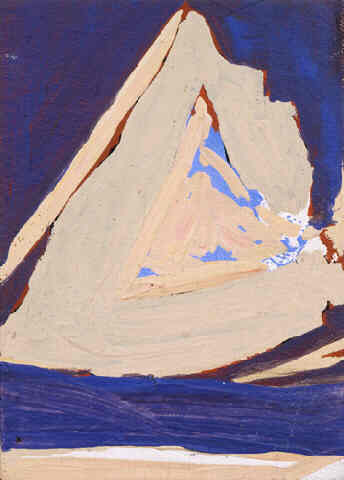
Robert Motherwell’s Summertime in Italy looks nothing like a summer that someone might spend in Italy. Traditionalists would probably argue that this is a poorly painted white triangle as opposed to a recollection of a summer spent basking in the sun near the Mediterranean. I, myself, am becoming angered, trying to find any hint that this painting is in fact a depiction of a memory from Italy. If not for the title, I never could’ve guessed that this was supposed to depict anything other than a white blob. Still, in abstract expressionism, it is more about what feelings the author means to convey and how it appears to him. An advocate of Abstract Expressionism might see Robert in a sailboat on the Mediterranean, enjoying his summer with friends. They might even suggest that his use of white indicates the innocence of his journey on the water; it might be related to the idea that water-logged voyages almost always result in the voyager becoming a new person through the baptism of the water. To me, this is stretching it, but I cannot judge what Robert meant to convey. With Abstract Expressionism, I can only manage a guess.

5. http://www.poster.net/rothko-mark/rothko-mark-red-on-maroon-2634052.jpg

Mark Rothko provides a very challenging task. How do you determine the message he is attempting to send through this collection of vibrant colors and vertical shapes? A traditionalist would see this painting and suggest that a kindergartener might be able to accomplish it. Thus, how can it possibly be art? There is no traditional technique, human figures, nor any clear message. Instead the painting stresses color, shape, and juxtaposition. Perhaps the two vertical columns are the gates of hell. Or maybe they’re meant to depict a window to another world. Looking at a painting this abstract really requires some form of art history experience. I look at this painting, see pretty colors, and that’s about it, but I don’t believe that it is an insult to the art world, I just simply think that it takes a lot of knowledge about the artist and his intentions before appreciation for the artwork can be gained.

Professor O’Sullivan recently mentioned a famous quote in my Shakespeare class: “The past doesn’t influence me, I influence it.” The famous Abstract Artist, Willem de Kooning, made this statement not out of arrogance but out of common sense. How can we take an art history course and then look at a crucifix without noting and recognizing the stigmata on his hands? Because of that same reason, after Abstract Impressionism gained popularity, it became impossible for the masses to look at traditional art with the same eye. Da Vinvi may now appear “stuffy” or “lacking in creativity” in comparison to Rothko’s crazy paintings. Would you rather have the Mona Lisa on your bedroom wall or one of Rothko’s bright images? This is an interesting theory to ponder while studying why people interpret art so differently—some very liberally and others very conservatively. Perhaps if we were all more educated about art, we would not only be

Sunday, September 23, 2007

kelly post 4

1. Art, as a part of a group of people’s culture, has the opportunity to influence large populations into thinking or feeling a certain way about an event in history, a controversial topic, or a political argument, among other things. This causes political leaders, especially rulers with more centralized and absolute power, to essentially fear art. Art can be considered a dictator’s best friend or his greatest enemy. Riefenstahl’s Triumph of the Will was condoned and praised by Hitler because it influenced people to support his cause. This would be a strong example where art is a friend to a ruler. Riefenstahl’s movies were later criticized by Susan Sontag in her article “Fascinating Fascism” for their ability to influence the public to support Hitler. On the other hand, anti-Nazi art influenced people to question Hitler’s motives. In Beauty without Sensuality, Mosse states that, “beauty with sensuality presented a danger to society because of what it symbolized, namely, a revolt against respectability as a principle of unity and order” (Mosse, p. 1). Art that inspired a revolt wasn’t accepted by Hitler because he was, in essence, that principle of unity and order. If art inspired those individuals to rebel against order, Hitler and his government might be the order that the people would be inspired to rebel against.

2. Expressionism was an art movement during the 20th century where artists tended to make their art evoke certain emotions into its audience. Expressionist art is rarely viewed as happy or enlivening but rather tends to have a strongly depressing tone. Edvard Munch was responsible for many great paintings during the German Expressionist movement. Edvard suffered greatly from depression and anxiety. His paintings, one of which is an expression of his sister’s death, tend to evoke the unsettling emotions he felt during his life. The people are often featured hunched over in a mourning position dressed in black. Some other paintings with more color show individuals with no facial expression at all. It evokes a dreary feeling, like there is no hope in the world or even in the world of art. Their figures are often bloated, as if their emotion is too much for them to handle. The bloating is a physical response to the amount of anxiety and commotion that they feel going on in their heads and hearts.

  1. The concept of degeneracy is any modern form of art, under the Nazi rule, was discredited as un-German art. Any Jewish artist or Bolshevik artist was discredited on such grounds. Hitler used degenerate art to discredit artists of a nature that he didn’t personally approve of. Those artist who were labeled degenerates lost teaching positions and credibility as artists.
  2. I think Hitler described Munch’s art as degenerate because he personally was unable to create such art. Although a theory that is not explored by other researches, it seems practical that Hitler labeled artists who created art that he wasn’t able to accomplish as degenerates. This art was able to influence the masses away from Hitler’s political regime. It influenced people to question his rule. Obviously this posed a problem for Hitler, so the creation of “degenerate” art was a defense mechanism to regain any lost power.
  3. The human body was a recurring theme throughout the Nazi regime. Note that Hitler supported research on twins’ genetic makeup, different races bodies’, and other invasive procedures on bodies. He was obviously fascinated by the human body, consistently making references through metaphors in his speech. Also realize that Hitler was never able to draw or paint the human body. This might create a fascination and potentially a compulsive obsession with other artists’ ability to portray the human body whether through traditional technique or creative modernism. I think Hitler was angry that such individuals who stepped out of the box and drew the human body the way it appeared to them were given critical praise for their work. If Hitler hadn’t been previously required to follow certain techniques in drawing the human body, he might have been able to portray it as well. Instead, the labeling of degenerate art helped to reinforce traditional art and the techniques required to accomplish it.
  4. As George Mosse stated, “Beauty with sensuality presented a danger to society because of what it symbolize, namely a revolt against respectability as a principle of unity and order” (Mosse, p. 1). This argument mainly means that modern art is a revolt against social order, and it has the ability to act as a catalyst for other social revolts. Mosse is right. Art has the ability to encourage certain social revolts such as the Civil Rights Movement and the Suffrage Movement in the United States. Just as it did in those cases, art had the ability to encourage more liberal attitudes amongst individuals. This liberal, free flowing thinking that was seen in “degenerate” art and thus inspired liberal thinking wasn’t acceptable under Nazi rule and had to be silenced immediately in order to safeguard Hitler’s reign.

3. In Chapter 5, “The Mass Media and The Public Sphere,” we learned that current artists can alter their images in order to mold the type of message they want to send. This causes the media to often be slanted towards a particular ideology or political theory. With current technology, art has the ability to be bent into a lie and to influence people into forming beliefs based on that art’s lie. This has caused a great culture war in the United States concerning the media and its credibility. B) The picture featured depicts a pregnant woman. (http://www.myartspace.com/blog/uploaded_images/m2-742516.jpg ) This picture is a pro-abortion painting made by Mary Tumulty. The picture suggests that the baby fetus isn’t human yet, and thus aborting the pregnancy wouldn’t hurt any human being. This painting portrays a pregnant woman outside of the regular techniques used to draw pregnant women and is thus deemed degenerate to our modern culture. It has political ramifications because it might influence people towards being pro-choice or even backfire and influence individuals to be pro-life. Abortion is an extremely prevalent political and ethical dilemma of today’s time. It will be up to our generation to determine how we want abortion to function or not function in our society. By bringing up a controversial topic through degenerate art, this painting inspires individuals to ponder the moral ramifications of abortion.

Thursday, September 20, 2007

laura post 4

1) Individuality of thought is far more capable than any nuclear warhead or biological weapon can ever be of enacting change or resolutions within a society. The National Socialists Party saw the threatening nature of such difference in mind and realized the only means for Germany being a world power would be to extinguish any existing flames of intellect. All forms of art are sound examples of how all brands of people construct their personalized ideas and sentiments into the tangible. Thus, the German autocracy utilized their power by ridding their society of any art that provoked thought or sensuality. In regards to the artistic movement of Expressionism in the early German 20th century, Goebbels, in probable agreement with all other National Socialist elites, saw the “spirit and chaos” of this particular movement “as analogous to the spirit of Nazi youth.” (Barron, 12) The art considered to be avant-garde work was not pure German and therefore should cease to exist in the eyes of those who adhered strictly to Nazism ideals. For any art associated with intellect, individuality, or sexual appeal was far too detrimental to any cultural “advancement” sought by the National Socialists. What was rather desired in this state was art “that could easily be understood and whose depictions of men and women exemplified the Germanic race”, which included the Neoromantic and Neoclassical art. (Mosse, 25) Thus, art that excited was eradicated, leaving repeated styles of art that did nothing but prohibit the advancement Hitler said he desired for Germany.
2) Lyonel Feininger was an American Expressionist and Cubist painter who taught at the Bauhaus during the reign of Hitler in Germany. His early works included comic strips that appeared in early German newspapers and Expressionist style art, but his later works involved the analytical forms of Cubism. “Lady in Mauve” depicts a woman, obviously in mauve, parading the streets of what can be interpreted as a city. She is painted with very few curves and rather contains long sharp lines and angles. This allows the object of criticism to possess an heir about her that signifies her own personal empowerment. “I am woman hear me roar” comes to mind while engaged in her cubic beauty. I imagine her strutting down the now darkening city sidewalks displaying her lack of a man’s shoulder to rest upon proudly. Her beauty can be found in her individuality. The Lady in Mauve is not like the rest of the European women of her day. Deviation from reality is most readily in place as her squared chest and blocked hands do nothing to depict what an actual woman may look like. Yet, I admire her tall and broad physique and her ability to stand as tall as the buildings that she rather surrounds.
“Uprising” displays a group of citizens in a town racing down the streets in various colors and figure forms. Feininger attempts to create a different bodily shape for almost every character in this painting. There is obviously an uprising in amidst, yet we cannot be certain as to its origins. The most prominent figure in the painting stands boldly in red and yellow coloring, marching with what can be interpreted as a pitchfork that has a red cloth clinging to its sharp ends. This particular figure’s face appears to have more monster or skeleton like qualities than an actual human. His flesh appears to be white with dark circles and lines for his mouth and eyes. Many of the other characters in the painting have very undistinguishable facial features, but all appear to be in a state of chaos and haste.
a) “And what do you create?” Hitler questions, “Misshapen cripples and cretins, women who can arouse only revulsion…as the expression of all that molds and sets its stamp on the present age.” (Mosse, 25) Degeneracy was all that involved the “immoral” behavior and “abnormal” sexuality and thus, those “who refused to conform to the moral dictates of society were labeled degenerate.” (Mosse, 25) The views that were uncomfortable to society were most likely those under this particular label. We can conclude that the universal questioning of “Is this really art?” that applies both now and in the time of the Nazi reign, is important in regarding the actions of the Nazi party with the artwork of that day. The art that was placed in Entartete Kunst exhibit was that of the sort that caused people to tilt their heads and ponder on what was being portrayed in the canvas or various mediums. Hitler used this succecptable nature of the masses to his advantage by solidifying the silent notions of the German public of whether the modern art was actual art and positive for the state.
b) The “body politic” is transformed in both of Feininger’s artworks shown above. In the “Lady in Mauve” a woman is depicted in a very “manly” like manner, according to the early 20th century standards. She consists of radical lines, angles, and shapes that aren’t of the norm in demonstrating a woman figure. This gives way to an unwanted deeper interpretation of the painting in the eyes of Hitler and his regime. Both the man and human form in the “Lady in Mauve” is threatened. “Uprising” demonstrates just that very well as the characters in the painting act very chaotic and exhibit lunacy. These would be the very reasons Hitler would label this work degenerate. He sees it as providing ideas of rebellion through both its title and even more so in its visual nature. Also, the characters in the painting do not really resemble actual human figures, but rather monsters or disfigured beings. Hitler wanted art to show what society should desire to have and in many cases, the approved art demonstrated bodies with perfect physiques that left nothing in question. By ridding of these types of modern art, there were no “crazy” ideas for the long-standing “good” German public to refute. Yet, by not adding anything innovative to Germany’s culture, Hitler would provide regression.
c) Hitler associated the entire state of Germany as being a single body and therefore each inhabitant of Germany a contributor to the health of that body. He sought to rid of all of the “degenerates” in order to attain the utmost health. Hitler was very persuasive in using this technique, because the body is a very relatable subject in which anyone can imagine an illness of the body and its effect on the production in the “giant human” named Germany.
d) Adolf Hitler claimed, “What good fortune for those in power that the people do not think”. He indeed decided to rid Germany of all “degenerate” art, a large part including art that provoked or displayed sensuality. The absence of emotion is what Hitler longed for in his “perfect” society and he decided to eliminate the threat of this from the constituency by not allowing art that motivated feelings.
3) The modern artwork, “Art and Sex”, by Karl Zipser, exemplifies authoritarian worries to the very extreme. The man and woman are engaging in mutual masturbation, where the woman is arousing the man and his genitals. Sex is most definitely not left to question in this painting and also the emotions that ride alongside. I see that this piece of art demonstrates the evolving nature of our society, as sex is becoming less taboo, as it should. Ignorance is not present, due to the fact that you are fully aware of what is going on in the painting. “Art and Sex” is both informative and creative in the way that the sexual act is being displayed.